Psychological Conditioning

Are you into playing mind games? Well, for the sake of your golf game, you’d better be. The plain truth is, to play anywhere near your own capabilities; you’ve got to do an admirable job of managing your thinking, emotions and behavior. It’s common knowledge that many of the best players in the world employ sports psychologists to help them through their peaks and valleys. If, it’s good enough for them, is it good enough for you? Of course, it is. Try these mental game suggestions. They might be your ticket to lower scores.

Develop a pre-shot routine. If you are interrupted, stop, take some deep breaths and start again from the beginning. Create a dependable game by having a consistent state of mind.

Slow down, take your time. Set your own pace when taking a swing and walking between shots. Stick to it.

Commit 100% to the shot. Focus on what you want to accomplish. Play to a specific target and only play when you are ready.

Trust your swing. Tell yourself – relax – you’ve got this shot. Then, let her go.

Breathe my friend. Develop your own tempo and timing. Everyone has a natural rhythm – tap into it.

Develop a pre-game routine. Give yourself plenty of time before you tee-off. Stretch; hit a fair amount of practice balls and roll some putts. Be prepared to begin your round.

Visualize the shot. Before pulling the trigger, picture in your mind the shot that you want to play. Give yourself the best chance of success by seeing the ball fly where you want it to land.

Be mellow. Overcome a poor shot with ease. Say to yourself – “No, that really wasn’t me.” Then, forget about it and move on.

Reward yourself. Reinforce good shots. Secure that feeling of satisfaction into your brain by saying to yourself – “Yes, that was me and, I can do it.”

Set yourself up for success. Be clear about what you want. Have confidence. One shot at a time.

Finally, golf is a game of excellence. Develop an excellent mental game. Play to the spirit of the game. Be driven to continually improve your golf swing and your thinking and emotional management on the course.

Laying the Groundwork

The transfer of body weight backward and frontward during the swing is connected with the movement back and forth of the arms and the turn of the shoulders and the hips. Weight transfer is also, related to footwork, as well. Nevertheless, if you’re like most golfers I see at the lesson tee, you probably haven’t given much thought to the role of your feet in this game. Believe me, their importance is fundamental to good golf.

But, let’s get back to the all-important weight shift that takes place in the backswing. Computer analysis indicates that, in good golf swings, nearly 75% of body weight moves to the right side by the time the golfer’s hands have swung back to waist height. Most of this weight shift takes place as the shoulders and hips begin to turn. And, it’s during this sequence that the feet begin to play their active part.

The proper footwork is based on rolling the ankles and heels. Follow this simple drill and, through practice, you can learn the feeling of and attain excellent foot action: On the backswing; roll your left ankle and heel in laterally, while holding or bracing with the inside of your right ankle and heel. On the downswing, push off your right foot by rolling the right ankle and heel inward, while your left ankle and heel rolls back to the left and into a firm bracing position. Note: While the correct movement of the feet enables a golfer to properly turn their hips and complete the weight shift, only a very flexible person can make a full backswing without lifting their left heel off the ground.

Weight shift and footwork are absolutely vital in the downswing, too. In good golf swings, body weight moves to the left side very early in the downswing. That all-important weight shift, and actually, the entire downswing, is started by the rolling and pushing of the right foot. The golf swing works from the ground up! It is not the knees turning, or the hips sliding or the arms swinging. It is the rolling and pushing of the right foot that actually transitions the swing and moves it toward the target.

That early roll and push from the right foot to the left foot is what initially causes the knees and hips and shoulders to go toward the target in a lateral direction. It is what causes the feeling or creates the sensation that you’re moving out toward centerfield in the downswing. At or about the same time the hips and shoulders begin to unwind and turn, weight shifts around 80-90% over on the left side (front foot), finishing with the body facing the target.

Sam Snead said, “Good players play from the legs up, and great players play from the feet up.” Poor players, of course, hit at the ball – mainly with their shoulders, hands and arms. Make an effort to consider the swing from the ground up, using the support of your feet and legs to generate power.

Physical Conditioning

I remember receiving a most unusual golf lesson from my father back in the late-1960s when I was a sophomore in high school. Dad was standing there, watching me pound out drive after drive when, all of a sudden, he grabbed me around the shoulders and exclaimed “you’re getting too muscle-bound!” Then, after restraining himself, he explained, “In my day, the pros didn’t do all those calisthenics they’re having you do at school. In dad’s view, too much exercise was causing my body to lose flexibility resulting in my shoulders not turning as freely as they once did. His prescription was to write a letter to my Phys-Ed coach forbidding me to engage in anymore classes.

My father felt that hitting golf balls, walking the course, being well fed and getting plenty of rest was all one needed for peak performance. In this respect, he was like many of his contemporaries on the PGA Tour in the 1930s and 1940s. I’ll joke and say that the heaviest object most of those fellows ever lifted was their golf bag!

However, there were some players back then, who believed in the importance of physical conditioning. Notables such as Gene Sarazen, Byron Nelson, Frank Stranahan and Sam Snead had a huge advantage on the rest because they kept themselves in the best condition. Snead said, “I always kept my body in good shape. Every day I had a routine that included stretching, push-ups and one hundred sit-ups in the morning to keep me toned and limber.

Today’s PGA Tour is more or less a collection of best practices learned since the early days. Accordingly, mobile fitness and therapy centers follow the circuit throughout the year. In these rehab and conditioning facilities, players can receive treatment for injuries and conduct a complete workout regimen.

These expandable trailers are large enough to accommodate multiple players at one time. They are open for business as early as 5 a.m. to roughly 7 p.m. to allow players the option to come in before or after starting times, or both.

The fitness trailer is staffed by certified athletic trainers specializing in strength and conditioning. The center is furnished with an array of cardiovascular equipment such as treadmills, elliptical machines and stationary bikes along with a selection of weights – both free weights and resistive training stations – as well as exercise balls, balance equipment and other apparatus.

In conclusion: To avoid injuries and prolong your career; before playing golf, warm-up exercises should be performed to increase flexibility and blood flow. Exercises should include neck range of motion, shoulder stretches, trunk side-bends and rotations, and hamstring stretches. A golfer should also spend a few minutes at the practice tee, hitting balls and putting before the game begins.

“Confidence”

Years ago, I was the golf professional at the old Jewish country club in Central Ohio called Winding Hollow (now called Champion’s of Columbus). The membership there was a lively bunch who patronized the golf operation by haggling over merchandise in my shop, pounding plenty of balls on the driving range and taking oodles of golf lessons. One member, in particular, a funny guy named Bob Gillery, was a regular entry in my lesson book.

As a golfer, Mr. Gillery was just an average shooter, though, he did try hard. As a person, I found him to be rather amusing. In a good- natured way, he would basically take you to task for your failings. He mocked and jabbed at you subtly but, the majority of his humor was self-deprecating.

Well anyway, one day Mr. Gillery and I were out on the practice tee together when he couldn’t seem to hit himself in the butt with either hand. I wanted him to keep trying whatever we were working on and offered these words of encouragement; “Jack Nicklaus said, confidence is the most important single factor in this game.” Upon hearing this, Mr. Gillery stopped hitting balls. Then, he calmly turned toward me and said, “Pro, I had confidence in a fart, once, and shit myself.”

A Proper Grip

Holding the club properly allows the golf swing to deliver the clubface square to the target at impact. For this natural and reflexive squaring to take place, the hands must work together as a single unit. The hands will operate in this fashion when the club is held with the palms parallel to the clubface and placed close together.

Today, there are three generally accepted ways of combining or “unitizing” the hands, e.g., the ten-finger grip, the interlocking grip, and the relatively new (circa 1900) overlapping grip. Actually, there is a fourth way, too. It’s called the classical interlocking grip. It was used when hickory shafts were being swung, but more about that later.

I. The ten-finger grip, sometimes referred to as a “baseball grip,” is the least popular of the three. Most golfers avoid gripping the club this way because they find it difficult for their hands to work together. It does, however, have its advantages. Teachers often suggest this grip to beginners as it simplifies early instruction. As a matter of fact, I remember my father having second thoughts about its value during his later years. He said, “If I had it all over to do again, I’d have put the baseball grip on more people.” It was apparent to me that he thought it just might give people with small, weak hands a better feel for the club head.

Ten-finger grip

To position your hands in this way, grip the club properly with the lead hand then, place the little finger of the trailing hand close against the index finger of the lead hand. Cover the thumb of the lead hand with the lifeline of the trailing hand. Pretty simple.

II. The modern interlocking grip is a tried and true method that helps keep the hands close together with less slippage. This grip has the thumb of the lead hand on the shaft, under the palm of the trailing hand in a manner comparable to the ten-finger and the overlapping grip. It involves twining the little finger of the trailing hand between the index and largest finger of the lead hand. To “unitize” the hands as much as possible, nestle the forefinger of the trailing hand close against its neighbor, and wrap it firmly around the club.

Modern Interlocking grip

Modern Interlocking grip (back view)

III. Among good golfers, the overlapping grip is the most popular of the three. The hands are positioned on the club in the same manner as the ten-finger and the interlocking grip except that the little finger of the trailing hand is wrapped around or lapped over the forefinger of the lead hand. Nestle the forefinger of the trailing hand close against its neighbor, and wrap it firmly around the club.

Overlapping grip

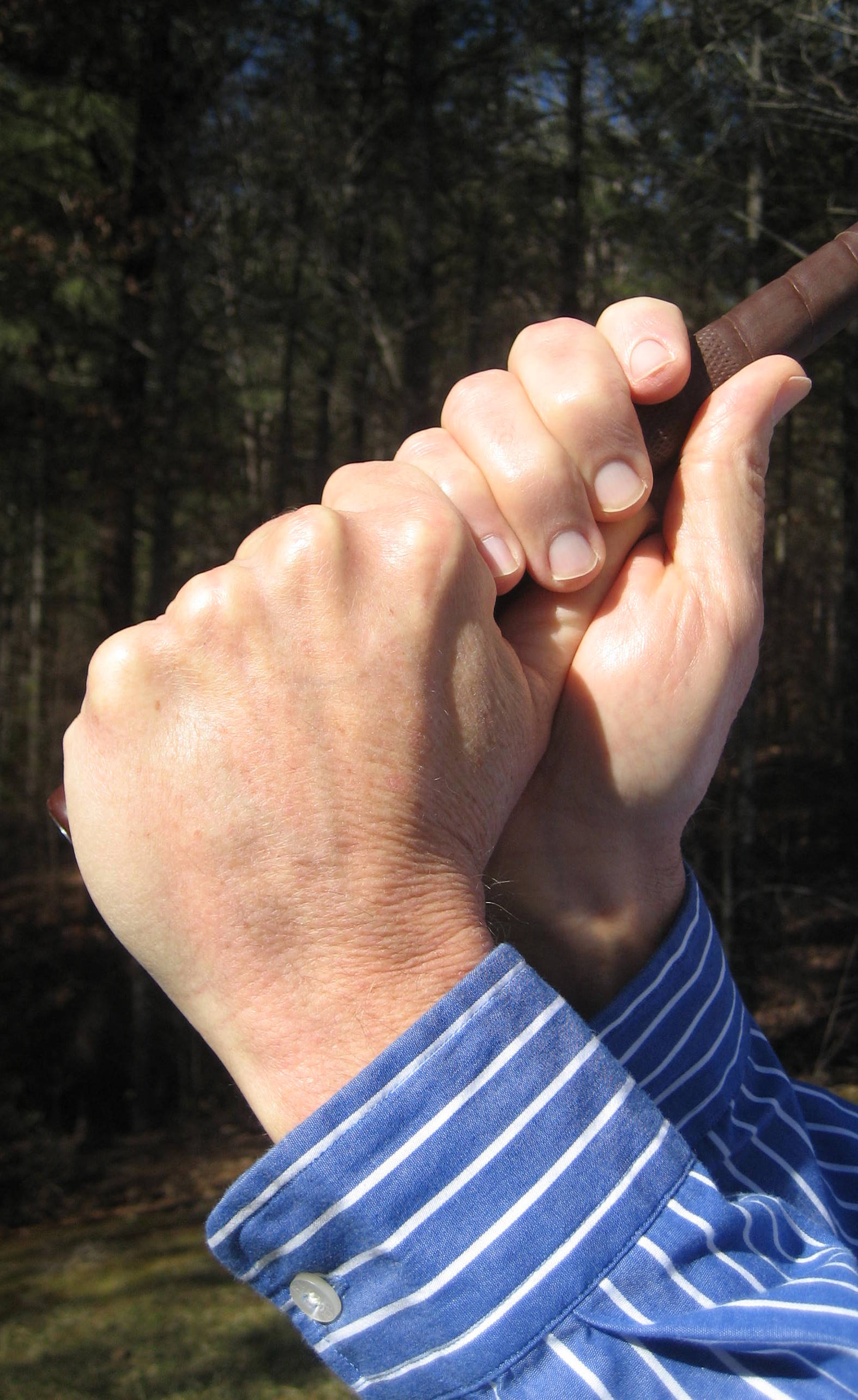
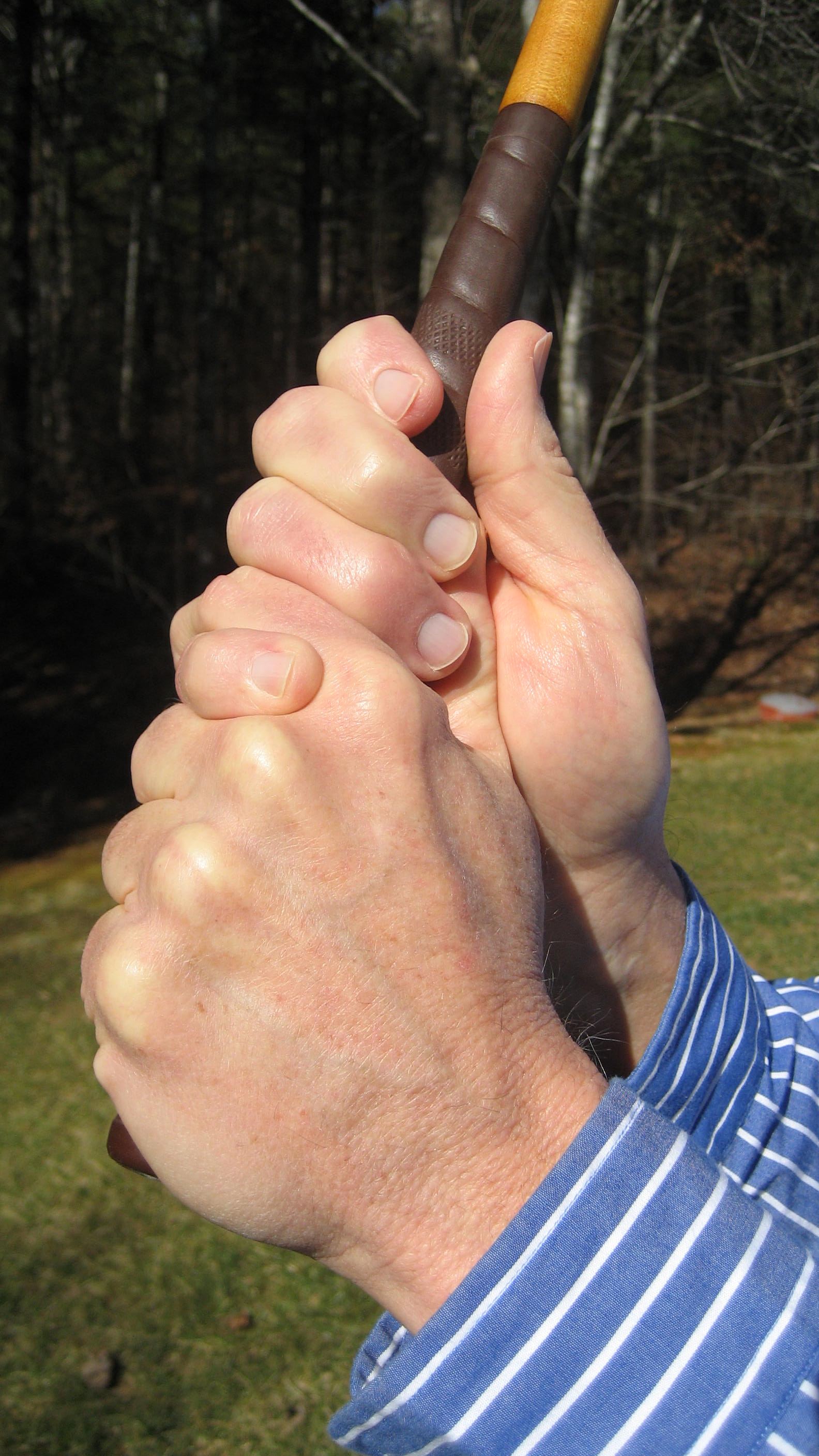
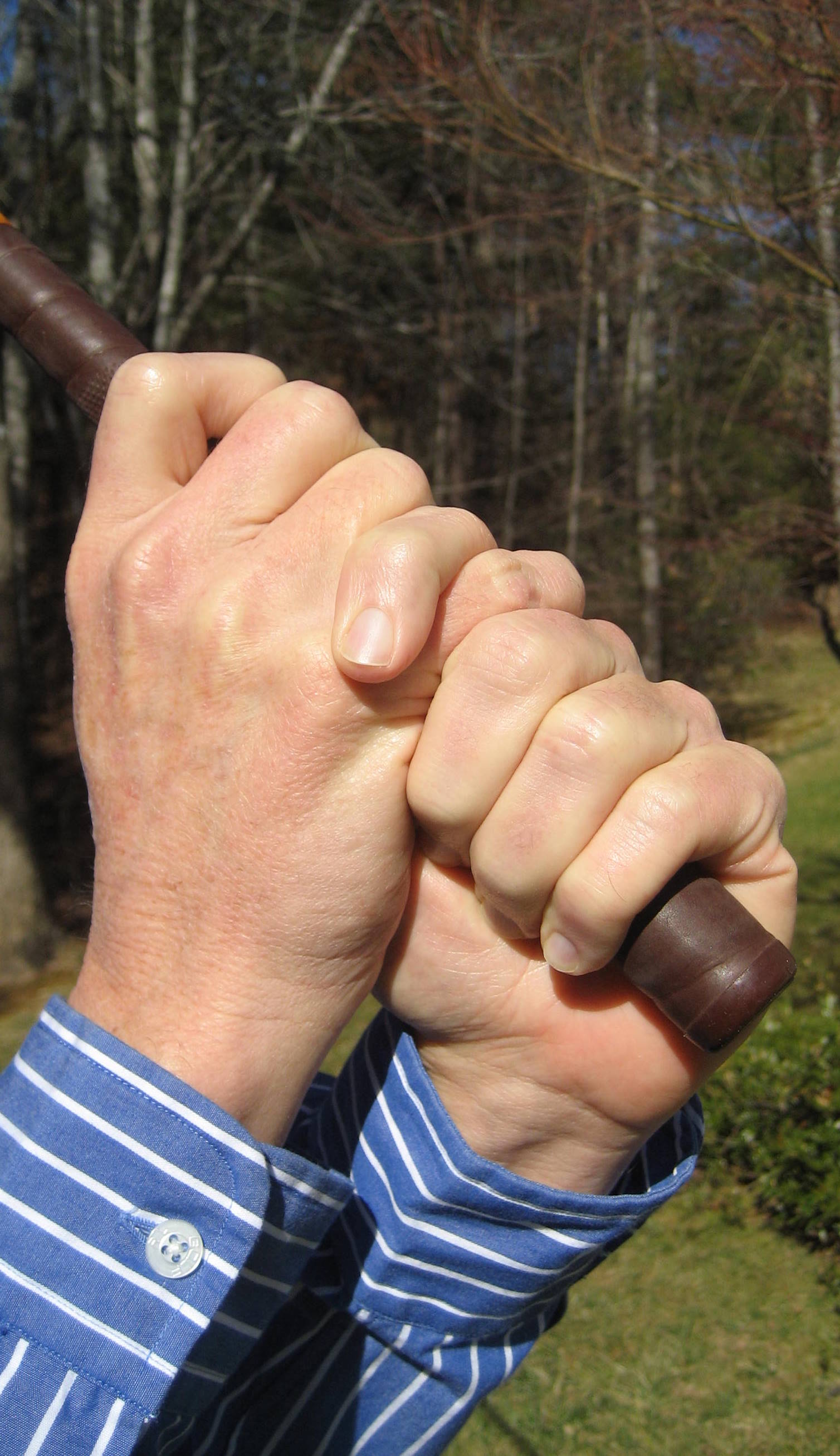
IV. The classical interlocking grip has been around for centuries but it’s seldom used and, all but forgotten. This grip included what was basically a fist with the lead hand and promoted a lot of wristiness that was necessary when hickory shafts were in vogue. It actually had the thumb of the lead hand off the shaft and positioned behind the trailing hand. Like the modern interlock, it involved twining the little finger of the trailing hand between the index finger and largest finger of the lead hand.

Classical Interlocking grip

Classical Interlocking grip (back view)

Gene Sarazen and Henry Picard were perhaps the last great players who used the full interlocking grip. My father gripped the club this way during his early professional career but, eventually opted for and advocated the modern overlapping grip. Note: In 1937, Henry Picard began experiencing pain in his left wrist at the top of his backswing. He had developed DeQuervains Tendonitis – inflammation in the tendons that control the thumb, resulting in pain near the base of the thumb. A doctor in Philadelphia told him, “Go to the classic interlock grip and it’ll never hurt again.” Picard took that grip and won the Masters (1938) and the PGA (1939).

In the final analysis, the size and strength of the hands plays a huge role in determining which grip is the correct one for you. Whichever grip you choose, be sure that your hands never separate during your swing. This forces you to regrip before impact and throws the clubhead off line. A light but constant nudging of the heel pad of your trailing hand against the thumb pad of your lead hand will counter any such separation.

Questioning the Importance of a Proper Grip

Years ago, after finishing up an enjoyable round of golf at the old La Gorce Country Club on Miami Beach, me, my brother John and our two buddies Armand and Georgey G. alias, “The Rocket,” decided to continue the fun by talking things over in the locker room. After trading some lies, our lively discussion turned toward Georgey and how his powerful game would improve if he’d only make a few subtle changes to the way he held the club. At some point, he was handed a club and we all began offering suggestions as to how our friend might improve his grip. Once we had his hands placed on the club just right, Georgey cried out, “You’ve got to be kidding. This feels awful!” With that, it was time to go out to the No. 1 tee and watch him in action.

With some trepidation our buddy Georgey fetched his driver and a ball from the club’s bag room and joined us on the first tee. After teeing up his ball, we helped him “properly” fashion his hands on the club. Once again, Georgey made it quite clear that he doubted he could hit the ball at all with the new grip. But, being a good sport, he was willing to give it a shot. When the time came, we all stood back to watch our new creation cut loose. After taking a couple of waggles, “The Rocket” launched into his swing. I can tell you, he swung down hard and followed through high. Everyone looked out to watch the pure flight of his mighty blow. But, we saw nothing! Instead, after glancing back down to the ground and there sat his ball. It lay 18 inches directly behind where it had been teed. Incredibly, Georgey’s ball had gone backwards! Needless to say, he was embarrassed and a bit angry, too. As I remember, he proceeded to make a hasty exit from the club.

Later, we theorized that his mighty downswing barely contacted the top of the ball. But, that he nicked it just enough to impart tremendous backspin causing the ball to go in reverse. For the record, Georgey never did make those changes to his grip.

“Far Ahead Of His Time”

Back in 1950, when the game was not understood anywhere near as well as it is today, my father Jack Grout formulated an approach to the golf swing that rested on a mere handful of fundamentals. He concluded that “knowledge of all the fundamentals,” e.g., A Proper Grip, Set Up Correctly, Steady Head, Proper Footwork, Full Extension, and Quiet Hands, was the most important asset for any golfer, male or female, professional or beginner. Whether it was Jack Nicklaus, Raymond Floyd or Harry Hacker who made appointments to borrow the high court of Dad’s fairway knowledge, they were all taught the same brand of instruction. Though few in number, they cover all vital areas of the golf swing.

While dad gave tireless attention to each one of these basic tenets, he felt strongly that the absolute first thing you have to master is to Set Up Correctly. He wanted you to understand that nothing has more to do with the success or failure of your shots than the way you position your club and yourself before you swing. With a good setup, everything else will fall into place much more quickly and easily.

Fundamental #2: A Proper Grip on the golf club. As a youth and new to the game, I remember him driving home this point by laying this pearl of wisdom on me, “Dickie, you can stand on the first tee of any golf course in the country and you won’t see a good player with a poor grip, nor will you see a poor player with a good grip.” It was his strongly-held opinion that at least 90 percent of the world’s golfers have bad grips that cost them both distance and accuracy.

Fundamental #3: A Steady Head is the balance center of the swing. Ideally, you should position your head slightly behind the ball as you set up to your shot. Put your left cheek about even with the back of the ball. Next, just before you start your backswing, turn your chin an inch or two toward your right shoulder. Finally, hold that head position until after you have hit the ball, when the momentum of your swing will force your chin to rotate to your left and into the finish position.

Fundamental #4: Proper Footwork is the key to balance. As my father points out, keeping a steady head while swinging does help you to maintain balance. However, it is proper footwork that primarily promotes both balance and full swinging. The feet are the key. Everything else follows. Good foot action is based on rolling the ankles. To put it simply, the left ankle rolls in laterally, toward the right foot, on the backswing; the right ankle braces against this motion. On the downswing, as the left ankle rolls back to the left and into a firm bracing position, the right ankle rolls in toward the left.

Fundamental #5: Full Extension is simply a matter of using all of your physical self as you swing – of fully stretching and coiling all the muscles of your body that need stretching and coiling. To achieve full extension you must (1) make as full a hip turn as you can without straightening your right leg or shifting weight onto the outside of that foot, (2) the best shoulder turn is the fullest shoulder turn, (3) swing your hands as wide and as high as you can without shifting your head or loosening your grip. Dad’s reasoning went like this: There is no getting away from the fact that the man who can hit the ball farthest has an advantage. Accordingly, a player should develop a power swing when he is young and his muscles are limber. That will stay with him. Control can come later.

Fundamental #6: Quiet Hands at the start of the downswing help preserve clubhead speed and keep the club moving on a proper path. Too much wristiness during the swing’s change of direction can ruin an otherwise superior golf swing, in that “flashing” or flipping the club down with the hands will either: (a) throw the clubhead off path, or (b) misalign the clubface, or (c) waste clubhead speed prior to impact, or (d) cause any combination of the above.

The proper first move of the downswing involves the fundamental of footwork already mentioned – a lateral shifting of weight from the inside of the right foot to the inside of the left. So long as your feet work correctly and lead your downswing, on all of your full shots you should try to accelerate your arms – and thus the club – through impact as fast as you possibly can without losing your balance.

My father said, “I must tell you in all honesty, however, that learning to apply these, or any other, golf fundamentals properly and consistently always requires effort.” He felt that it takes a person about five years of regular practice and play to implant all of these fundamentals to the point where they are second nature.