Statistical Rash Is Contagious

In 1988, the PGA Tour began the Historical Statistics Project which was the process of examining the competitive records of nearly four thousand professional golfers from 1916 through 1988. The purpose of this analysis was to provide new perspectives for ranking these players from a historical standpoint. The underlying agreement being that overall long-time performance was the true standard and best common denominator – rather than money won – for ranking throughout the history of the Tour.

Because the early years of professional golf lacked continuity and a solid structure, it was open to conjecture about what were sanctioned tournaments, what didn’t meet “official” criteria and what were considered merely exhibitions. In the final assessment, a series of “blue ribbon” non-expert panels mostly directed by PGA Tour commissioner Deane Beman and a group that included other golf administrators plus journalists, such as Jerry Tarde (Golf Digest) and Dan Jenkins (Sports Illustrated), made their determination based on which events were of “historical significance” instead of deciding which events should be considered “official.”

One might assume that it was based on exhaustive study and scholarship in the way Major League Baseball has created an unassailable statistical record book, but the tour’s effort, was to put it charitably, haphazard. “A gang of fools, dunces, point-missers,” Jenkins called them as they walked out of one meeting. They ended up publishing a “history” book ranking players by year that was immediately disputed, as my own personal examples (below) demonstrate.

Decisive factors for determining a tournament’s “historical significance” were the following:

a. The history of the PGA Tour starts with the formation of the PGA of America in 1916.

b. Match play, team match play, and team stroke play are included in the study because

many such events were highly significant in various eras.

c. Round-by-round scores are included

d. The name of the course with par and yardage are included

Since the conclusion of their meeting at Augusta National Golf Club on April 5, 1989, the panel’s recommendations have been the criterion used by PGA Tour. The end result being that tournament wins have been credited to certain players while other players have had tournament wins snatched away from them. Take, for example, the unmatched record of the player known as “Slammin’ Sammy.”  No golfer has won more tournaments, although the actual total number is still disputed. The PGA Tour record book says Snead leads with 82 victories. But there is a crowd of people who contend that Snead should be credited with 90 victories.

Here’s what happened to Sam: Up through 1985, the PGA Tour listed Snead as having 84 titles. But in 1986, the Tour’s “blue ribbon” panel readjusted Snead’s total to 81. The number rose to 82 in 2002 when the Tour added his 1946 British Open title. Then, the review panel gave Snead credit for six wins that never had been included in his 84, including four Bing Crosby Pro-Ams. However, it also took away eight titles that had been listed in his original total. To say the least, Snead was livid over the Tour’s decision and carried the bitterness with him until he died in 2002 at 89.

Regrettably, for Jack Grout (my favorite Tour player of all time), two of his PGA Tour wins and one of his PGA Tour second-place finishes were completely erased from the record book. Those three tournaments were deemed to be unofficial events because at the time they weren’t considered to be “historically significant.” Even though, they were considered to be so in previous years. For example: When Dick Metz and his pro partner Gene Kunes were victorious in the 1935 Mid-South Four-Ball it was deemed an official win. However, three years later when Jack Grout and his pro partner Henry Picard were victorious in the 1938 Mid-South Four-Ball it wasn’t deemed as such.

Then, in August 1948, when there was every indication that an official PGA event was being held, Jack Grout outdistanced the whole pro pack at the $2,500 Spring Lake Invitational in New Jersey. My father’s final round of 67, not only overwhelmed Craig Wood (winner of 21 PGA Tour titles including two major championships) but, also the likes of Gene Sarazen, Claude Harmon, Mike Turnesa, and Willie Goggin, to name only a few.

Furthermore, when the potent combination of Henry Picard and his amateur partner Frank Ford won the 1937 St Augustine Professional-Amateur, with a 4 & 3 victory over Jimmy Hines and Mark Stuart, it was duly noted in the official record book. However, that is not the way things turned out in 1941 when Jack Grout and his amateur partner Frank Allan yielded 1-up in a spine tingling 36-hole duel to Sam Snead and Wilford Wehrle; in perhaps one of the greatest matches in the history of that event.

In the end, it was Beman’s powerful personality and the strength of the PGA Tour’s brand who were instrumental in discounting from the record books certain pro tournaments and not others. A tiff that divides historians and contemporary opinion alike.

Raymond And The One-Ball Rule

Golf’s one-ball rule; ever heard of it? Well, found near the back of the R&A/USGA Rules of Golf is a section titled Conditions of the Competition. The portion dealing with clubs and ball requirements begins: “The following conditions are recommended only for competitions involving expert players.” Key word: only.

What’s more, the game’s rules-makers tell us that conditions should not be confused with the rules, which are the same for all of us. Technically, that might be true, but these conditions read, penalize and sound (quack?) like rules.

One of these conditions is the so-called one-ball rule, which limits a player to one brand–and model–of ball for the round. Its genesis goes back to the late 1970s, when good players, on certain holes and under certain conditions, would switch from a softer-feeling (balata) ball to a rock (surlyn) ball for less spin and extra distance. It allowed them to switch from, say, a 4-wood to a more controllable 4-iron on par 3s and, to switch from, say, a driver to a more dependable 1 or 2-iron on par 4s and par 5s with narrow landing areas. Many leading PGA Tour players argued that this practice was akin to having a “secret weapon” in the bag. In time, PGA Tour commissioner Deane Beman agreed and led the charge to stop ball-switching during a round. Though the tour could have made this change on its own, it sought and received the blessing of the U.S. rules-making body, the USGA. The USGA and the R&A were sympathetic to the tour’s point of view, but they did not want to force this limitation on the millions of golfers throughout the world who would find it impractical to carry a sufficient number of “one balls” in their bag to complete a round. But they also didn’t want to see the tour create its own equipment rule. So, common sense prevailed, and a condition of play, the one-ball condition, was written as an optional requirement for elite-play tournaments.

So, where am I going with this rules/conditions chatter? For the most part, it’s my preamble to informing you about the highlight of my college golf career and the wonderful lesson that I received from World Golf Hall of Fame member Raymond Floyd. It all happened in the days when I was on the golf team at Florida International University. Ray told me about the clear-cut advantage of using my trusty 1 or 2-iron and a top-flite (a two-piece ball with a solid core) especially during windy conditions or when playing a particularly narrow hole. As it happened, this great piece of advice helped me to win the well-regarded University of Miami Invitational  in 1974 when I came from several shots behind during the final round. The 72-hole event was held in March at Biltmore Golf Course and the old Le Jeune Golf Course (now Melreese). And, on a particularly blustery day, with nerves being frayed and the wind switching around quite a bit, my final-round score of 69 was low by five strokes.


Lesson From A Legend

From 1950-1961, my father was the Golf Professional at Scioto Country Club in Columbus, Ohio. When the club hosted the 1968 United States Amateur Championship, Dad decided to attend the event and I was fortunate to make the trip with him. After arriving at the course on one particular morning, he told me to meet him on the driving range at 4:00 p.m. so he could watch me hit some balls. That afternoon I got to the practice tee a little early and began warming up. A short time later, I could tell that Dad was on his way to meet me because I could hear his voice in the distance. By the time I looked up to greet him, I noticed that he was standing nearby and speaking with a man not at all unfamiliar with the game of golf. There, beside my father was the illustrious Byron Nelson.

My father introduced us and said that his friend Byron had come to the practice tee because he wanted to watch me hit some balls. At that point, Mr. Nelson told me to just relax and swing away like I always did. I may have been only fifteen years old at the time but I knew very well who it was standing there with Dad. Almost immediately a small crowd began gathering to watch me whack them out there. This, of course, was pretty cool and gave me the feeling of importance until later when it occurred to me that it was probably Lord Byron and not me who was the real person of interest.

I remember hitting shot after shot and hearing Mr. Nelson’s gentle voice echoing words of encouragement and praise. Then, as I was about to launch another one, he moved in close enough to actually step-on the head of my club. This particular action did not confuse me because I was already a veteran at taking lessons from Dad who was always doing thought-provoking stuff like that to illustrate a point. Mr. Nelson’s instruction for me was pretty simple, just go ahead and generate the movements that I could produce even though his foot was on the club. In other words, he wanted me to try to make as much of a backswing as possible while the club remained stationary. When I got about as far into my restricted backswing as my body would allow, he lifted his foot off the club head. The club seemed to rebound in an instant and found its way to the top of my backswing. I was amazed at how far the club had traveled which really seemed to demonstrate the elasticity of young muscles.

Then, Mr. Nelson asked me if I knew what point he was trying to make. I told him, “I think so,” but then I didn’t say much more, not wanting to be wrong in my assessment. He told me that it was important for “everything” to move at the same time when starting the backswing. Apparently, I was just swinging the club back with my hands and arms which resulted in my weight shift and turn occurring too late. He also pointed out that by keeping the club head on the ground (as I began my swing) was really an exaggerated way of showing me the difference. I knew just what he meant because that was how Dad always taught. Both of them thought that the quickest way to stop doing something was to do just the opposite.

That bit of instruction I got from Byron Nelson, one of the world’s greatest players, did much for my golf game. However, receiving his undivided attention that day did even more for my love and respect for the greatest game of all. I’m pleased to say that I was fortunate to remain in contact with this wonderful man through the years and right up until his death on September 26, 2006. It was indeed an honor for me to know him.

For the record: The U.S. Amateur Championship was held August 28-31, 1968. It was won by Bruce Fleisher with a score of 284. Of all the major championships held at Scioto, the ‘68 U.S. Amateur might have been played on the most difficult golf course. The greens were very firm, almost too hard and the rough was typically thick USGA rough making shots to the green virtually impossible to hold.  The course was set up as a par 70, with the eighth hole playing as a 465 yard par 4 instead of a par 5. The field of 150 was full of collegians: Bruce Fleisher, Tom Watson, Hubert Green, Lanny Wadkins, Andy North, Doug Tewell, Leonard Thompson, Rod Curl, Barry Jaeckel and Jim Simon, as well as well-known amateurs Michael Bonallack, the British Amateur Champion, Dale Morey, Jack Hesler, Vinnie Giles and Gary Cowan, Canadian Amateur champion.

1964 PGA Championship

I attended my first men’s major golf championship in 1964 at age 11. We were living in Miami Beach, Florida at the time and I got to travel back to Columbus, Ohio on my first airplane ride with my father for the 46th PGA Championship, played July 16–19 at Columbus Country Club. It was a fun and exciting trip because I had fallen head-over-heels for the game of golf.

The next morning when Dad and I arrived at the Donald Ross-designed golf course on Columbus’ east side for one of the tournament practice rounds, I found myself remaining close to my father instead of running off in every direction like a lot of other kids seemed to be doing. I suppose I did that for two reasons. First, I always enjoyed being around the old pro and two, this whole tournament scene seemed like pretty serious stuff and I wanted to get it right.

IMG_9554

As I remember it, we visited the giant scoreboard with all the contestant’s names written upon it. Then, we made our way over to the practice tee and watched some of the contestants warming up and going through their routines. There, Dad pointed out many of the best players by name. It was another great experience for me because it was the first time I saw the unique swings of so many Tour pros.

Next, as we walked over to the pro shop and the clubhouse, it became evident to me that my father knew a lot of people there and that he was quite a popular fellow. Also, I saw a number of people with large round badges attached to their shirt, hat or purse which included the name of their favorite player. There may have been others but I recall seeing only 3. They were: “Arnie’s Army,” “Jack’s Pack” and “Lema’s Legions.”

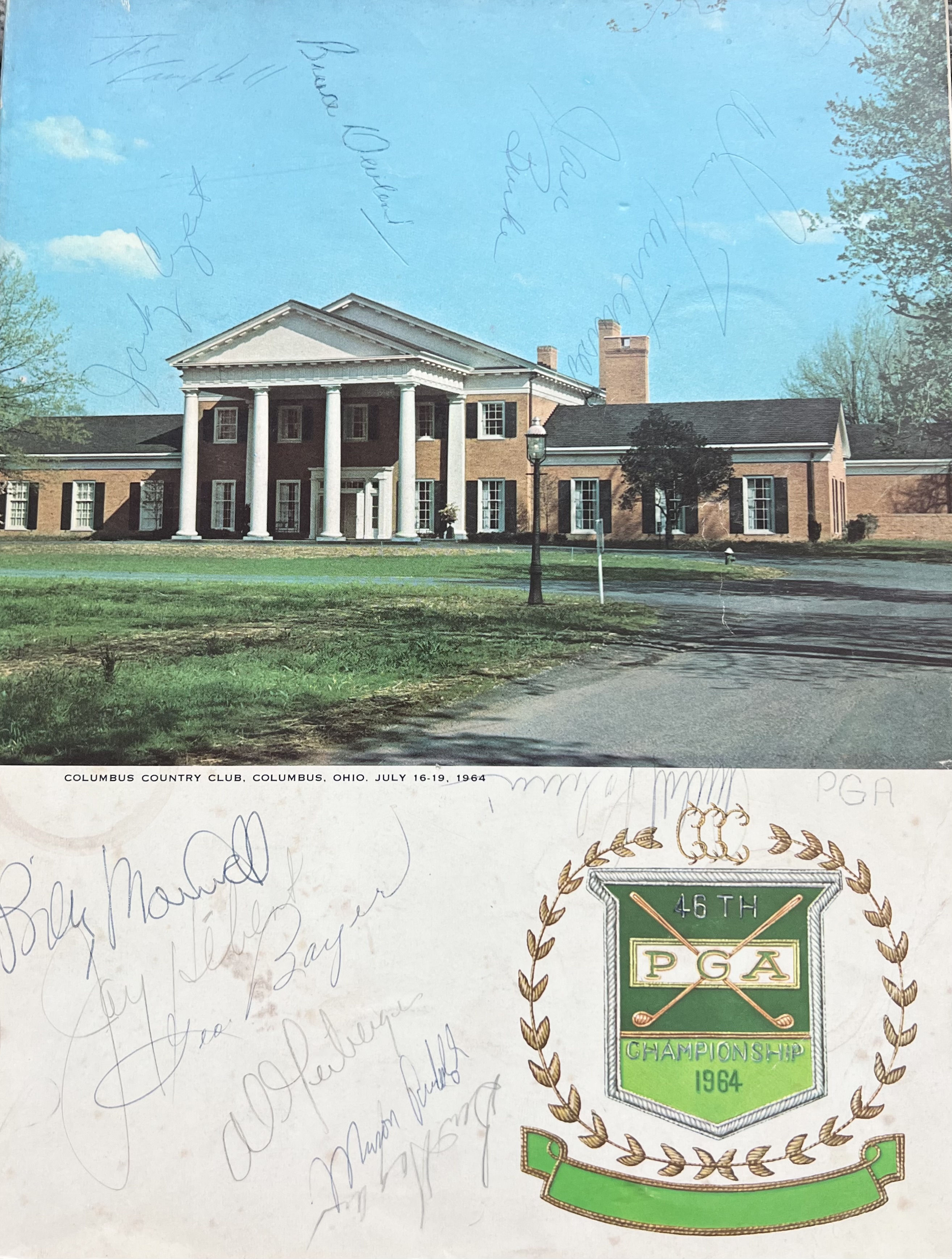
Around lunchtime, Dad purchased a tournament program for me and recommended that I make an effort to collect some autographs. After retrieving a pen and some last-minute advice, I was off. I enjoyed the hunt and the challenge of getting those autographs. However, at times it seemed to me that it might have been a nuisance for some of the players. In any event, that day I was able to receive the following signatures: Billy Maxwell, Jay Hebert, George Bayer, Al Geiberger, Mason Rudolph, Ben Hogan, Jacky Cupit, Joe Campbell II, Bruce Devlin, Jack Burke, Dow Finsterwald, Rex Baxter, Jack Nicklaus, Frank Beard, Bob Charles, Jack Rule Jr., Tommy Jacobs and Arnold Palmer. Also, more than fifty years later, I still have that souvenir program!

IMG_9558

Though Dad and I rooted exclusively for Jack Nicklaus; the fact remains, the golf”s number-one player at that time was Arnold Palmer which made his signature was the toughest one to acquire. He was the current Masters Champion and the golfer who definitely created the most excitement. It seemed that everybody wanted a piece of Arnie. And, for this eleven-year-old to secure the autograph of “The King,” I had to devise a plan.

Here’s what happened: Palmer had just finished his practice round. He was making his way toward the clubhouse albeit slowly while constantly signing autographs. He was being mobbed by men, women and children. To get within 10 feet of him was asking to be trampled upon! Instead of risking that, I decided to position myself in-front of the double doors which led to the locker room. Standing guard at that doorway was a mighty-big law enforcement officer. I looked up at him and asked for permission to position myself where I’d have the best opportunity to meet with Palmer. The big sheriff looked down and told me where to stand. Then, moments later and just as I had hoped, Arnold Palmer walked right up to me. As he did, I stuck out my program. He took it from me, signed it and handed it back to me. I had gotten the last autograph that he signed before disappearing through the doorway. Yippee!

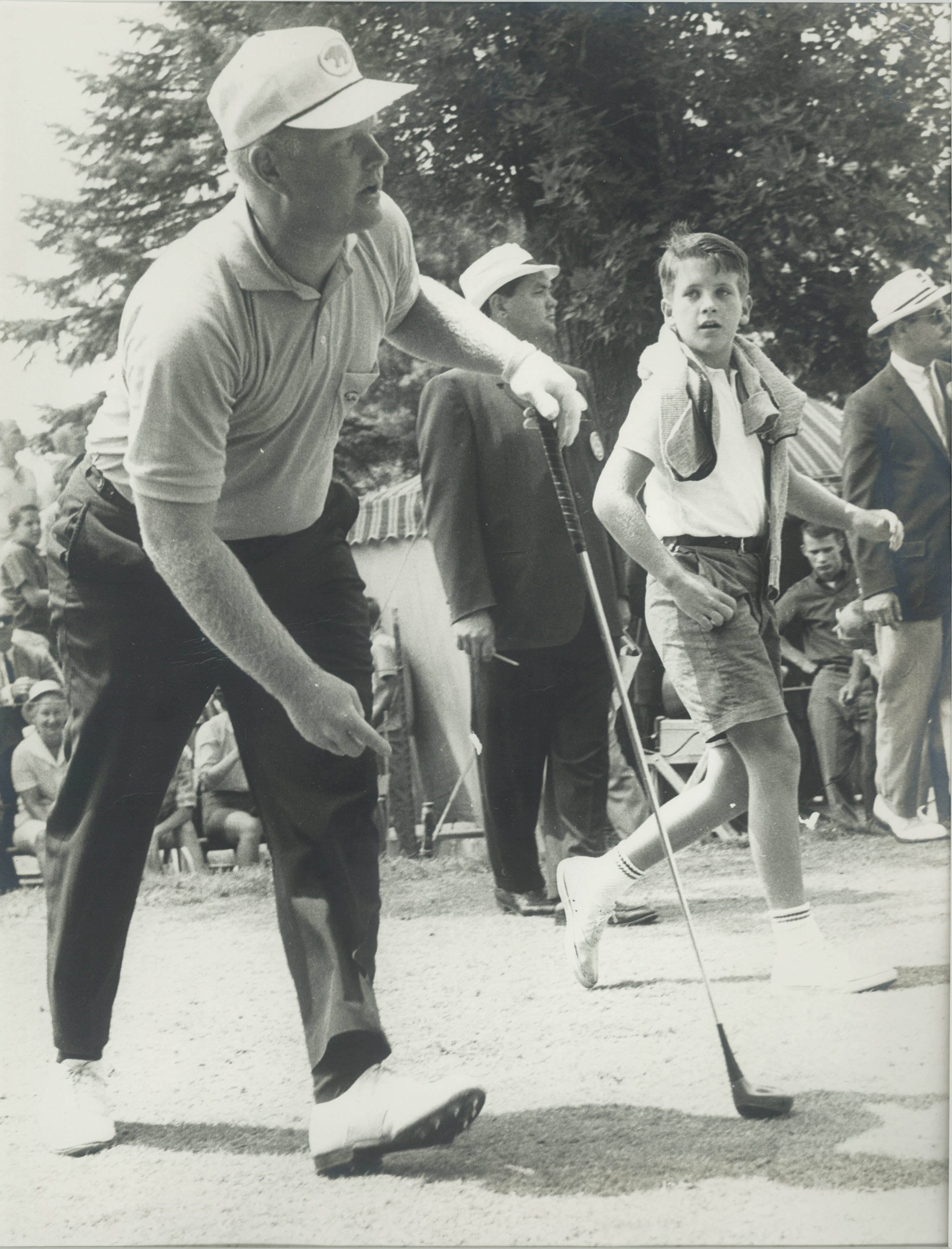
On the first tee at Columbus Country Club in Columbus, Ohio during the 1964 PGA Championship. Dad said, “Dickie, watch Jack.” As usual, I followed his directions. (Bill Foley photo)

For the record: At Columbus Country Club, Bobby Nichols won his only major title, three strokes ahead of runners-up Jack Nicklaus and Arnold Palmer. Nichols led wire-to-wire after a first round 64 in the hometown of Nicklaus, who shot a 64 in the final round to gain his third runner-up finish in majors in 1964. Ben Hogan, age 51, competed at the PGA Championship for the first time since 1960. Tied for fifth place after a third round 68, he finished tied for ninth for his penultimate top-ten in a major. His final top-ten came at the 1967 Masters.

Also, The British Open was played the previous week in St Andrews, Scotland, one of five times in the 1960’s that these two majors were played in consecutive weeks in July. The PGA Championship moved permanently to August in 1969 (except 1971, when it was played in late February).

War Toll

In October, 1929, just as my father and his contemporaries were entering the job market, the Great Depression crippled the national economy. A dozen years later, when countless members of “America’s greatest generation” were about to enter their peak years of earning potential, they had their hopes, dreams and lives shattered, once again, by devastating worldwide circumstances.

Prior to the Japanese sneak attack (December 7, 1941) on the headquarters of the U.S. Pacific Fleet at Pearl Harbor on the island of Oahu, Hawaii, the future of our nation looked so bright. For my father and his colleagues in the golf business, the coming years had held much promise. The United States was taking the game of golf more seriously than at any time since the market crash of 1929, and the consensus was that unless the country was dragged into war, golf could experience a tremendous boom. But, war indeed intervened. Suddenly huge amounts of our manpower and raw materials were diverted to the war effort.

Although the United States was fully engaged in a world war at the onset of 1942, tournament golf had not yet been deeply affected. What happened was that the Tour continued on in a limited way while doing its bit for the war effort. The PGA Championship, the only national championship held in 1942 (the U.S. Open was canceled from 1942 through 1945), placed 40 percent of its purse into war bonds. A number of exhibitions to raise money for the Red Cross were staged by the PGA, with Ben Hogan, Sam Snead, Byron Nelson, Jack Grout, and other star players participating and taking their expenses in bonds. Bob Hope and Bing Crosby showed up at various stops on the Tour to give fund-raising exhibitions.

In 1942 the boys played twenty-one tournaments for $116,000. In 1943, though, the Tour all but ceased to exist. There were only four tournaments played, and the PGA Championship was canceled. Gasoline rationing caused some Tour events to be canceled given that the PGA could not guarantee the tournament sponsors that the leading players would be able to appear at any set place or time. And, of course, a number of Tour players served in the military.

Ed “Porky” Oliver was the first well-known pro to be drafted. Jimmy Thomson was in the Coast Guard, Henry Ransom in the Merchant Marine. The Navy got Snead, Jimmy Demaret, Lew Worsham, Jack Fleck and Herman Keiser. Lloyd Mangrum, Jim Turnesa, Vic Ghezzi, Dutch Harrison, Jim Ferrier, Clayton Heafner, Horton Smith, Ben Hogan, Ted Kroll and Johnny Palmer were in the Army and the Army Air Force.

Of the best known pros, Herman Keiser, Vic Ghezzi, Clayton Heafner, Horton Smith, Jack Fleck, Ted Kroll, Johnny Palmer and Lloyd Mangrum went overseas. Fleck, Kroll, Palmer and Mangrum were the only ones who saw combat. Fleck was part of the D-Day invasion; Palmer was a B29 gunner on thirty-two missions over Japan; Kroll earned three Purple Hearts and was wounded four times; and, Mangrum received two Purple Hearts, and was wounded a final time at the Battle of the Bulge.

Without question, America and the PGA paid a heavy price during World War II. No one will ever know how many potential Sneads and Hogans were killed in action. I remember that my father would occasionally comment to us kids saying that he knew several wonderful golfers who never made it back from the war. One casualty was Billy Masters, Dad’s young friend and protégé at Fox Hill Country Club, who was killed in the Pacific only six months after he enlisted in the Marines. Others, he knew that lost their lives were; Stanley Pokorsky in January ’44 on the Italian front; William “Red” Francis in June ’44; and, Elwood J. Brey in the Battle of the Bulge in Belgium in 1945.

The Lost Fundamental?

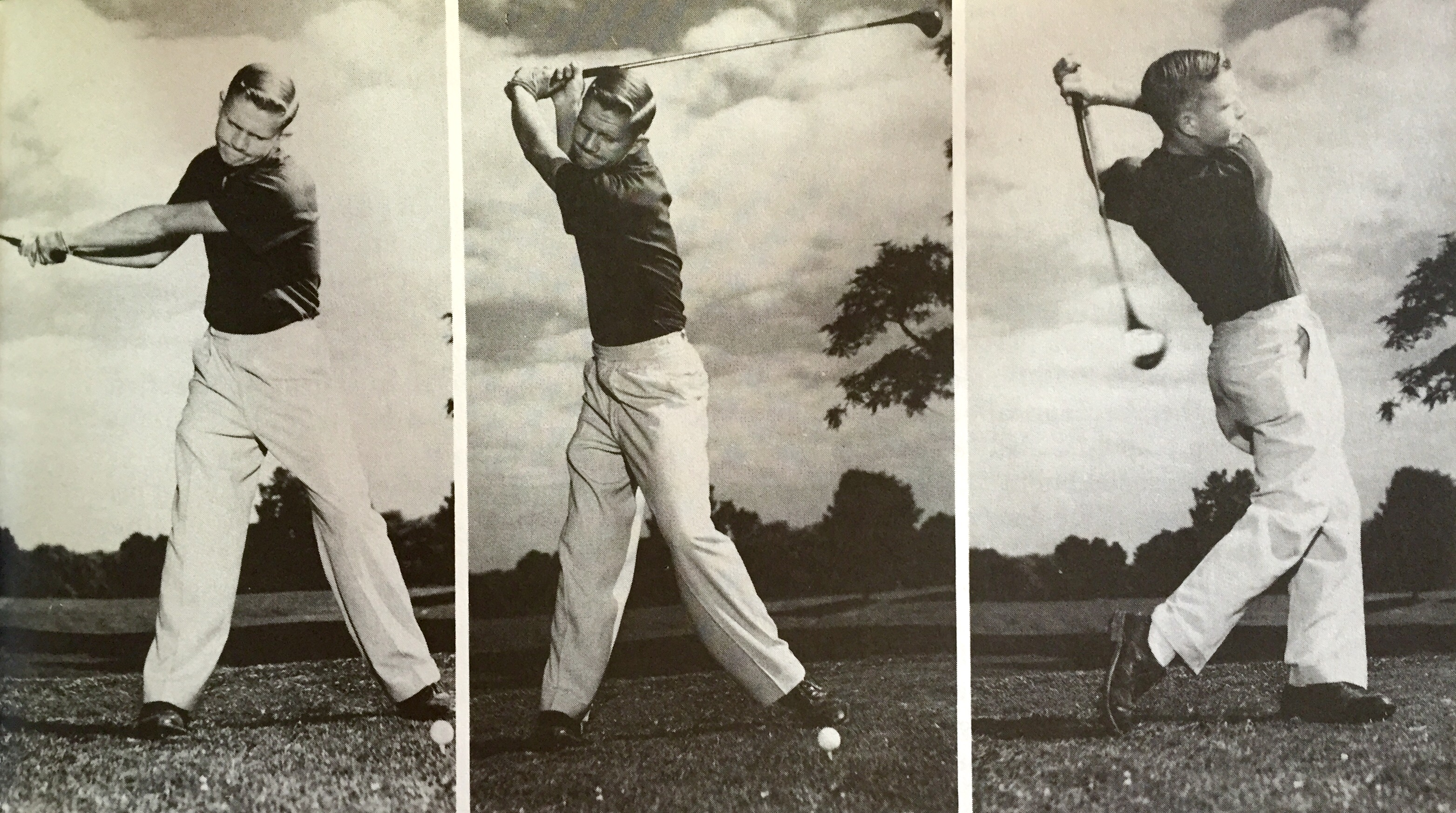
At a very late juncture in the downswing it is highly desirable that you, as a right-handed player, find yourself in a position to hit against a firm left side. This classic piece of swing advice is noteworthy because it just might be the determining factor that either makes or breaks your success as a golfer.

Once the swing has totally changed directions, the initiating movements of the forward-swing create a chain reaction of events that eventually result in the firming up of the left side. Correctly executed, this sequence of motion is rooted in good footwork. Thus, it is led by the feet with a weight shift toward the target. Then, the ankles roll toward the target, followed by the lateral movement of the knees toward the target. Next, in the chain of events, come the thighs and the hips. Trailing along behind them come the shoulders, arms, and so on and so forth.

DG at MVGC5 8:76

At a later stage in the forward swing, when your arms and hands reach hip height, you’ll want to have the feeling that both hips are moving laterally toward the target. At this point, approximately 75% of your body weight should have shifted to the inside edge of your left foot; with the remainder on the inside edge of your right foot. Your right foot should propel your legs and your flexed knees laterally toward the target. Also, it is essential to keep both knees roughly level with each other – neither allowing the left knee to straighten nor allowing the right knee to collapse forward.

As you advance toward the “hitting area” and, your objective of hitting against a firm left side, a noticeable feeling of firming up, or stretching, in your left leg and side should be felt. This sensation is the result of a forward weight shift and an upward movement of your left shoulder causing the “bowing in” of your right side. Despite the left-side stretching action, both knees remain flexed and resilient, neither straightening nor stiffening at any point prior to impact and beyond.

The right side must stay “under” the left side through impact. For this to happen, the left side must provide resistance; it must be firm, extended, and stable. This left-side stability is achieved through a feeling of stretching your left side – from your left foot to the tip of your left shoulder – without, straightening your left knee.

Therefore, regardless of what you may have gleaned from listening to certain golf instructors and commentators about hitting against a firm left side, please do not conclude that they mean to imply you should stiffen or lock your left knee-joint as you deliver your clubface to the ball at impact. While straightening the left leg allows you to rotate your upper body more quickly on your downswing, it also places tremendous stress on the knee-joint.

Personal Note: As this post relates to Tiger Woods: When he pushes his weight into the ground with his left leg just before impact for the sake of a few extra yards, I believe that it’s a dangerous and controversial move that he makes which has led to the leg and knee injuries that have plagued his career.

Straight Down the Middle

As many of you already know, my book “Jack Grout: A Legacy in Golf,” was an eight-year labor of love. From the start, I was convinced that my father’s story was one that needed to be written and one that I needed to share with all who would listen. I felt this way because of the vast influence he had on the game of golf and because of the caliber of man that he was. Over the past year I have been overwhelmed by the positive responses the book has received. I wanted to take the time this holiday season to say that I appreciate your kind words. They have reaffirmed my belief that a book about my father’s life was worth creating. Below I have included a few excerpts from some of the awe-inspiring notes I have received from readers. Thank you all for your continued love and support in making this wonderful dream of mine a reality. Merry Christmas!

“I had known the name of Jack Grout, but only in the most superficial way; as the golf coach to Jack Nicklaus. How exciting to read that there was so much more to him. The stories of his early days with Picard, Nelson, Hogan, et al is a story that I hope many will read. What came out of your book, to me, is what a great man your father was. I close with my thanks for your kindness to me and this – Even though I never met your father your book has made me miss him all the same.” – Will M. in South Carolina

“While your Dad was a great teacher of golf, he was a much better teacher of life. He taught me and everyone around him that a gentle manner wasn’t a show of weakness, but rather one of strength. I don’t recall ever hearing him raise his voice. His voice always had that gentle lilt with a hint of mischief in it. He could really spin a yarn.” – Rick B. in Ohio

“I found this book to be not just about a great man but a great person and one that everyone seemed to hold in high regard. What more could any of us wish for?” – Daniel F. in Florida

“I really enjoyed reading about the “old” days and such things as how hard it was to make a simple long distance phone call or the small amount of money your dad and others played for on the early tour. I came away from the book with an even greater respect for Jack Nicklaus and his accomplishments. He won about everything when I was growing up and I considered him the best putter ever. It was quite interesting to read about the troubles the great golfer had towards the end of his career with his full game as well as his putting stroke. It hammers home to me what I already knew – golf is one hard game. I also came away from the book wishing I had a chance to meet your Dad… he seemed like a wonderful teacher and human being.” – David S. in Pennsylvania

“I was fortunate enough to meet your Dad in 1972 at La Gorce C. C. while he was giving a lesson to my roommate. We were on the golf team at Miami-Dade North. Your Dad did not say much during the lesson but the few things he did say have stayed with me to this day. My roommate was struggling with the left hand in gripping the club, he could not get comfortable. Your Dad was sitting in a cart and he reached forward with his left hand and grabbed the frame of the cart that connected to the top. He said, “This is how the left hand should be put on the club. Hold the shaft of the club in your right hand, grip pointing to the ground at shoulder level. Then, reach and place the left hand on the grip and lower the club to the ground.” I have shown that tip from your Dad to several hundred golfers while sitting in a cart and always giving credit to Jack Grout. It has helped me and everyone that has heard the story.” – Larry Z. in Florida

“The story has so many interesting aspects especially about the club professionals during that time. I never quite understood why you always rooted against Tiger when he was playing. However, after reading this book I completely understand the concept. Jack Grout, in my mind, after reading his story was such a true pioneer in golf that he deserves recognition unquestioned. The story had such a powerful message & being a fellow golf professional it has many things I can relate to. I wish I was alive during that time period to have been able to meet your father. I’m sure he would have quite a few interesting things to say about my swing, especially being a lefty!” – Matt W. in Michigan

“In these times of excess, entitlement, and disappointment with people of notoriety it is gratifying to read about your father, his talent, and character. The most impressive thing is the type of role model he was.” – Frank H. in Pennsylvania

“By the end of the book I was moved to tears. Your father had a lot to be proud of; not only because of the man and father you have become, but also because you are a wonderful and endearing son. I hope the powers in golf read your book, and your efforts result in the ultimate recognition for your father, and he is inducted into the Golf Hall of Fame. He certainly deserves this accolade, and it would be a thrill to see you representing your father at the ceremony.” – David B. in New Jersey

“An avid golfer myself, I really enjoyed the stories of your father’s golfing exploits and travels with some of golf’s greatest players… His love for teaching most assuredly affected his playing success, but as you so artfully disclosed, that was what he loved to do most…” – Bill L. in Pennsylvania

Are Golfers Improving?

Despite all the modern know how and technology, the handicap of the average golfer has not gone down over the years. This does not make sense. Is the game too difficult? Perhaps the game is difficult because the teaching does not follow learning principles. In other words, good learning is not taking place because golf is being presented in an overly analytical way.

Today, too many golfers are too full of technical trivia ever to be able to make a decent pass at the ball, and I think sometimes the fault lies in the sheer volume of needless information they pick up from overly detailed instruction. To weigh down a student with thoughts about positions, swing paths, body parts and mechanics is the wrong approach. Being conscious of too many things just doesn’t mesh with how the human mind works: And, with how sports, athletics and activities are supposed to be played. Teachers who do that are well-intentioned but generally misguided.

A talented coach will watch you long and carefully enough to figure out the root cause of whatever you are doing or not doing. Then, he will never give you more words than are necessary to explain a particular fault and its cure. A gifted teacher will always keep his message both simple and fundamental which is the only way to help a student become a good player in the first place and to stay one for a decent length of time.

The Waggle

All great ball strikers past and present waggle(d) the club. However, this fundamental is almost never taught today and it’s rarely seen outside of the players on the PGA Tour. As a result, few golfers take full advantage of this simple yet vital body action done immediately before starting the swing.

Essentially, the waggle motion provides a smooth transition from the static position at address to the dynamic movement of the swing. These techniques act as a trigger to relax, tune up and tone up the muscles that will be used during the swing. It also gives them a feel for the pace at which the movement of the swing will take place. Unfortunately, most recreational golfers and even some modern Tour players get too mechanical over the ball. They stop moving and take too much time before they draw the club back, which almost guarantees to create tension.

Jack Nicklaus initiated his backswing by turning his chin to the right, so it points at a spot a couple of feet behind the ball. This distinctive move served as a trigger to help get his swing started, and it allowed him to turn more easily. A tilt of the chin also helps to identify the line for your backswing so it doesn’t get too far inside or outside. It previews the straighter-back path that is suited to a basic fade or a more inside path that is suited to a basic draw. It’s a principle that Alex Morrison advocated and discussed in his 1940 book, Better Golf Without Practice. Morrison recommended holding the chin back through the strike to keep the right shoulder from becoming too active and causing the club to swing down from the outside. This action prevents an over-the-top move.

Every fine player in the game, past and present, has kept their arms and hands in motion prior to taking the club back. Historically, Johnny Revolta; a marquee golfer from my father’s generation and winner of the 1935 PGA Championship, is widely credited for being the first to realize the importance of a precise and refined waggle of the hands and arms. Revolta was a master of the short game and a real “hands” player. He was one of the first to make use of the waggle as a precursor or mini-simulation of the upcoming golf shot. He also used it to establish the path of the clubhead on the backswing and for overall swing tempo.

It seems that Revolta was the first to vary the speed and rhythm of the waggle according to the different circumstances he encountered. On normal shots, he waggled the club head back and forth along the target line. For a fade, he waggled on a slightly out-to-in path. For a draw, he followed an in-to-out line. Essentially, it’s good form to feel that your weight is moving back and forth slightly as you waggle the club. It keeps your arms, wrists and legs from becoming taut.

The lesson here is that waggles, when not exaggerated and done properly, are an integral part of your swing. And, to a degree, they have varied among the top players. Bobby Jones kept his entire body “lively” with little hesitation into his swing; Lee Trevino did a little dance step from left to right previewing an open stance and fade. Gary Player kicked in his right knee to trigger his backswing and, of course, Nicklaus swiveled his chin. The point is, good players all do something prior to beginning the swing, and you need to find what works best for you. Be sure to practice your waggle, just like you would any other part of your game.

How to Waggle the Club Properly: Hold the club slightly above the ball. Use your hands, wrists and arms to motivate the club in the backwards waggle. Then, use them again to let the club return in the forward waggle. During the back waggle, the shaft moves on the same angle established at address. Allow the left hand to control this motion with some help from the right hand. Keep the left arm in the same space as at address and allow the right arm to bend slightly and touch the inside of the right hip. The lower body picks up on the rhythm being created and reacts in unison with the coordinated movement of the entire body. In the forward waggle, the entire shaft and movement of the club moves on a slightly flatter plane and more from the inside as compared to the back waggle. This matches the change of plane and path from the backswing and forward swing. Certainly, the clubface returns back to the ball squarely or as appropriate for the desired result.