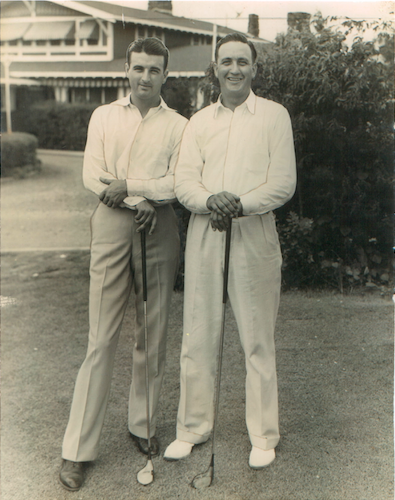
CLASS ACT

Jack Grout, a teacher’s teacher, guided prize pupil Jack Nicklaus on the game’s fundamentals-and those of life as well.

At the Columbus Airport, 1959: Teacher sending protégé off to Scotland for the Walker Cup.

AT ONE TIME, FEW PEOPLE REFERRED TO JACK GROUT AS “JACK NICKLAUS’ teacher,” fewer still called him his “coach” and nobody spoke of him as his “guru.” Grout wasn’t a “celebrity.” Far from it. “Jack Grout seldom set one foot on a practice tee at a major championship,” Nicklaus says of the man who taught him until Grout’s death in 1989. “He might be there, but he’d be back in the bleachers. If I was doing something I didn’t like, I’d go back and ask him.”

In a season in which Nicklaus’ finest hour, his 1986 Masters triumph, is being celebrated, it also is appropriate to recall the modest man who molded the immensely talented Nicklaus in ways that helped the Hall of Famer separate himself from other golfers of his time.

It is part of Nicklaus lore that his father, Charlie, signed him up for Grout’s two-hour Friday junior clinics at Scioto Country Club in Columbus, Ohio, in 1950. Nicklaus was 10 years old, and Grout was the Head Professional. Pandel Savic, a long-time friend of the Nicklauses who was close with Grout, says: “Jack Grout recognized quickly that Jack was ahead of others in terms of intensity and ability. He told me that Jack’s power impressed him. He always taught him to hit it hard, even if he hit it all over the world.”

As Grout’s son, Dick, a courtly golf professional who lives in Greenville, South Carolina puts it: “Dad was an aficionado of the long drive. He maintained that young muscles need to be stretched and that accuracy can come later. During a lesson from him, you didn’t want Dad to say, ‘Let’s go get a lemonade or iced tea.’ The only reason he’d utter those words would be because you weren’t being aggressive enough, and so the lesson was over. He’d say, ‘Don’t let’s try to be pretty. Let’s not lollygag out here.'”

Nicklaus was his star pupil from the start. Grout would ask the boy he called “Jackie Boy” or “Jackie Buck” to demonstrate to the other kids in the clinic, gave him a free private lesson every two to three weeks and provided him with the fundamentals that helped Nicklaus forge golf’s finest record. Moreover, he was a friend and confidante. “I’m much better off for having known Jack Grout,” Nicklaus says, and he means on and off the course.

On the course, Grout gave his charge the knowledge to correct his own swing. “Rarely did I call him from a tournament,” Nicklaus says. “I didn’t need to call him every five minutes. I had to learn how to correct myself, which is the antithesis of the way it is today. For me it was more like the way it was with Bobby Jones. Jones told me that he became a good player when he didn’t have to run back to [his teacher] Stewart Maiden.”
Grout let Nicklaus be, even when that meant Nicklaus letting out a little shaft with his emotions as well as the club. “One time we were out on the course and I was trying to hit 2-irons,” Nicklaus says, “and I wasn’t doing what I wanted to do. I was so frustrated that I took the shaft and broke it. Jack said, ‘Good boy, Jackie. You got to get that out sometimes.’ We went over to the shop, replaced the shaft and went back at it. I only did that the one time, but I could do it with Jack. He’d tell me [it was] fine, that I [had] to get rid of how I was feeling.”
Aware that young Nicklaus was a powerhouse in the making, Grout wasn’t about to make radical changes in the way the child wanted to go after the ball. He taught him how to use the clubhead while swinging hard and to stay centered over the ball with a steady head, rolling his left ankle toward his right in the backswing and his right toward his left in the downswing. “Most guys today teach by positions. I don’t agree with this way of teaching,” Nicklaus says. “Jack taught you what to do with the clubhead, not with your body. I think you should be playing with the golf club.”

A family of words comes up when people speak of Jack Grout. One is “gentleman,” another is “humble” and a third is “quiet.” Dick calls his father “a quiet, proud man.” Nicklaus’ wife, Barbara, says: “He was the kindest and sweetest man there ever was. He never raised his voice or said an unkind word. He didn’t know how.”

One of eight children, Grout was born in Oklahoma City, in 1910. When he noticed some of his older brothers had extra money during golf season, he wondered about the source. Grout followed them to Oklahoma City Country Club, where he learned they were caddies. He started to caddie as well, and by age 15 he became the assistant pro at Edgemere Country Club under his older brother, Dick, the head professional. When Jack was 19, he traveled with Dick to Glen Garden Golf Club in Fort Worth, where he again gave assistance to his brother, and was soon to pal around with junior members Ben Hogan and Byron Nelson, respectively 17 and 18 at the time. The threesome practiced most mornings and played a few times a week in the afternoons. The Grout brothers noticed that Hogan’s equipment included only seven clubs, three left-handed and four right-handed. Hogan hit hooks from either side. Grout’s brother gave Hogan three hickory-shafted right-hand clubs, and they soon convinced him to play exclusively from the right side.

Jack Grout and his wife, Bonnie, were married in 1942 and had two sons, Dick and John, and two daughters, Ronnie and Debbie. Grout delivered Debbie in a taxicab in front of the hospital. Bonnie Grout lives in Stuart, Florida, with Debbie. She suffers from Parkinson’s disease and osteoporosis, and, Debbie says, “is in constant pain, just getting by.” Of her father, she says, “He was my best friend. I just felt comfortable when he was around.”

From Glen Garden, Grout moved to Hershey (PA.) Country Club, where he worked as an assistant professional with legendary player and teacher Henry Picard. There, Grout learned the value of footwork, which Picard had assimilated from the instruction that renowned teacher Alex Morrison had given him. Grout later wrote that Nicklaus had better footwork than anybody, including Bobby Jones, Walter Hagen, Nelson and Hogan.

As the Head Professional, Grout came to Scioto in 1950 and worked there until 1961, when he went to La Gorce Country Club in Miami Beach. He retired in 1974 after Nicklaus made him Professional Emeritus at newly formed Muirfield Village Golf Club in Dublin, Ohio, north of Columbus. He had a similar role at Loxahatchee Club when the Nicklaus-designed course opened in 1985, and also taught at Frenchman’s Creek and, during the winters of 1977 and 1978, at the Cheeca Lodge in the Florida Keys, where Ted Williams liked to fish for tarpon and bonefish in the flats.

While employed as a club professional, Grout qualified for and played in six United States Opens and three PGA Championships. When traveling the ragtag early PGA Tour, he frequently roomed with Picard. According to PGA Tour statistics, Grout is officially credited with 20 Top Ten and 40 Top Twenty-five finishes. In the PGA Championship, then a match-play event, he knocked off Jimmy Demaret in the first round in 1941 at Cherry Hills CC in Denver, defending champion Bob Hamilton in 1945 at Moraine CC in Dayton, Ohio, and medalist Johnny Palmer in 1953 at Birmingham (MI.) CC.

Colonial Country Club January 18, 1941

Grout succeeded as a player despite severe nearsightedness – he was one of the rare pros who wore glasses – and a mild manner. At Scioto CC during the PGA Championship in 1950, tour veteran Toney Penna stated: “If that guy could see, he’d be right there with the best of them. He has one of the finest swings in the game and everything to go with it but eyesight.” Ben Hogan told writer Ken Bowden, who has collaborated with Nicklaus on 11 books, that Grout could have won plenty of tournaments with his graceful swing and ball-striking. “Ben said he could have been a great player if he had a different personality,” Bowden says. “I think he was implying that Jack didn’t have the killer instinct.”

Bowden first met Grout during the 1965 PGA Championship at Laurel Valley Golf Club in Ligonier, PA., when British writer Pat Ward-Thomas introduced them. Along with some 60 pros, they were watching Hogan stamp out 4-wood shots on the range when Grout asked Bowden if he would like to meet Hogan. Bowden certainly did.

“I’ll never forget how warm Ben was to Jack,” Bowden says. ‘He softened right up when he saw it was Grout. He wouldn’t talk to anybody else on the range, but it was like they were relatives. It was a very different Hogan.”

As gentle as Grout was, he was firm in his views. But he provided advice only when he had something to contribute. In 1972, Hall of Famer Ray Floyd was having a terrible time when he sought out Grout at La Gorce. “I was laid off and short, and it’s hard to play golf that way,” Floyd says. “He gave me a move with my right elbow that solved the problem. He told me to get my right elbow up going back, which got the elbow and my right thumb under the shaft. Jack was an incredible guy. He dealt with what you had, and he kept it simple. He was very much a positive influence. Jack would tell you how good you were.”

After Charlie Nicklaus died at age 56 in 1970, Grout became even more of a father figure to the Golden Bear. In the late-1980s, “We would go out on the driving range,” Nicklaus says of the time he spent with Grout at Loxahatchee, “go down there and hit balls at the other end and talk about everything but golf and my golf swing. We did that day after day, and finally maybe after four or five days, we would be hitting balls and he would finally say, ‘Hey, you know, I would like to see your hands in a little different position at the top.’ ‘Oh, really? What do you think that would do?’ He said, ‘It will make you hit it better.’ “OK, We’ll do that.’ But that would be the only comment he would make for a week. We weren’t talking about golf. We were talking about being friends and the relationship between two people.”

Away from golf, Grout loved thoroughbred horse racing and often slipped out with Floyd and others to one of the Florida tracks. He made small wagers on college and pro football games, and at Loxahatchee, club co-founder Gordon Gray and his pals taught Grout a card game called “Oh, Hell,” an offshoot of hearts for which they made their own rules. One of Loxahatchee’s formal dining rooms is named after Grout, which is both an honor and an irony given that he wasn’t much for formality.

On the practice tee at Muirfield Village Golf Club during The Memorial Tournament.

Jack Grout was comfortable in his own skin. He didn’t need to go to parties although he knew how to have a good time. He didn’t need to promote himself as the man who taught Jack Nicklaus – “never in 100 or 1,000 years would he do that,” Nicklaus says – and he was even reluctant to write a foreword to Nicklaus’ book Golf My Way, for fear of drawing attention to himself and away from the golfer he loved. But, as Bowden points out, Grout did finally agree to write the foreword, “and he was glad he did.”

Nicklaus was about to tee off in Saturday’s third round of the 1989 Memorial Tournament when a siren went off to stop play because of storms. Barbara presently received a call that Grout had passed away. “It was very weird,” Barbara says. “I think he died within a minute or two of when Jack was supposed to tee off.” Nicklaus had last seen his teacher, mentor and friend a month earlier, just after the Masters, where Nicklaus had missed the last green. Grout was in bed at his home and asked Nicklaus to stand up and make a swing. He watched and, Nicklaus says, “He told me why I hit the ball to the right. He was still teaching, and he couldn’t even get out of bed.”

Item 6 of Grout’s Last Will and Testament included observations he had made about his relationship with Nicklaus. Grout felt he had been given far too much credit; at the same time he acknowledged that he had helped him with the fundamentals of the game.

Quiet, proud and humble to the end.

By Lorne Rubenstein, GolfWorld Magazine, May 5, 2006
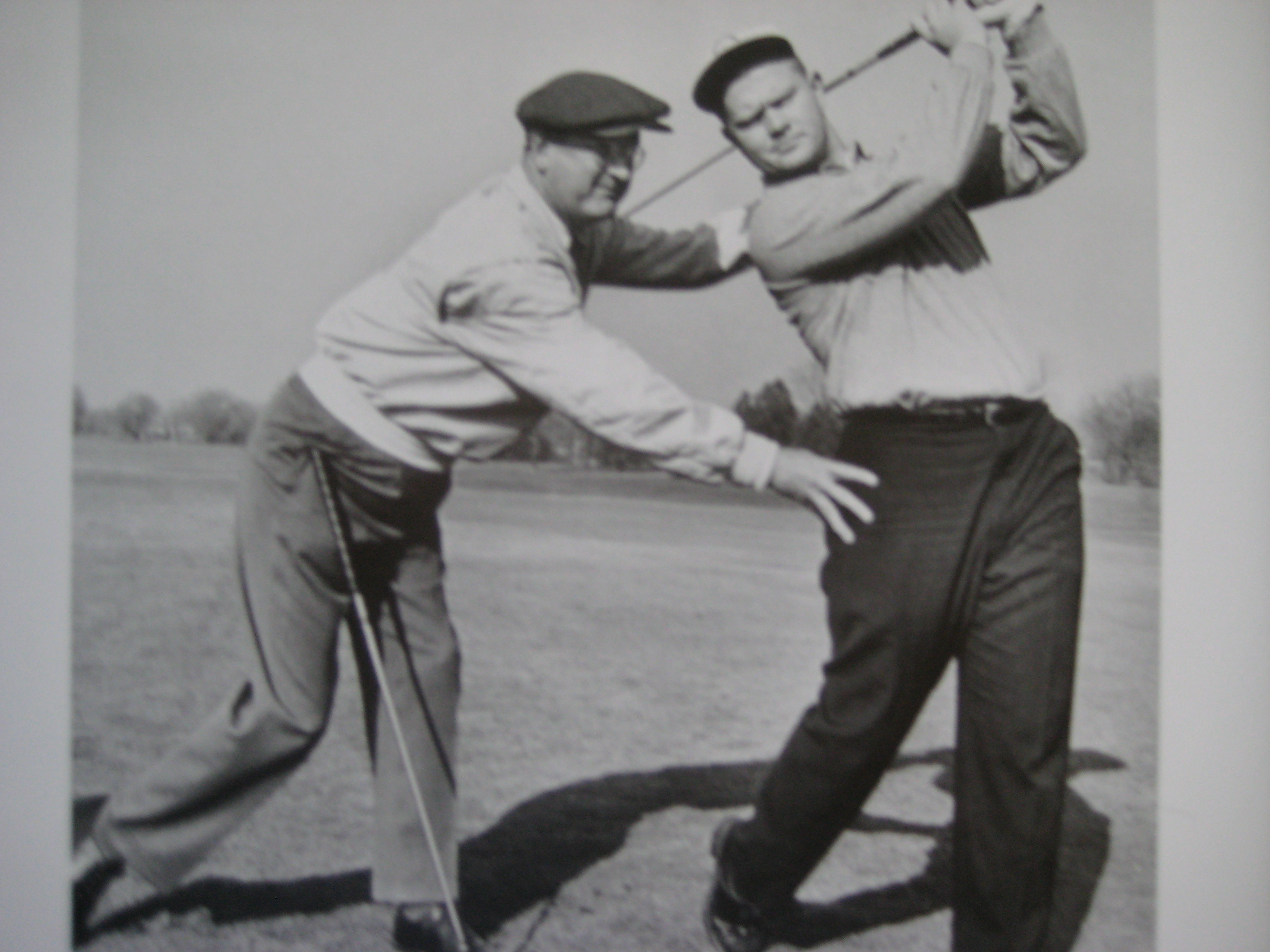
He Got Back 10 for 1

Right hand gripping the shifter of a battered Willys Jeep, left hand tight on the wheel, young Dick Grout would criss-cross his father’s range at La Gorce Country Club in Miami Beach, aiming a makeshift scoop at Dad’s black-striped range balls. Dust billowed behind the boy in summer and mud puddles hid his balata harvest after a rain.

When the balls were all picked they would be cleaned in an old clothes washer in back of the range shack, which must have sounded thunderous in the spin cycle. “You had to throw rags in there to keep the balls from getting scraped up too bad,” recalls Dick, now 50 and a Golf Professional at The Cliffs, near Greenville, South Carolina. He and I were warming up on an ultra-modern practice facility at The Cliffs at Keowee Vineyards, talking about driving-range innovations devised by his father, the distinguished professional and legendary teacher Jack Grout. Most of these inventions dated to the 1950s and Scioto Country Club in Columbus, Ohio, where the elder Grout’s lifelong mentorship of Jack Nicklaus had begun.

“You wouldn’t think of a Jack Nicklaus starting out in junior golf and not having a place to hone his swing,” reflects Dick, but in fact Nicklaus came along at a serendipitous time. Jack Grout was there just in time – part of a vanguard of teaching pros who helped upgrade the golf practice facility from a scruffy field where only a few members could hit balls and schoolboy shaggers had to chase down every shot. These days a clean, full-service place to practice is a refuge we take for granted. We ought to thank the dedicated teachers of the mid-20th century for hand-building the infrastructure that made real learning possible.

“You couldn’t just order range balls back then, either,” Dick remembers, “so Dad figured out a way to keep up his supply. He would trade the members one brand new ball for 10 of their used balls. Ten for one – and he was picky. He wouldn’t take any ball that was too nicked up.

“And the members, who were generally wealthy individuals, they would jump at the chance to make this deal, which Dad always marveled at.” Mr. Grout even had a homemade striping device in his back room, consisting of a tube that fed balls into a pincher, which in turn held each ball against a narrow applicator moistened with black paint. La Gorce members paid 50 cents for a small bucket, $1.25 for a large. “Before we striped them, Dad would say, ‘Dickie Bird, go back into my shag barrel and dig yourself out some real pearls.'”

The first driving range in the U.S. is credited to Pinehurst Resort and went by the name Maniac Hill. The term has always amused people but it’s also mildly regrettable, somehow associating golf practice with a deluded desperation. I would rather think of the practice grounds as a place where the golfer can stand on one spot and take a journey at the same time – from one thought or idea about the golf swing to another, from this move or feeling to the next move or feeling.

We do need guides for this journey, and the Jack Grouts with their Yankee ingenuity filled that role. One of these instructors must have shown up for work one day and hand-dug the first practice bunker. One thought to build covered hitting bays. Yet another devised the first range plan, letting members who lusted for improvement to pay up-front for a full season of ball-beating.

The motivation is always the same – to see flashes of excellence emerge from the divoted ground. The teacher starts out wanting to be a great player, then one day re-channels that ambition into teaching. Conscious or not, the search begins for a protégé, but it’s the teachers who take no student for granted, who, I believe, are most likely to come across that proverbial one great talent that gives their career distinction.

Jack Grout spent the 1950s at Scioto nurturing “Jackie Boy” Nicklaus (as the pro always called him) and then, years later, waiting for his own son, Dick, who showed promise, to develop into some greatness of his own. Other than a stylish swing and prodigious length off the tee, Dick never displayed the traits of anything but a respectable tournament player. For that reason, he looks back now and savors the summer days spent in his father’s world, listening to grown-up conversation, trying this or that swing technique, scooping up 10-for-ones in the Jeep.

Meanwhile, golf history had begun to unfold in the person of Nicklaus, who was fourteen years older than Dick Grout and already the golfer whose development under Jack Grout would define the pro’s teaching career.

To think that the way things turned out cast no shadow across Dick’s path would be naïve, and when his father lay dying, Dick drew up the strength to address it.

“I was holding his hand,” Dick recalls, “and I said to him, ‘Dad, we both worked so hard to bring out my best as a player, and it didn’t work out the way we wanted. I just want to say I’m sorry I never became the player you wanted me to be.'”

“He looked at me and said, ‘Dickie, it’s OK. You were a good player, and you were a good boy, and that’s just fine with me.'”

We were standing on a tee box on the back nine by now. It was Dick’s turn to hit but his driver was still in the bag and his gaze was steady on a treeline above the fairway. “Whew, I’ll tell you …” he said. “His words took the weight right off my shoulders. I told him, ‘Thanks, Dad. Thank you for saying that.'”

By: David Gould/MONOLOGUE

LINKS Magazine, April 2004

Last Will and Testament

Don’t be too proud to take lessons. I’m not. Jack Nicklaus

In his first forty years of golf, Jack Nicklaus had but one teacher. That man, Jack Grout, died in 1989 at the age of seventy-nine from lymphatic cancer.

Nicklaus was only ten when he met Grout in 1950 at Scioto Country Club in Columbus, Ohio. Grout, an Oklahoman, had become the club’s Head Professional that year. He’d turned pro at fifteen, in 1925, and in 1930 accompanied his brother Dick to Glen Garden Country Club in Fort Worth. Ben Hogan, then seventeen, and Byron Nelson, then eighteen, were junior members. The threesome practiced mornings and played three or four times a week in the afternoon.

Grout, Hogan and Nelson took to the road to follow the PGA Tour. They drove a roadster from tournament to tournament, tying their bags of clubs on the side of the car. Grout lasted until 1957 on the Tour, the final seven years while working at Scioto, where Nicklaus’s father Charlie belonged.

The elder Nicklaus asked if he could enroll his ten-year-old son in Grout’s two-hour Friday junior clinic. Young Jackie enrolled all right; he was the first to register and was always the first youngster on the tee. Soon, Grout was asking his young protégé to demonstrate certain points about the swing.

The rest, as they say, is history, where Nicklaus is concerned. He went on to become probably the best golfer ever. And, Grout was always at his side. Grout and Nicklaus went over the swing from A to Z at the start of every season. Meanwhile, they became close friends.

In the way of the world, Jack Grout died precisely at 7:45 a.m., on Saturday, May 13. That was Nicklaus’s scheduled starting time in the third round of his own Memorial Tournament at his own Muirfield Village Golf Club near Columbus, where Grout was also the Professional Emeritus. “J. Grout,” Nicklaus always called him, and now J. Grout was gone.

Said Nicklaus: “Jack was like a second father to me. He was part of our family … He taught me how to play the game and he’s been at my side whenever I needed him.”

Grout also had something to say. Item 6 of his Last Will and Testament was handed to Nicklaus soon after Grout died. The document tells it all.

“Having heretofore disposed of all my worldly goods, I have just one final bequest I should like to make. If there is anytime at all in the life of a man when he should make an extra effort to be truthful, and at the same time sincere, I think it must be while he is preparing his Last Will and Testament. What I have to say in the next few words comes straight from my heart.

“Over the course of the past thirty years or so, from time to time I have read in various books and magazines about the contributions I have made to the career of Jack Nicklaus. Since this may be my last opportunity to do so, I thought maybe it would be well to set the record straight.

“In all honesty, I don’t think I ever hurt Jack’s golf game in any way. To put it another way, if he had not come under my tutelage in the early 1950s I don’t see how he could have turned out much better than he did. From the outset of our relationship I recognized that the thunder in his stroke and the courage in his heart were gifts that clearly had been bestowed upon him; and that there was very little I could do to take them away from him.

“I do not mean to suggest that I made no contribution whatsoever to his game. For one thing, I worked him hard (and he seemed to enjoy every minute of it). I made him stand away from the ball with his arms fully extended, and I insisted that he swing hard. Within a few months you could hear the swish of his clubhead all over the practice range when he took one of his legendary cuts at the ball. I made sure that his posture was correct; I fitted him correctly with equipment; from time to time I would check his grip, or maybe the rhythm of his swing. I always tried to encourage him; and in the early days of his development I made a special effort to explain to him and interpret for him how extraordinary I thought his talents were, and for that matter still are.

“If I made any other worthwhile contributions, which I can’t think of now, or if I made any of which I may be unaware, I am grateful that I had the opportunity to do so. There is not the slightest doubt in my mind that Jack Nicklaus is the finest golfer ever to swing a club in the entire history of the game. It has been a distinct honor and great pleasure for me to have played some part in his career. And that brings me to my final bequest.

“To you, Jack Nicklaus, I give my thanks.”

Lorne Rubenstein, SPECIAL MOMENTS from CHICKEN SOUP for the GOLFER’S SOUL

Remembering Jack Grout, The Legendary Coach Whose Student Roster was Filled by More Than The Golden Bear

By Bob Denney, PGA Historian Emeritus (Published on Wednesday, August 5, 2020)

Jack Grout grew up among a generation of talented self-taught players during the 1930s and ’40s. At that time, the full-time teaching professional didn’t exist. As Ky Laffoon, Grout’s golfing buddy, once said, “There was nobody around who knew much.” 

As it turned out, Grout gleaned more than Laffoon or his contemporaries could envision, making the transition from tour professional to the lesson tee. His impact is still being felt today.

In 1930, Jack Grout and his older brother Dick moved from Oklahoma City to Fort Worth, Texas, where Dick became head professional at Glen Garden Country Club and Jack his assistant. Among the junior members Jack began playing with were two teenagers, Ben Hogan and Byron Nelson.

Grout brothers, Jack and Dick outside the clubhouse at Glen Garden Country Club in 1932.

The Grouts noticed Hogan carried only seven clubs—three left-handed and four right-handed. Jack Grout said that the first time he met Hogan, he was playing three different ways — cross-handed, right-handed (or “Cow-handed,” as they say in Texas) and orthodox left-handed. Andhe could hit hooks from either side.

The brothers convinced Hogan to play from just one side—the right—aided by three hickory-shafted right-handed clubs that Dick gave him.

“Uncle Dick said Hogan always was a loner, didn’t ask anyone for advice on his game,” wrote PGA Life Member Dick Grout in his book, Jack Grout, A Legacy in Golf. “He worked things out himself. Byron Nelson took a different approach, reaching out eagerly for advice on his game and his future.”

The Grouts were quite the golf family. Dick won the Oklahoma Open and State PGA Championship multiple times and played in the 1926 PGA Championship as well as the 1929 U.S. Open. Younger brother Raymond (Dutch) played in the 1934 U.S. Open. Jenny, the youngest Grout sibling, was one of Oklahoma’s greatest female players. 

While Jack played on the fledgling professional golf tour for nineteen consecutive years and participated in ten major championships, his notoriety came as the man who taught golf to Jack Nicklaus, who owns five PGA Championships among 18-lifetime professional major titles. 

“Dad never made a big deal out of a lot of things,” said PGA Life Member Dick Grout, 67 and named after his uncle. “While coaching Jack Nicklaus, dad rarely was on the practice tee at a major. However, Jack always knew that my father was close by should there be any need. In addition to his great diagnostic eye and his minimalism, I think dad’s understated manner was what appealed to students like Jack.”

Nicklaus followed Grout’s tutelage until 1989, when cancer claimed his longtime coach and dear friend. In  2015, Grout was inducted into GOLF Magazine World Golf Teachers Hall of Fame. Those who believe Grout taught just one prodigal student are short-changing the legendary coach.  Among the others he helped includes Tommy Aaron, Joe Turnesa, Dow Finsterwald, Ben Crenshaw, Grier Jones, DeWitt Weaver, Marty Fleckman, J. C. Snead, Gibby Gilbert, Jerry Heard, Roger Maltbie, Tom Purtzer, Lanny Wadkins, Bruce Devlin, Jim Colbert, Butch Baird, George Burns III, Jerry McGee, Fred Ridley, Steve Melnyk and Olin Browne.

Raymond Floyd credited Grout’s instruction and encouragement in helping him win what he called “my most cherished victory,” the 1986 U.S. Open.

Additionally, Grout gave advice to LPGA Tour professionals, including Barbara Romack, Jo Ann Prentice, Maria Astrologes, Beth Stone, Kathy Cornelius, Kathy Farrer, Dianne Dailey, Silvia Bertolaccini, Sandra Spuzich and Sally Little. Never a self-promoter, Grout was the prototypical golf professional, ensuring his students came first.

From his home in Taylors, South Carolina, Dick Grout has often reflected on his father’s lofty perch in golf history. Like many players prior to World War II, they served apprenticeships in the caddie yard where sharing of golf knowledge took place. 

“Champions like Walter Hagen, Gene Sarazen, Nelson, Hogan and Sam Snead said that they “never learned from anyone,” said Dick. “While this may be technically true, they indisputably all learned from one another.”

Jack Grout – Unparalleled Teacher of the Game

By Jeff Groezinger

“On May 13, 1989, Jack Grout passed away. Though his physical presence may no longer be with us, his gentle warmth and kind words remain fixed in the minds of the thousands who were fortunate enough to know him.

I met Mr. Grout through my father. Dad was a PGA professional and operator of a public golf course on the northside of Columbus Ohio. Jack Grout was the head professional at Scioto Country Club; then and now, one of the country’s finest private golf courses.

The two men frequently crossed paths at PGA meetings and while staging junior clinics. Eventually they came to an interesting business arrangement. You see, at premier country clubs with well-heeled members, buying new sets of clubs is something of an annual tradition.

Typically, a purchase of new clubs is accompanied by a trading-in of the former set. As you might well imagine, there was neither then or now, a great demand for used clubs at Scioto. And thus a business and personal relationship was begun. Eventually, Minerva Lake Golf Club became the home of some of the finest “used” clubs in the city.

In the mid-70s, after Mr. Grout had accepted the offer of Jack Nicklaus to become the new Club’s “pro emeritus” at Muirfield Village, my father gave his youngest son a sixteenth birthday he’ll never forget; a lesson with Jack Grout. I wish I could tell you that one lesson led me to a string of amateur titles, wealth and fame, but I’m afraid those fables are better left to Aesop. No, after completely reworking my grip, I went out the next day in a nine-hole school match and shot a score much closer to 56 than the par of 36.

Several years later, after deciding to make a serious effort at the game, Dad called Jack and set up a series of lessons.

After our first session, we ended up in Muirfield’s grill room. There, it was decided that the series would be five lessons. “How much do I owe you?” my father queried. “Aw nothing,” replied Mr. Grout. “It’s a pleasure.”

Fifteen minutes later Jack reluctantly consented to accept a payment in an amount that escapes me, but I recall it wasn’t enough.

Our weekly sessions on the practice tee were pure pleasure. But even though Jack didn’t have “the secret,” he did have something that few men do – genuine warmth and humility. You see, the man absolutely loved the game. On the lesson tee he would show you the idea or fundamental to perform. As you gradually started picking up the concept, Jack would get excited. He loved to see you take a divot, and before you knew it you’d be just as excited as him. I soon came to realize that nothing pleased him more than seeing a good golf shot. By the end of our series, I felt the same way … I still do.

Almost without fail I would leave the lesson tee (often ten or fifteen minutes later than the lesson was scheduled to last) just looking for a golf course to play. To try out the new grip or swing thought.

That’s my memory of Jack Grout. It’s a memory of one of the kindest, most humble men I’ve ever met. But above all, it’s the memory of a man who loved the game for what, in my opinion, is its greatest thrill … the excitement of hitting a good golf shot.

In Jack Grout’s case he saw the best of two worlds, as an outstanding player in his earlier days, he hit many a perfect shot on the PGA Tour in the company of his friends Ben Hogan and Byron Nelson. But Jack had the special knack of communicating those abilities to a host of aspiring amateurs as well as professionals, and though an ailing back forced him off the course, he was able to share the enthusiasm and yes, even provide his own brand of excitement to all those whose lives he touched.

To be able to genuinely love the game of golf is rare enough, to share that love through enthusiasm and teaching is a very rare gift indeed. Many very good instructors can teach you the proper grip and set-up. But only a very few can teach you how to love the game of golf. Jack Grout was one of the few. The world of golf is fortunate that Jack Grout was a member of its community, and the world of golf will miss him.”

The Coach who stands above them all?

May 12, 2013

By David Waldenstein of the New York Times

LEAVING GREAT ENOUGH ALONE

“The greatest coach of the 20th century performed his job so well, he made himself obsolete.

Jack Grout new

Jack Grout, the first and only instructor of Jack Nicklaus, believed that self-reliance was the key to golfers’ reaching their fullest potential. It worked for Nicklaus, who won 18 major championships and is widely considered the greatest golfer of all time.

Unlike today’s instructors, Jack Grout never showed up on the practice tee with a video camera bag slung over his shoulder. He would have shuddered at the thought of becoming a reality television personality. Grout’s face rarely graced a PGA Tour practice range. Nicklaus said that he very seldom set foot on the practice tee at a tournament. When they got together for practice, Grout taught Nicklaus how to fine-tune his game, and when the major championships rolled around, he was often there but stepped back into the shadows.

 Far from trading on Nicklaus’ fame, he hardly acknowledged his part in it. Unlike today’s coaches, Grout never would have earned his own endorsement deals, unless it was for Wite-Out. In the galaxy of coaches, Jack Grout was the Pistol Star, the brightest star in the Milky Way but totally obscured by dust clouds.”


Memories of a Champion


JWN80-Grout bookJanuary 15, 2020. Jack Nicklaus reflects on career and turning 80 years old. Note: Displayed prominently on Jack’s desk is a copy of my father’s book: “Jack Grout, A Legacy in Golf.”
“Looking back, the most remarkable thing about those earliest days was how much time Mr. Grout always seemed to have for me. He’d see me coming in off the course and it was always the same: “Well, Jackie boy, how’d you play today? How’d you hit ’em out there, young fella.” And I’d tell him my score, a 93 or an 88 or whatever, and he’d say, “Well, let’s go out and hit a few, let me take a look.” And off we would head once again for the range or the putting green. Certainly he was tickled by my enthusiasm, and in later years he liked to suggest that a certain clairvoyance about where I would go in golf stimulated his efforts to help me. Whatever the reasons, without fail his time was my time.

Equally valuable – especially during my inevitable slumps – was the durability of Jack’s conviction about my innate golfing abilities. Come a bad patch and he couldn’t wait to start getting me refocused and remotived by helping to make the game fun for me again. It was like that every day of his life, even in those terrible times when he was dying of cancer and could barely sit upright in a golf cart. The phone would ring and there he would be … the faint voice trying so hard to sound upbeat and cheerful: “Jackie boy, come on, let’s go out and hit some balls.”

There would be some times as the years passed when Jack’s enthusiasm was my only motivation, when I would go to the practice tee and hit shots for him that I knew his failing eyes could not even see, simply because he wanted to spend time with me, and because I wanted to be with him just as much. And when I got there it was always fun, and, like as not, without him telling me even one teacherly thing, I’d fall back in love with the game again.

Jack Grout was the most fortunate thing that ever happened to me in terms of golf, and the reason was that he would not, under any circumstances, allow me to get really down on myself. In this respect he was relentless. “Come on Jackie boy,” he’d urge and exhort me, “you’ll get it, stay with it, keep at it. You’re the best, Jackie boy, you’ve beaten ’em all before and you’ll beat ’em all again. Okay, you lost it for a while, but forget that, put it out of your head. It’s another day, and there’s another tournament coming up. Now, let’s get out there and go to work. Come on, let’s go hit some balls, there isn’t any time to waste. Now, don’t you forget, it’s right there inside of you and we’re going to find it. Jackie, young fella, you’re going to be unbeatable … you hear me … Un-beat-able! Now, let’s get out there and start playing some real golf.”

It was heady stuff, and there was no way I could not respond to such boundless faith in me. Thank you, Jack, from the bottom of my heart.”

JACK NICKLAUS: MY STORY, SIMON & SCHUSTER, 2003. PAGES 50-51

Death of the Country Club

The country club, once a mainstay of American suburbia, faces a cloudy future, with a changing culture eroding its societal influence. Golf and tennis, the traditional club pastimes, have lost popularity. Declining marriage and fertility rates mean fewer families joining. Young professionals, many burdened with limited incomes and high debt, balk at paying dues. And a yearning for broader community makes the exclusivity of the clubhouse unappealing. The country club is increasingly a refuge for retirees—and, upon closure, a site for mixed-use development.

Country clubs once served as communal centers for social climbers. Dating to the 1880s, the clubs—modeled on the country houses of the British aristocracy —opened in the bucolic outskirts of industrial cities and towns. For a growing upper-middle-class, wealth permitted entry into this local society. Golf, dormant since the colonial era, became the favored sport for club members; in 1895 alone, more than 100 courses opened. Country clubs would help shape the development of streetcar suburbs, with stately homes lining manicured courses. By the Great Depression, nearly 4,500 country clubs existed across the country.

Throughout the twentieth century, the club’s influence was reflected by its prominent place in American literature. “In Zenith it was as necessary for a Successful Man to belong to a country club as it was to wear a linen collar,” wrote Sinclair Lewis in his 1922 novel, Babbitt. A decade later, in Appointment in Samarra, John O’Hara documented how a set of missteps at a country club could destroy a man’s social standing. In the 1950s, John Cheever’s short stories revealed the centrality of club life to upper-middle-class suburban America. Philip Roth’s first book, Goodbye, Columbus, sets a New Jersey country club as the stage for exploring class divisions in a youthful romance. John Updike’s 1981 Rabbit is Rich offered the country club as a paradise of relaxed indulgence; by 1990, in Rabbit at Rest, the poolside and fairways of the club are shadowed by mortality.

By the early 1960s, shortly after Roth’s fiction debut, the U.S. had 3,330 clubs with 1.7 million members—fewer than during the Roaring Twenties, but membership now extended beyond “old money.” The typical postwar suburb featured several country clubs, divided by ethnicity and class, where young professionals and successful businessmen enjoyed status, exclusivity, and recreation. The prosperous Reagan years yielded even more clubs—and baby boomer members—though concerns started to emerge about changing lifestyles, age-old restrictions, and exorbitant fees. Country clubs responded with family-oriented attractions and cheaper “junior memberships” for younger people. More than 5,000 clubs operated during the 1990s, and thanks to Tiger Woods’s ascendance, the golf market enjoyed a 20-year period of growth.

The Great Recession changed the club’s fortunes. According to a recent Business Journals analysis of 449 U.S. counties, the number of golf courses and country clubs declined by 5 percent between 2005 and 2015. A generational shift will only intensify this trend. As the Wall Street Journal recently reported, Americans born between 1981 and 1996 are financially outmatched by every generation since the Depression. Despite higher levels of education, millennials have “less wealth, less property, lower marriage rates, and fewer children.” Annual country club dues, which run in the thousands of dollars, put membership beyond practical reach for many. Leisure for today’s younger adults more often involves streaming TV shows in a high-rent city bedroom, not playing 18 holes on a suburban green.

A combination of millennials’ empty pockets and aging club members has brought more closures, and the suburbs have had to adjust. In El Paso, to take one example, the struggling Vista Hills Country Club recently shut down. More than 500 households surround the club’s golf course, and owners worry about depreciating property values. Following a community meeting, an initiative is underway to raise money from homeowners to maintain the golf course.

Mixed-use development projects are often replacing defunct courses. At the site of California’s Santa Clara Golf and Tennis Club, a developer plans to build City Palace, which would be the country’s largest entertainment complex, featuring nearly 2 million square feet of retail and dining. In suburban Harrisburg, Pennsylvania, the Blue Ridge Village will replace a former country club with hundreds of single-family homes, townhouses, and apartments, along with an assisted-living facility and retail space. The redevelopment, occurring near the base of an Appalachian ridge, will transform a once-quiet corridor outside the city.

A country-club resurgence is unlikely, even with Woods’s recent comeback. The houses in today’s mixed-use developments recall those of earlier suburban patterns, from fifties-era ranches to the nineties’ double-arched McMansions. Ironically, it is millennials, not baby boomers, who will ultimately reside in these communities. They will become condo tenants on their parents’ former links, seeking cheaper housing, decent schools, and a respite from the rush in an age that moves too quickly for a round of golf.

Charles F. McElwee, Assistant Editor, City Journal; June 7, 2019

“Wee Bobby”

Bobby Cruickshank (Born, Grantown-on-Spey, Scotland, November 16, 1894; died, Delray Beach, Florida, August 27, 1975.) Known as “Wee Bobby” or the “Wee Scot” because of his small stature (5-foot-2 to 5-4), Cruickshank served in the British Army in World War I. Captured in action by the Germans, he was a prisoner of war and later successfully escaped with the help of a local woman he had befriended. He then rejoined his regiment and saw out the war with distinction as Sergeant RA Cruickshank.

Once the Great War ended with an armistice on November 11, 1918, Bobby returned to Scotland and resumed his promising golfing career. With the success he was enjoying, Cruickshank turned professional and left Scotland for America in February 1921. He rose to prominence in the United States after reaching the semi-finals of the PGA Championship in 1922 and 1923, but lost both times to eventual champion Gene Sarazen. Cruickshank was also the runner-up in the U.S. Open in 1923 and 1932, won by Bobby Jones and Sarazen, respectively.

As one of the star names in golf, Cruickshank was well placed to take advantage of the extra cash ($300 per appearance) that could be earned by way of exhibition matches. The Scotsman’s flair and colorful game brought him to Oklahoma City in the fall of 1924. On Sunday, October 12th Cruickshank and his traveling companion Al Espinosa played in a best-ball match against Bill Creavy and Harold Long.

During that match, my 14-year-old father, who was the No. 1 caddie at Oklahoma City Golf and Country Club, was assigned the honor of toting Wee Bobby’s golf bag. As time passed, Dad’s admiration deepened for Cruickshank and he caddied for the Wee Scot every chance he could. In those days it was considered a privilege to caddie for a player the likes of Cruickshank. My father said that the Scotsman was the first truly distinguished golfer that he was able to observe. Cruickshank was a magnificent player with a beautiful style and my father paid particular attention to the distinctive and artistic way in which he played. Dad is quoted as saying, “But, Cruickshank too, experimented with his game and taught others what he had picked up along the way.”

Bobby Cruickshank was an active member of the P.G.A. tour from 1921 to 1950, winning 20 tournaments. His greatest year was 1927, when he won the Los Angeles and Texas Opens and led the tour with winnings of $17,800. In 1967, Cruickshank was elected to the PGA Golf Hall of Fame. When his competitive career was over, he took on a series of pro jobs across the country, until his death at age 80.

Without a doubt, Cruickshank’s was no ordinary life. He lived it without regret, and remained philosophical about his “near misses”. He made this clear in the 1974 interview: “I’ve no regrets. We had our chance, that’s the way the Lord makes it. I think things work out for the best. If you win, you win, if you don’t, you don’t. It’s fate’s work, you see.”

Cruickshank

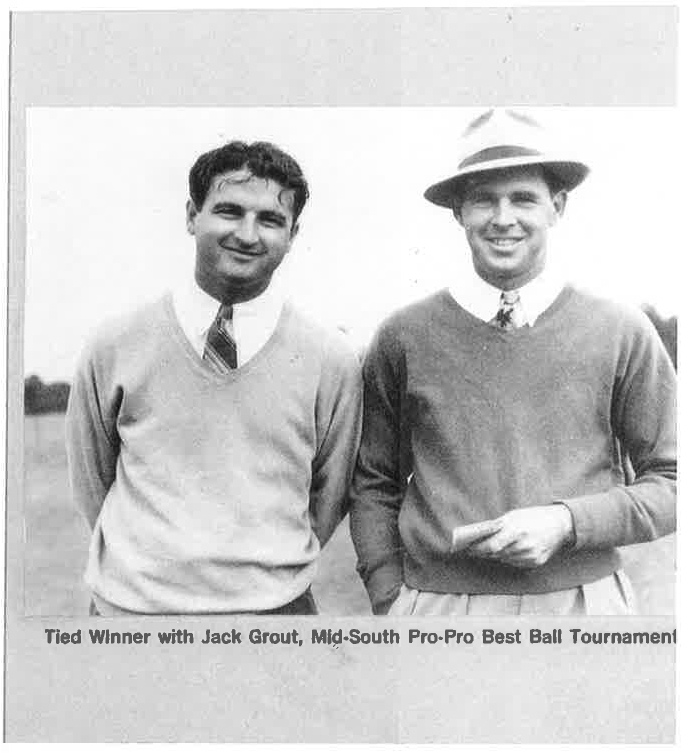
Bobby Cruickshank (left) and Thomas (Tommy) Dickson Armour were fierce competitors on the golf course and lifelong friends off it. In the above photo, Cruickshank and Armour are shown after turning in 66-66-132 total strokes to tie Jack Grout and Henry Picard 67-65-132 in the Mid-South Pro – Pro Best Ball Golf Tourney. The four-ball event was held at Pinehurst #2 in Pinehurst, North Carolina.  The title attached to these historical images is “Tying Pain in Southern Golf Tourney.” Below, is a photo taken of my father and Henry Picard upon completion of their round on November 16, 1938.1938 JG & Picard @ Mid-South 4-Ball


“You Must Go Where the Money Is”

The era of the 1920s embodied the beginning of modern America. Under any moniker, The Roaring Twenties” were an age of dramatic social and political change. For the first time, more Americans lived in cities than on farms. The nation’s total wealth more than doubled between 1920 and 1929. However, this economic growth was not being felt by those playing on what passed as golf’s pro-tournament circuit. The colorful Gene Sarazen called pro golf “a sucker’s game.” Even the best players made little cash from tournament play, golf’s purses of the day being far inferior to the pay offered the top athletes in, say, boxing and baseball. For example, the prestigious U.S. Open title carried a purse of only $500 in 1926 (equivalent in purchasing power to about $7,265 in 2020).

A golf champion’s overall earnings, then, depended largely on his personal showmanship and ability to market his playing skills away from the scheduled tour. Exhibitions were where the money was in golf, and stars such as Walter Hagen and Gene Sarazen were among those who crisscrossed the country playing one- or two-day events for cash. These matches were a sure thing – no pressure and an automatic payoff. Once a player had established himself as one of the leading tour pros, the exhibitions offered an easy supplement to tournament winnings.

In 1922, Hagen aimed a glaring spotlight on the importance of these good-paying exhibition matches to leading professionals. After becoming the first American to win the British Open, he opted just a few weeks later not to defend his PGA Championship when the tournament was held at Oakmont Country Club in Pittsburgh. Hagen wasn’t ill or injured. Rather, his schedule was full of more-lucrative engagements. During his career as a golf pro, Hagen played close to two-thousand one-day stands. The man called “Sir Walter” played wherever cash was available – from Chatham, Massachusetts, to Salt Lake City, to the dusty fairways and sand-based greens of the Southwest.

In October 1922, the Hagen caravan pulled into Oklahoma City for an exhibition match at the Oklahoma City Golf and Country Club. This one pitted club pro Sandy Baxter and caddie master Dick Grout against Hagen and fellow touring pro Joe Kirkwood Sr. Seven hundred people turned out to watch, and Hagen and Kirkwood were paid about $300 each. Baxter made $100, and my dad’s brother, Dick, just eighteen years old but already playing in high-level company, took home $50. My dad also played a role in the club’s big day. Having established himself by then as a first-rate caddie, even at age twelve, he was assigned to tote Hagen’s bag, giving him yet another great learning opportunity. Hagen was at that time the most celebrated American professional golfer. Dad’s terrific opportunity, then, would be comparable to a pre-teen caddying for Tiger Woods in his prime.