Tee Shots

 For Distance – “You’ve Got to Have Speed in the Swing.”

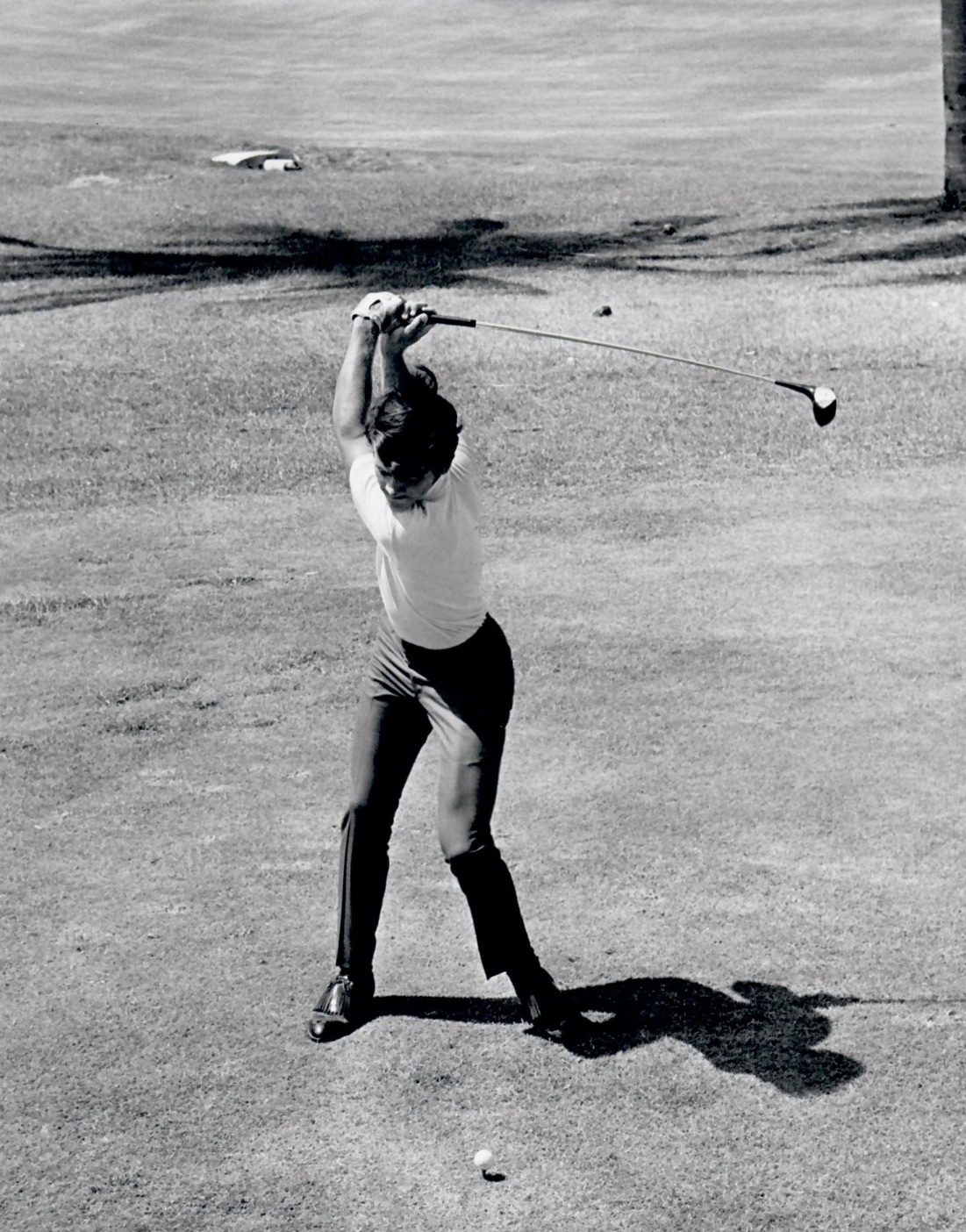
I. The Waggle Motion helps to initiate your golf swing. These movements act as a rehearsal for the swing and they serve to ready the body and to relax muscles. It provides a smooth transition from the static position at set-up to the dynamic in-swing movements.

II. The club head moves away from the ball in a swinging manner. To achieve full and complete extension, the arms and hands travel out and up in a wide arc. When the club head is traveling through a wide arc it gathers speed and velocity. That equals distance!

III. The violent force of a tee shot has to swing around a steady head position. Even though the actual center of the swing is located in the sternum, it is easier to think about the head as it relates to the body turn, weight shift and swing.

PGA Tour analyses indicate that professional’s heads move about two inches on the backswing. Allowing for a slight movement makes room for a good full turn.

  • The head at set-up must be slightly behind the ball.
  • During the backswing the head must stay within the stance, that is, move no farther back than the inside of the right foot.
  • During the forward swing, the head must remain behind the ball position until after impact. It should then move forward and up to a relaxed finish of the swing.

IV. Weight Shift and Footwork

 A fundamental weight transfer takes place during the backswing. Nearly 80% of the body weight shifts to the right side by the time the hands have swung back to waist height. Most of that happens because the hips and shoulders have started to turn. And, as that happens the feet begin to play an active part.

The correct movement of the feet during the backswing and forward swing is rolling the ankles. This technique makes it easier to keep the weight balanced throughout the swing, never letting it slide to the outside of the right leg and foot

V. Impact and Balanced Finish

 The club head must be released during the forward swing. Unless the club is being held too tightly, the swinging action of the arms and the unhinging of the wrists will square the club face immediately before impact.

Releasing the club is a rotation of the entire left arm as it goes through the impact area. The left arm does not collapse or bend at impact. And, the wrist does not break down.

At the end of every swing you should experience – Complete balance. A good, completed swing pattern will have the weight totally to the target side with the hips and shoulders facing in the direction of the target; both arms should be relaxed with elbows bent.

Putting Lesson of a Lifetime

Dick Grout was one of my father’s older brothers. As a golf professional, he was both a respected teacher and a fine player. In 1926, at twenty-two years-old, he received an introduction into the “big leagues” when he played in the 9th PGA Championship held at Salisbury Golf Links, Westbury Long Island, New York.

After making it through the thirty-six-hole stroke-play qualifying round, Uncle Dick managed a satisfying victory in the first round of match-play. Only problem was a fellow by the name of Walter Hagen awaited him in the second round. Unfortunately, during next day’s 36-hole match, my uncle did not play his best, and defending champion Hagen dispatched him from the tournament.

After that match, “The Haig” had lunch and drinks with Uncle Dick, then took him to the practice green for a putting lesson. Evidently, Hagen had no qualms with my uncle’s scientific approach to putting. He even complimented him on his sound technique.

  • A steady head
  • Hold the club in a comfortable, light grip of your preference
  • Set up with your eyes directly over the ball-target line
  • Keep the putter head low going back
  • Accelerate through the ball

However, the “master putter” did find fault with my uncle’s apparent inability to read the greens. According to Hagen, Dick needed to get in touch with his artistic side and develop a “sixth sense” of how the ball will roll. His tutor added that, it’s a skill that comes after hitting enough putts over enough different types of terrain and grass. In other words, it’s a skill that comes with experience.

Here is a synopsis of what Walter Hagen told Dick Grout back in 1926:

As you walk on-to a green, whether you realize it or not, you take in all sorts of subtle information. This data runs through your mind before you even mark your ball.

  • Even if you don’t look closely at the surrounding terrain, you are aware of any major slope in the land.
  • Without having to tell yourself, you know where the low side of the green is and where the high side is.
  • If the putting surface is hard and crusty under foot, you receive one message; if it’s soft and spongy you get another.
  • If the green is situated on an elevated section of the course and, you feel a breeze as you step on-to it, you sense that the putt will be fast.
  • If, the grass appears light, you’re putting against the grain; if it’s dark you’re putting with the grain.

The most subtle aspect of green reading has to do with the grain. Grain refers to the direction in which the blades of grass grow. The light/dark appearance is one way to read it. Another method you can use is to take your putter blade and scrape it across a patch of fringe. If the blades of grass brush up, you’re scraping against the grain. If they mat down, you’re scraping with it. (Incidentally, be sure to do this scraping on the fringe. If, it’s done on the greens, it’s a violation of Rule 35.)

A third method is to take a look at the cup. Often, the blades of grass will grow over the edge of the cup in the direction in which the grain moves. Grain usually grows toward water and, especially toward the ocean. In the West, it’s apt to lean toward the mountains. If, you’re not near any such topography, figure on the grain-growing in the direction of the setting sun.

Grain is strongest on Bermuda grass, where short, crew-cut-like blades tend to push the ball strongly. As a general rule, you can figure on stroking the ball about 20 percent firmer than usual on a putt that’s into the grain and about 20 percent easier on a putt that’s with the grain.

These effects are less noticeable on long-stemmed bent grass and other strains of grass, but they are present nonetheless. The break of your putt will also be affected by the firmness of a green, the wetness/dryness, the amount of wind you’re facing, and even the time of day. In general, any time you have to hit the putt firmly, you should play for fewer breaks.

Another way of reading the break on a green is to observe the putt of another player. Hagen told my uncle that he favored “going to school,” but with one stipulation: Allow for any difference between your own playing style and those of your fellow players. If, for instance, your friend is an “aggressive” putter and you’re a “lag” putter, allow for more break than he does.

Hagen wrapped up his coaching session with Uncle Dick by explaining matters like this. And, I quote: “Did you ever notice a flower when the sun first hits it? It leans toward the sun’s rays. Well, the same thing happens to grass on a green when the sun first touches it. When the rays of the sun touch the grass from the left side, the grass leans that way. If, the sun reaches the grass from the right side, the rays pull it in that direction. In other words, just like a flower, the grass leans toward the sun.”

“Putting well is no accident,” Hagen declared. “It’s not simply a matter of stroking the ball in the general direction of the cup and hoping that it drops. You must read the green as best you can. You have to study the line and roll to the pin, form a definite plan of attack, then go ahead and execute it. The grass in relation to the sun’s rays figures in your firm plan of attack.”

“The direction in which the grass is leaning will have an effect on the roll and break of the ball as it heads toward the hole. If, you have a break to the left and the grass is leaning in the same direction, you must anticipate that the ball will break more sharply and compensate for this when lining up your putt. If, the grass leans the other way, the ball will make a slower break toward the hole.”

In conclusion, Hagen emphasized that “Good putting is never an accident. It always requires careful thought and preparation.” FYI – Several days later, Walter Hagen went on to win that PGA Championship. In fact, he won it a record-tying five times (1921, 1924-1927).

Golf Vision

Golf is about precision and concentration and instincts. The game is played with an eye on the ball, an eye on the slope of the green, an eye for the hazards, and an eye to gauge the distance to the pin. It’s important, then, to improve these qualities and your visual skills if, you want  to play your best.

  • Peripheral vision refers to the outermost boundary of a person’s range of vision. Central/peripheral awareness – is being aware of the primary target (the ball) while simultaneously knowing where you want to direct the ball with your club. Obviously, this is a basic skill to master.
  • Depth perception – the ability to judge distances is crucial in golf. When trained properly, depth perception acts as a valuable aid in estimating yardage, in selecting the proper club and, in making solid contact with the ball.
  • Fixation ability – using a series of quick and accurate eye movements, it’s the ability to fine-focus on a target, whether 3 feet or 300 yards away. Then, being able to properly focus on the ball. This skill is essential in making good contact between the clubhead and the ball. Fine focusing techniques can help both in hitting the sweet spot and stroking a smoother putt.

This scenario requires the golfer to focus or “gaze” at the right points in their surroundings and ignore the rest of the scene. Research has proven that expert golfers with “quiet” eyes are able to focus on specific targets, e.g., a precise spot in the landing area or, the flagstick. Then, they can finely focus on a specific point on the back of the ball and, remain fixated on that part until the club strikes the ball. In contrast, average golfers with “noisy” eyes allow their gaze to wander all over the place, without having a very specific focal point on their target or their ball.

No doubt, the age-old decree to keep your head down and keep your eye on the ball stems from the poor habits of the high-handicapper. Most good players, on the other hand, try to maintain their head position through impact and focus their attention at a precise point on the back of the ball until it is struck. This arrangement seems to give them a straighter path to the ball, better contact, increased swing speed, more hip rotation and improved balance on the follow through and finish.

But, this principle of keeping the “head still” and the “eyes-on-the-ball” isn’t preferred by everyone. In fact, the natural move for PGA Tour stars like Jim Furyk, Robert Allenby, Annika Sorenstam and David Duval is to not even look at the ball during impact. Instead, they let their right sides turn through the shot, allowing their heads to swivel with the rotation of their body. Maybe, those that favor this particular method are right eye dominant and/or simply prefer to play a fade. In any case, these players have found success by allowing their head and eyes to move freely through the impact zone.

My father was quoted as saying, “Never keep your eye on the top of the ball, chances are you will blade it.” Aspects like depth perception and, the fact that a golf ball’s diameter is 1.68 really mattered to dad. When he’d watch me play and I’d happen to mishit a sand shot, often his best advice would be to finely focus my attention on the sand behind the ball. Regrettably, I found this course of action to be unsettling. And, it bothered me because purely and simply I did whatever my dad told me to do on the golf course.

Occasionally, I’d find myself wondering about the ifs ands or buts of dad’s viewpoint. Well, the opportunity to discover the “truth” finally presented itself one day. It was May, 1977, when I happened upon the talented Taiwanese professional Lu Liang-Huan or “Mr. Lu” as he came to be known to British golf fans. He was practicing sand shots in a bunker at Muirfield Village Golf Club. Mr. Lu was a regular winner on the Asian Tour and, in 1971, he finished runner-up to Lee Trevino in the British Open at Royal Birkdale,

I remember being excited by the sight of Mr. Lu because, at the time, he was regarded as a world-class bunker player. Not wanting to disturb the master, I approached him cautiously. As I stepped closer to the bunker, Mr. Lu looked up to acknowledge my presence. Then, the polite man nodded his head as if to say hello. At that point, I asked him if, it would be ok to watch. After he nodded, yes, I moved to within 20 feet of him and positioned myself immediately to his right. Then, after watching him splash several more shots right next to the flagstick, I asked him my question. I said, “Mr. Lu, where do you focus your attention when you’re playing sand shots? Do you look at the ball or do you look at the sand behind the ball?” What happened next was truly amazing. Mr. Lu gazed up at me and, while maintaining eye-contact, he said “I look at you” as he proceeded to delicately extricate the ball from the sand. Then, I got to watch another of his unreal shots trickle to within several inches of the cup!

Seeing & Feeling is Believing

In the February 1988 issue of Golf Illustrated, there’s a section entitled: “The Top Teachers Talk” Q&A “An Interview With Jack Grout.” In it, writer Bill Fields discusses various golf matters with my father. One question, he raised was: “When video came in, did you use it in your teaching? Dad’s reply was, “No, it’s a waste of time. “Why,” he asked?” Dad answered, “I don’t teach from pictures, I teach from fundamentals. You don’t need pictures for that. They don’t prove anything to me.”

Some years earlier, I, too, sought out dad’s view on the subject of video. I remember him giving me this response; “Dickie, most golfers, I know, would quit the game if they saw what their swing looked like.” At the odd time, though, when the “old school” graduate wasn’t being quite so resolute, he’d acknowledge that high-speed, stop-action cameras might be of some benefit to the visual learner. Nevertheless, he cautioned video buffs against getting hung up on pictures. His vast experience taught him that it was wrong to consciously try to replicate the swing of another by placing the club into certain “positions.” Dad said, “Keep in mind, from start to finish, the entire golf swing takes less than two seconds to execute. And, besides, you find the correct place from your own sense of feel. What is a picture going to tell you about how something feels?”

My father knew that developing feel is essential in becoming a good golfer. And, that feel isacquired, in the highest degree, by learning the correct fundamental moves, then practicing them over and over again. He recognized that a golfer could learn certain things by watching great players. But, he warned against getting yourself tangled up with small details and bogged down with gimmicks.

To the best of my knowledge, my father’s only compliance with “new school” gadgetry came in the mid-1970s, when he purchased a Polaroid SX-70 Camera. He had done some research on the new-fangled contraption and figured that it might come in handy for his teaching. But, first he would have to learn how to operate it. And, during experimental times like this, it was my good fortune to be his usual test subject.

Well anyway, when dad came looking for me, I was hitting balls on the practice tee at Muirfield Village. As I remember it, he came driving up in a golf cart. Then, after showing me his new “point-and-shoot” camera, he said that he wanted to try it out on me. For the longest time, he’d been wondering about my position at impact and now, maybe, after clicking off a few, the mystery would be solved.

After fumbling around a bit with his new toy, my father declared that he was ready and, that, I should swing away. At the instant my driver made contact with the ball, a “whirling” sound emanated from the camera. I can tell you, both dad and I were anxious to see what that picture looked like. But, first, we had to wait about 30 seconds for it to develop in the sunlight. Once it did, though, dad was holding a genuine snapshot of me at the finish of my swing.

Being only slightly confused, dad said, “let’s try it again.” Once more, he took the picture at the moment of  impact and, once more, the result was a fine representation of my finish. Then, showing some insight, the sage pointed out that he would have to push the camera’s button as I reached the top of my backswing in order for us to get a picture of my position at  impact. Eureka, it worked! The next photograph was a lot closer to what he wanted and, his timing with that Polaroid did get a lot better.

To tell you the truth, my father remained true-to-form and never did make use of that magic camera when he taught. Before too long, it was back at the house and destined for family matters. A few weeks later, though, I remember finding in dad’s locker, several images of Jack Nicklaus’ swing that dad had taken with the camera. All of them were excellent depictions of Jack demonstrating incredible extension during the backswing and follow-through.

Fortunately, I was able to glance quite often at those pictures because they stayed in my father’s locker for a long time. During Nicklaus’ backswing, with the club at about waist-height, not only was his left arm straight but, his right arm appeared to be straight, too. And, on his follow-through, the pictures revealed that, at waist-height, not only was his right arm straight, but, his left arm (having had rotated correctly through impact), was straight, as well. Wow! It is my belief that nobody has ever swung the golf club with the superb extension and wide arc of Jack Nicklaus.

Rules of Practice

“All great golfers have been great practicers at some time or other in their lives. Practicing golf is an art unto itself. The sooner you master the art, the better you’ll play. The more you improve the quality of your practice, the less quantity you’ll need.”

Jack Grout 1977: Let Me Teach You Golf As I Taught Jack Nicklaus

  • The first rule of good practice is to have a plan. Don’t just go out and “hit balls.” Plan some specific objective you want to meet. Practice some swing component. Try to groove your swing. Work on aiming. Work on distance. Different practice sessions should have different goals. Just make sure you have one.
  • Practice as much as you can. Most of us don’t want to pay our “sweat equity.” Often enough while growing up, I experienced my father’s high regard for “putting in your time on the rock pile.” One afternoon on the practice tee, during his tenure as teacher-in-chief at Muirfield Village Golf Club, I walked over to him and complained about how sore my hands were from hitting balls. He scanned my puffy red paws, then looked me straight in the eye and said, “That’s good, now go back and hit some more.”
  • Practice what you don’t do well. Instead of automatically reaching for the favorite clubs in your bag, pull out the ones that are misbehaving and work on them. Everyone likes to bang out drives. Few people will spend hours chipping and putting. Through careful analysis, determine your weaknesses and set about trying to improve them.
  • Take lessons. Even PGA Tour players need the analytical eye of a competent teacher to keep their games sharp. I’ve taken over 1000 lessons in my life and have learned something from every one of them. Naturally, some pros taught me more than others. Be selective and stick with the teacher(s) you like.
  • Spend time studying the game and the golf swing. There’s not a successful player who doesn’t know a great deal about the golf swing and how they swing and play. Learn about the game by reading books and by listening for helpful hints that you happen to pick up along the way. Evaluate everything and use what works.
  • Prepare yourself both physically and psychologically. Keep your body and mind in tiptop shape. Don’t settle for less than the best from yourself in these areas. Utilize every advantage there is to help you play better.
  • Practice and play within yourself and your capabilities. Rise to your highest level. Accept your limitations of time, of talent, of technique, of physicality and strength. However, never stop trying to improve and never stop loving the game. It’s like no other you will be privileged to play.

How Do You Learn?

There are a lot of people who absolutely love reading golf books – some of them could really do with a library attached to their homes just for the books! However, I find I’m increasingly disappointed by the range of golf instruction books being offered.

I’m also looking carefully at writing a golf instruction book and I obviously want to try to make it as effective as possible to help people learn. The question I’m confronted with is how best to do that.

What follows are some thoughts on:

  • the way people learn
  • the way people learn about golf
  • the nature of instruction available in golf books

Golf Instruction Books

Golf Instruction books are supposed to help people learn. So – here are some things to think about:

  • Is it possible to become a decent golfer just by reading books?
  • Can you really learn all you need to know from books?
  • Do golf instruction books help to make it easier to become competent?
  • Can golf instruction books – which tend to show golf as a simple step by step process – make it possible to hasten the process of learning how to play the game properly?

Keep in mind today’s post sets its sights just on instruction books. The question about becoming skilled at golf is actually a much larger issue. Recently, I attended a conference on how best to obtain favorable results at golf schools and, the most effective methods of teaching golf! The discussion – between lecturers – tended to focus on different ways of teaching, while personally; I felt it needed to start from the perspective of different ways of learning.

How do people learn?

Here are some of the ways that I know about how people learn.

  • On the left of the table below are some of the standard ways in which people learn
  • On the right are some of the ways in which the usual methods are employed. The right hand column emphasizes golf instruction rather than golf instruction books. However, I’ve highlighted the latter to demonstrate how often they play a part in the process

I hear, and I forget;
I see, and I remember;
I do, and I understand.
Confucius (China’s most famous teacher, philosopher, and political theorist, 551-479 BC)

BASIC WAYS OF LEARNING GOLF INSTRUCTION
Analysis of process: Breaking knowledge and components of a skilled process down into parts and steps – creating an appreciation of the whole and how it is constructed Step by step procedure of explaining and demonstrating golf technique- in golf instruction books
– in a golf lesson or class
– in a golf video
Being very focused on the task to be learned. Focus is generally recognized as being a characteristic associated with those who achieve exceptional levels of performance Focus can be encouraged however it tends to depend on the student rather than the course of instruction
Watching how a specific process is executed – a very traditional method of instruction across many skills Watching the teacher demonstrate how the club is swung and/or how to execute a particular shot.
Golf instruction books can try to replicate this
– however golf instruction videos and individual/group lessons plus, demonstrations by a professional probably work better.
Action Learning – get the equipment, follow the instructions and find out what happens Can be advanced through individual/group lessons and by golf instruction books and, can involve practicing on your own time
Less feedback and opportunity to compare results with others when not done as part of a group or class.
Repetition (simple) – learning a process or skill through practice until competence is achieved Golf teachers and golf instruction books can encourage this but the practice of repetition is essentially down to the student
Students can be influenced by the practices of and the tone set by the teacher
Repetition (complex)– deliberate and devoted practice of a process or skill until mastery has been achieved Essentially down to the motivation and drive of the student – usually assisted by a knowledgeable teacher/mentor/coach
Achieving complete control of one’s game requires precise physical technique, dedicated hard work, an alert and innovative mind and strength of character.
Osmosis – being in an environment where a process is talked about and practiced all the time leads to “a gradual, usually unconscious, process of assimilation or absorption of ideas or knowledge,” Simple if one or both your parents are accomplished golfers!
A benefit allegedly available for students attending golf school (although some would disagree)
A beginner could well find themselves in an environment conducive to osmosis
Story telling – a traditional way of transmitting culture, beliefs and practices Teacher may tell stories – in an individual or group session or in a golf instruction book
Friends/Peers may also tell each other stories
Collective learning through social interaction and dialogue with peers – participation in story-telling and problem-solving in groups This form of learning is restricted to those who are members of a group or league (i.e. an association that has minimal input from or presence of a teacher).
Members of a golf school, golf league or golf clinic or online network may
– tell each other stories
– review swing problems and find solutions
– discuss and debate different strategy’s
– share with each other valuable tips
A commitment to lifelong learning Essentially a mind-set, an existing attitude and, an approach to life that is both personal and unique to the individual
Promoted through the practices of and the tone set by an excellent teacher

As always, I’m interested to hear your views on this topic.

He Whistled While I Worked

May 15, 1970 on the practice tee at La Gorce Country Club, Miami Beach, Florida

Jack Grout was an aficionado of the long-drive. It didn’t matter if you were pro or amateur, man or woman, large or small. When you were swinging your driver, he wanted you to whack the daylights out of that ball. Even a hint of laziness in this regard would bring his stern disapproval.

Dad even had his own lexicon when promoting this philosophy. Some of his more inspirational maxims were: “Let’s see you peel that onion! Come on, put some smoke on that potato! Hey, quit hittin’ it like a girl! Go ahead, wheel and deal this next one! This time, put a little smoky Joe from Idaho on it! Don’t worry where it goes. We can fix that later.

Of course, a golf lesson from my father involved a lot more than just “swinging for the fences.” Typically, when he watched me, we’d begin with a few short irons, maybe 6 or 8 with a wedge or 9-iron. Next, I’d hit about 8 or 10 middle-iron shots. By the time I struck another 10 or 12 balls with my three-iron or a fairway wood, Dad would say, “OK, let’s see you get out your smoke pole.” Then, I’d spend an hour or so, walloping drivers.

During one of these slugfests, a famous member of the club walked past and made a brief observation. The man came out with, “Jack, you’re gonna kill that kid!” It was none other than the great Eddie Arcaro, the only jockey in history to ride two Triple Crown champions, Whirlaway in 1941 and Citation in 1948. Mr. Arcaro had witnessed our extravaganza and apparently was concerned for my wellbeing!

One morning, just before engaging in another ball-busting session, Dad presented me with “metaphor” which was one of his teaching methods. Trying to create some “images” in the mind of his young student, my brilliant teacher asked me, if, I thought I could keep the ball up in the air for a longer period of time than he could whistle. Naturally, I knew it was another one of his ploys to coerce me into creaming that ball even farther. In any case, the arrangement was this; he would take a deep breath during my backswing. Then, at the moment my club contacted the ball, he would exhale and begin to whistle.

I was sixteen-years-old when Dad and I began that whistle contest. Throughout the next two or three years, whenever he whistled he could always out-whistle my very best drives. It didn’t matter how far I launched one. I was never able to bomb one far enough to outlast that consarned whistle of his. In spite of developing into an extremely long hitter, I never won!

Then, during a break from college, he and I were on the practice tee once again, going through our routine. I was really cranking them out there and Dad was just whistling away. After one colossal blast, that actually cracked the persimmon face of my driver, my father pursed his lips and blew. I knew it was now or never for me in our little contest. As his eyes were riveted on the rocket that I blasted which continued to go up, up and away, I posed on my finish and peeked back at him. The ball took so long to come down that Dad had to sneak in a quick breath to keep whistling. But, this time I saw him. I cried out, “Ah-ha. I caught you. I caught you breathing!”  My father, knowing the gig was up, nonchalantly replied, “Dickie, I’ve been breathing for a long time.”

Go On, Step Into it!

To step or not to step into the ball, that is the question?  Does your body empower you more when you move into and step into the ball, or when your weight lags behind?  Well, try pushing “a close talker” away from you, or throwing a ball without stepping into what you’re doing.  The answer is clear: move yourself and take that step.

How about accuracy?  Ever hit a golf ball with your weight on your back foot? Your golf shot will have very little accuracy, if your lower body fails to keep pace with your arms and hands. The result will most often be a weak slice.

Power means shifting body weight.  The weight is shifted, creating momentum, into your body’s power zone to empower your arms and legs.  There’s acceleration with the striking mechanism (arms and hands, clubhead, etc.) for more pop, but it’s the weight shift that sets everything in motion.

Tour pros are the best at transferring their weight and stepping into their shots. Even if, it appears that the soles of their shoes aren’t moving, their weight is shifting subtly backward and forward, advancing their center of gravity into the shot.

To add some pizzazz to this important lesson, a meaningful story: One summer day, back in 1977-78, my father was watching me hit balls at the far end of Muirfield Village’s practice tee, when Jack Nicklaus and his oldest son Jack II came riding up in a golf cart. After exchanging hello’s, big Jack said, “J Grout, I want the boys to work on a particular move that I think is crucial to playing good golf.” Dad’s response was, “Sure, go ahead.” At that point, the best player that ever lived, demonstrated to us what he wanted done. Needless to say, Jackie and I went on to practice the step drill for many hours.

This same drill will help you feel the strong shift of body weight that must occur as the backswing transitions into the downswing. Though, it requires coordination, give it a try during your next practice session. At first, do it as slowly as possible. Then, as your technique and your timing improve, apply more speed.

Step Drill: Take your normal set up position with a golf ball on a tee using a 7-iron. As you swing the club away from the ball, just take a small step back with your front foot towards your back foot. Then, to start the forward swing, move yourself. Simply, step towards the target with your front foot. Let your arms and hands fall naturally, allowing for centrifugal force to build up and unleash the clubhead through the ball and into the finish position.

Step Drill (Specifics): The step consists of a short (5-7 inches) step with your front foot either directly towards the back foot or at a slight angle in that same direction. Lead with your heel and land on the ball (instep) of your foot. During the step, shift your weight at least 40/60 towards the back foot. Also, complete your backswing by making a full shoulder and hip turn. About the time that you complete the backswing, you should be stepping towards the target and transferring your body weight forward. The step of your front foot needs to be short in length, no longer than 5-7 inches. You should have the step foot (front foot) down and balance maintained well before the club contacts the ball.

Should you have trouble with this motion, your problem could be a lack of strength and/or flexibility with your core muscles. If this is the case, then, practicing alone will not cure your problem. You will have to exercise to get stronger and more flexible.

Knowing Your Own Strength

It seems to me, the average recreational golfer is obsessed with hitting the ball farther. As an alternative, I wish they’d become more preoccupied with hitting the ball the proper distance. Distance control is something the Tour professional’s have down to the half-yard, but something few amateurs get overly concerned about until they’re about to pull the trigger.

Here is a simple assignment that will help you precisely measure your distances and, in turn, feel more confident that you’ve got the right stick in your hand for any given shot:

1. Take note after your next round of golf how many shots you lost by using the wrong club. It will most likely be more than you think. This will give you the motivation to proceed to step 2!

2. Hit some balls on the practice tee. Then, take a good look at where they’ve landed. What you need to do is hit a half-dozen or so shots with each club and make note of where the “average” shot lands. If, you hit 10 seven irons and the average is 150 yards that, is your 7-iron distance. Jot it down. Do this for every club in your bag. No need to count any miss-hits, just the decent ones. You’re trying to find your “comfortable” average length.

Now, equipped with all this new info on your average distance for every club in your bag, you can approach your shots with the confidence that you have the right club in your hand.

This can prove especially helpful when you play different courses and don’t “automatically” know what to hit. Today, many courses have detailed yardage books with distances from just about wherever you may have landed. Sometimes these distances don’t seem accurate. In any case, at least you can stand over the shot knowing that, if, the yardage are correct you’ve got the right club.

This might seem like a lot of work, but every uncertainty you can eliminate from your mind when playing golf, will make it that much more likely you’ll make a good swing.

So get going. Your clubs are waiting for you to start cozying that shot right up next to the flagstick …and don’t forget your pen and note pad.

Golf – Recession Proof?

The Great Depression of the 1930s wiped out individuals, businesses, and banks. Ultimately, 5,000 banks failed, and 9 million savings accounts simply disappeared. Unemployment snowballed disastrously. By the end of 1932 approximately 13 million Americans (25% of the workforce) were without jobs. As you would expect, the entire golf industry was devastated by the Depression. As golf club memberships plummeted by half, more courses closed their doors and ceased operations than opened them during this desolate period.

Unfortunately, this deflationary period bears a resemblance to the Great Recession of the late-2000s. One year after the Wall Street crash of 1929, real estate values had tumbled 30 percent. By contrast, from 2008 through 2010, home values showed steady monthly declines of between 7 percent and 19 percent. Real unemployment in 1930 was 16.9 percent. In the third quarter of 2010, real unemployment (factoring those people who were no longer looking for a job or who had fallen “off the grid”) was 17.1 percent.

The big difference between now and the Great Depression is the national debt. In 1930, America’s debt was $16.2 billion, 100 percent of which was held by American citizens. In 2010, the national debt was $13.7 trillion, of which $5 trillion was held outside the United States (mostly by the government of China). And while, as individuals, we have no real control over decreasing home values and the skyrocketing national debt, these dismal economic facts have a pronounced effect on our collective psyches as golfers.

In 2010, the National Golf Foundation reported that golf course closures in the United States outpaced openings, marking the fifth straight year that we’ve lost more courses than we’ve gained. The NGF reported the opening of 46 18-hole equivalents last year vs. a total of 107 closings. From 2006 to 2010, the NGF reports a net loss of 220 18-hole courses, or roughly 1.5 percent of the total supply.

The NGF released a few other tidbits of information that, along with the course openings/closure data will form the foundation of the 2011 edition of their “Golf Facilities in the U.S.” report that is expected to be released in early February.

  • There were golf course openings in 29 states.
  • Of the 46 openings, more than 60 percent were daily fee facilities.
  • There are currently more than 80 U.S. golf course projects under construction (excluding renovations).
  • States with the most openings in 2010 were Pennsylvania, Illinois, Florida, North Carolina and Texas.
  • The region with the most courses currently under construction is, not surprisingly, in the South Atlantic with 16.5 courses.
  • The total facility count at the end of 2010 was 15,890, 167 less than the all-time high of 16,057 in 2004.

Since 2005, when it peaked at 30 million, there’s been a steady decline in the number of U.S. golfers, dropping to 27.1 million in 2009. Rounds played were down in 2010, too. A building boom in the 1990s and early 2000s brought an oversupply of both public and private courses.

Golf courses all over the U.S. are closing due to lack of funds and members. Even in the golf Mecca’s of Florida, Arizona and California, the economic meltdown and changes in family dynamics combine to threaten club life. Whether it’s a $50,000 initiation fee for a private club or a $5 increase in the cost of a round at a public course, the price of playing golf is giving a lot of duffer’s cause for concern.

Private club members are finding it increasing difficult to pay the fairly significant initiation fees and annual dues. Many of them with their own recessionary problems have had to quit the clubs for financial reasons. The changing lifestyles of family golfers are also at play. The social life kids have today is not the country club way of life.

It used to be that the man of the house could just announce to his wife that he was “going to the club.” And, then hang out there all weekend. That dynamic has been changing steadily over the last thirty years.

In most areas of the country, courses owned by municipalities are in slightly better shape. However, in my old hometown back in Ohio, the Champions Golf Course isn’t doing well, at all. In 2010, the city of Columbus took another shot at trying to sell the layout with an admired pedigree (designed by Robert Trent Jones) but a record as a consistent money-loser for the city’s Recreation and Parks Department.

In regions, where golf is played year-round, many courses were built to sell real estate and to raise the prices of new houses around them. Now, with the housing market in free fall, a number of storied residential real estate developments are in foreclosure or bankruptcy proceedings. The family owned Sea Island Co. – with a stretch of private beaches and ancient oaks in coastal southern Georgia – has recently gone into bankruptcy.

All across the country there is hope that things will turn around for the struggling game but despite the best efforts of the The PGA of America and the U.S.G.A. to “Grow the Game, and, the doubling and tripling of golf advertising and marketing expenditures in various areas, the golf industry continues to flounder badly.

To add insult to all of this misery on the links, golf itself appears to be battling to remain relevant in our fast-paced society. Back in the 1930s, Walter Hagen reminded everyone that it was ok “to smell the flowers along the way.” Nowadays, people are moving too fast to even notice the flowers planted alongside the “information superhighway.”

TV golf ratings, which were already leaking before Tiger decided to whack a fire hydrant are now, even with his expected rebirth, only up a bit, while the all-important 18-34 year-old segment is tanking. Combine that with the stressed out national economy; along with extreme weather throughout the country, and the outlook for the game in 2011 appears bleak. Needless to say, this is cause for great concern for the business of golf in America.