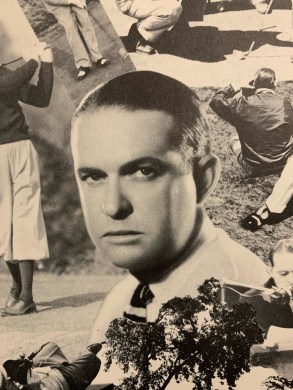
Alex Morrison

During the late-1930s, while working at Hershey Country Club in Hershey, Pennsylvania, my father’s aptitude for playing and teaching the game improved as did his status on the PGA Tour. Certainly, his day-to-day association with Henry Picard helped him immeasurably in this regard. For sure, the two men spent countless hours together on the practice tee.

It was during those practice sessions that my father, for the first time in an intensive way, was exposed to the philosophy of another great student of the swing. Picard began passing along “secrets” shared with him by one of the most respected golf theorists of the day, Alex J. Morrison. Picard had been under the aegis of the West Coast swing doctor since the summer of 1935.

Alex Morrison

Morrison felt that golf was 90% mental, 8% physical, and 2% mechanical. By the 1920’s, he had become a noted teacher and exhibition golfer traveling the vaudeville circuit. Stage entertainment was the perfect fit for a man who favored multi-patterned sweaters, bright argyle socks and had the nervy showmanship to smash golf balls off a man’s head. Still, Morrison was a serious instructor, who prided himself on using “impersonal, scientific” principles and state-of-the-art films of famous golfers to demonstrate technique. Morrison was the first person to make extensive use of a high-speed camera to film the golf swing. At his Southern California base of operations on Catalina Island, his clientele included Charley Chaplin and Douglas Fairbanks – Bob Hope and Bing Crosby frequented his driving range in New York City. Morrison authored two books on golf instruction; A New Way to Better Golf by William Heinemann LTD London, England and “Better Golf without Practice” by Alex J. Morrison Simon and Schuster New York * 1940.

While doing extensive research for my book “Jack Grout: A Legacy in Golf,” I was fortunate to receive the following information about Alex Morrison on Wednesday, June 10, 2009 from Adrian Whited, Club Historian at Los Angeles Country Club:

  • I was privileged to meet and have a four-hour recorded conversation with him (Alex Morrison) shortly before he died September 25, 1986 at age 90.
  • In 1908, at age 12 or so, he started caddying at The Los Angeles C.C., when the Club was located at Pico and Western. In 1910, he was still caddying and going to school (Manual Arts High School).
  • In 1911, the Club relocated to our present location where Alex continued to caddie for a time. He did assist the golf professional by cleaning clubs, oiling shafts, etc.
  • As far as I know, Alex was never a Club employee. He was a friend of many members and was a guest at the Club whenever he was in the area.
  • One story Alex told me was when the Club leaders asked him to hit shots to help locate some holes, and to help verify the playability when the course was redesigned in 1920. They called him “Slats” (very thin) and fellows would say “Hit it Slats, see if you can reach it” etc…
  • In the 1920’s, he had become a noted teacher and exhibition golfer traveling the vaudeville circuit. He told me his brother George was a better golfer.
  • Alex also wrote several books (the last in the early 40’s) and was the first to use a high-speed camera to film the golf swing (on Catalina Island). He was friends with and taught many movie people. In fact, he was still teaching Claude Aikens when we met in 1986. I met Aikens later and he spoke very highly of Alex.
  • Morrison told me that Henry Picard started taking lessons from him in 1935 or so, and Alex continued to be his mentor for several years. I have read where Picard gave Alex much credit for the resurgence in his career and resulting large number of wins; including The Masters, in the late 1930’s.
  • I understand your father learned from and was influenced by Picard. And, I know that your father taught Jack Nicklaus. From reading and observing, it appears Nicklaus flattened his swing (1980) towards the end of his tour career which is part of what Morrison had taught.

Regards,

Adrian Whited

Happy New Year!!!

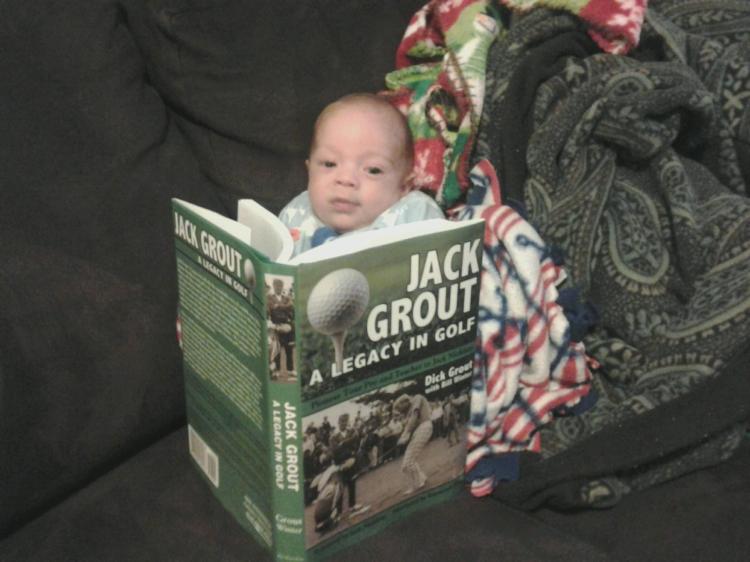
nolan reading jg

Here’s wishing you and your’s the happiest and most productive New Year in 2013!

For the Grout family, 2012 was “a banner year” with the birth of our precious grandson Nolan Michael White on August 26 and the October publication of my book about Jack Grout, our beloved patriarch.

P.S. Please remember to check out Vintage Photos and PGA Tour Chronicle for updated content on GroutGolf.com

The Transition

The first time I heard anyone say the word transition was during a golf lesson I had with my father when I was about ten years-old. As I remember it, dad was demonstrating the various ways in which to grip the club and explaining their advantages and disadvantages; when he used that term to highlight the fact that once I became a little bigger and stronger my current method of gripping the club would transition from interlock to overlap.

Over the next several years, I got really comfortable with that interlocking grip and during that time my golf game had progressed rather nicely. So, on that fateful day when dad made it clear that he was going to modify my grip, I can honestly say that I was not in favor of any stupid transition.

Nonetheless, by the age of thirteen my hands had gotten stronger and according to dad the moment was at hand. My teacher had me place the little finger on my right hand on top of the forefinger of my left hand. Then, he stepped back and told me to “let her go.”

I wish I could tell you that with one swing I felt the magic. Well, I can’t. That would be a lie. But, I can tell you that with one swing I felt the shank. I actually shanked about twenty in a row! I shanked so many that it became almost impossible to see the ball through all the tears pouring from my eyes. In my utter despair, I accused my father of purposely and intentionally trying to ruin my game. And, I meant it!

Looking back, I’m sure that dad felt bad, too. He knew how serious I had become about golf. After a slight chuckle, he said, “No Dickie, I’m not trying to ruin your game. I’d never do anything like that. Let’s just keep going with this new grip and things will get a lot better. I just know they will.” My father was right, things did get better. Before long, the shanking stopped and my tears disappeared. I’m happy to report that ever since that day, I have used the overlap grip. And, the dreaded transition is now a fond memory.

Playing with Hickory

Beginning in the 1860s, golf club manufacturers in Great Britain began importing hickory from the United States, making it the standard material for shafts. Expert clubmakers found American hickory to be light in actual weight and supple. Yet it wasn’t wobbly and it had a fine steely spring without being too stiff.

My uncle Dick Grout (1903-1982) said, “The hickory shaft was a great-feeling club to hit. You know, I would buy hickory shafts by the gross and then I’d have first pick of them. Out of the crate there were probably a dozen or so that were really top-notch. I first learned how to test them from my mentor Sandy Baxter. He showed me how to spot the right spring, the right flex. After a while I could tell what shafts had the proper yield just by handling them. When I found a grade-A, it would be marked and carefully laid aside.”

Uncle Dick continued, “The truth was, I couldn’t make hickory shafts with the different flexes that are found in steel – nobody could. To get a really stiff hickory shaft you’d have to leave it as thick as a post. If you took it down as slim as you dare, then you’d better have a grade-A piece of hickory in order for it to withstand the shock of impact. In the hands of an expert some of those hickories would last for years. It was something.”

“Of course, it was the amateur who allowed the professional to make a fine living repairing and replacing those shafts.” Grout explained, “After a busy weekend, we’d always seem to have a lot of broken shafts. So, it was on Monday morning when I did the majority of the club repairs for my membership. Most of them were broken accidentally by the mediocre golfer, but some were shattered in a fit of rage. My assistant and I, who sometimes was my brother Jack, would spend all Monday replacing shafts. It was tough work, but the shafts cost me fifty cents and I’d charge $3, so that was a tidy profit in those days.”

Hickory shafts, while generally durable, were still prone to breakage, particularly over time. And, by the mid-1930s, the added resiliency and increased consistency of steel spelled the end of hickory shafts; which, ultimately closed the doors of a veritable gold mine in repairs for the club pro.

A Little Boy Discovers Golf

From 1961-1974, my father Jack Grout was the head golf professional at La Gorce Country Club which sits smack dab in the middle of Miami Beach. Occasionally, when his work schedule permitted he would saunter over to poolside and watch my younger sister Debbie and I splash around in the water, and whenever he did that he could always get our immediate attention by giving us that distinct whistle of his. In short order, the two of us would look up, see him, then excitedly exit the water and hurry to his side.

Once, while I was standing next to him I caught a glimpse of a huge circular, red and black sphere that was in the distance. At that point, not knowing what it was, I asked dad if the strange thing was some kind of target meant for bows and arrows. I remember he looked at me kind of funny. Then, he told me to change out of my wet swimming suit so he could give me a closer look. After the two of us walked around the side of the clubhouse, we proceeded down to the club’s golf practice area, and it was then and there that the proverbial “light” came on for me. The oversized target was definitely not an aiming point for archery; it was a target meant for the many golfers who were out there trying to improve their games. Much later on I realized the real purpose behind my visit to the practice tee, and I can tell you that it involved a lot more than just seeing the target. Actually, my father’s true intention was to give me my first glimpse into his world.

When my dad took me to see that big bulls-eye positioned at the far end of the driving range at La Gorce Country Club, I got to see the same wonderful sight he first had encountered in Oklahoma City forty-four summers earlier, a sight that led to his lifetime love affair with the game of golf. Getting my first peek at the “greatest game ever” was something I never forgot. It actually resulted in me following in my dad’s footsteps and becoming a playing professional and member of the PGA of America, just like him. Golf has truly been a major part of my life, as it was of his.

Why Junior isn’t getting any Better

1. Lack of focus:

Juniors are easily distracted by what’s going on around them. They get sidetracked by noises, their playing partners and the opposite sex. Very few of them know what they should focus on.

For them, developing a consistent, effective pre-shot routine is vital. Young golfers must be aware of how their ball is laying, their target, which club to use, and what type of shot they are going to play.

2. Lack of confidence and having a poor attitude:

A general fault among junior golfers has to do with being too hard on themselves. They have a tendency to live and die with every shot. If a good shot is played then, things are fine. However, if they hit a poor shot they tend to feel horrible. It’s difficult for them to bounce back for the next shot.

Young golfers must learn that their mental attitude needs to be as good as their physical skills. They must develop a mental toughness and be able to remain positive even after a poor shot.

3. Poor Practice Habits:

Juniors tend to mess around and just go through the motions when hitting balls. They don’t focus and don’t have a plan. Juniors need to know in advance what they are going to practice with the help of their instructor.

When a young golfer learns how to practice and thus, not waste time they will begin to make strides toward improvement.

4. Being overly conscious of the score:

Juniors tend to get ahead of themselves and forget to focus on the shot that is right in front of them.

Golf involves two steps: process and outcome. Young golfers need to be reminded that how they swing the club will result in a certain outcome of shot. Basically this is a cause and effect. If their only focus is the outcome of the shot they will forget to focus on the best process to achieve better results.

5. Not using enough club and swinging too hard:

Juniors routinely under-club: Sure, they might be able to hit that 9-iron 140 yards… when they swing hard from a perfect lie and catch it right in the sweet spot.

Take out a little more club and swing at 85%, they’ll make more consistent impact on the ball and find their shots becoming more consistent.

6. Automatically shooting at the flag and not playing away from trouble:

Most times, the flag is not the smartest play… For juniors, the center of the green is a higher percentage shot: Because from there, at least they’re putting instead of chipping from an uncertain lie.

Sometimes, shooting at the green isn’t a good idea at all! If they would learn to play away from trouble, it could take 10 strokes off their score today.

7. Trying for too much out of trouble:

Often, juniors find it difficult to regulate their natural bravado and shoot the ball sideways back into the fairway … but if they’d give it a try for a round it would do wonders to their score!

When trouble is looming just take out a short club, or hit a safety shot. Sure, it might be an assured way to get a bogey instead of a lucky birdie/par… but it’s also an assured way to get a bogey instead of an unlucky triple/quadruple.

8. Attempting to hit shots that they’ve never practiced:

Juniors need to pay strict attention and observe what’s going on around them. They must learn to judge when their ball is laying poorly. Misreading turf and lie conditions is an easy way to mis-hit shots.

Also, practice it first! A young golfer needs to hit flop shots and sand shots for hours and hours or else they should expect to blade a lot of balls over the green!

9. Not spending enough time working on putting and the little “scoring” shots around the greens:

Young golfers underestimate the importance of learning to properly read the greens. They tend to under-read the break on the greens and their ball will slide beneath the hole on a putt with any significant break.

Without a doubt, improving their short game is the quickest and easiest way to cut strokes from their game. It’s the area where a junior can turn three shots into two. For any young golfer, it’s the key to being a better player.

10. Playing “outside” their comfort zone and not being “tournament ready:”

Sometimes this mistake is made by overzealous parents who want their child to play in a tournament when the junior really isn’t ready and, they don’t know how to properly prepare for a tournament.

Junior golfers can and will enjoy competition when they ready themselves by playing practice rounds and by having a pre-round routine: Because, like the old sage said, “You fool no one when you overestimate your abilities, least of all yourself.”

Use Your Head & Play Smart Golf

  • Identify your own strengths and weaknesses
  • Be realistic about your skill level…don’t play with the idea of hitting shots that you HOPE to pull off
  • Avoid low percentage shots. Never attempt a shot that you have not practiced
  • PAR is the number of strokes taken on a hole by an expert golfer! Are you an expert? If not, play for bogey and be pleased when you make a better score
  • Develop your own pre-shot routine and stick with it
  • Change your concept of keeping score. Don’t always fixate on the gross score; instead focus on your GIR (greens in regulation) and FIR (fairways in regulation), and the number of putts you take and how often you get the ball up and down from around the greens
  • Stay focused. You only need to concentrate during the 20 – 45 seconds when it is your turn to play
  • Develop some confidence by thinking and saying positive things
  • Learn to relax because tension absolutely destroys the golf swing

First tee jitters:

  • Always arrive at the tee after hitting some balls at the practice area or, at least, after doing some stretching exercises
  • Take some deep breaths; then, slowly exhale
  • Always take a practice swing…make it a dress rehearsal of your actual swing
  • Leave the driver in the bag. Use your 3 wood for the first few holes until you develop some rhythm and confidence

Tee Shots on Par 4’s and Par 5’s:

  • The goal should be to keep that ball in the fairway
  • Divide the landing area into a 3 lane highway…eliminate the lane on the side of trouble and aim at the other two lanes
  • Always tee up your shot on the side of trouble
  • Good golfers stare at the target and glance at the ball; while, poor golfers glance at the target and stare at the ball
  • Don’t try to hit the ball 300 yards. Remember the woods are full of long hitters!

Approach shots to greens:

  • From 100 yards or more…always aim at the center of the green
  • Most greens are 3 clubs in depth…always use enough club to get to the center of the green
  • Make your club selection once you have a clear mental image of the shot and after you’re sure of the proper distance
  • Be content with any shot that comes to rest on or near the putting surface

Par 3’s:

  • Pay close attention to the wind…it can make a 2 or 3 club difference
  • Aim your shot at the center of the green
  • Most of your misses are going to be short and right of the green

In Trouble:

  • Your first and only thought should be…to get the ball back in play in the fewest amount of strokes

Putting:

  • A 3-putt is worse than missing the ball…Learn to detest a 3-putt
  • Develop your own putting routine and use it
  • Remember that there are only two issues involved; Distance and Direction.
  • Putting is the most individualistic part of golf. Putting is not a science…Be an athlete, not a robot!

Characteristics of Great Putters:

  • Weight slightly toward the hole
  • Head remains steady
  • Eyes over the ball (from the target line view)
  • Stroke is smooth…tension free
  • Light grip pressure
  • Ball position is forward in the stance

Additional Thoughts:

  • Have a Practice hat and a Practice glove…a Playing hat and a Playing glove. Don’t mix the two!
  • Play by yourself. Play a 3 ball scramble…Hit 3 shots from each location.
  • Play a few rounds from the forward tees and get use to shooting some lower scores.
  • Get comfortable playing with better golfers. It will bring out the best in you.

Yankee Doodle Dandy

As the 2012 Ryder Cup (September 28-30) draws closer at Chicago’s historic Medinah Country Club’s #3 Course, the odds-makers in Las Vegas are backing Team USA to hoist the Cup at the conclusion of play. According to the “wise guys,” the Yanks are going to squeak out a tightly contested victory. But, not so fast my friend! For my money, Europe looks like the better team and a solid play at +140.

I believe that the American squad captained by Davis Love III will once again be given its comeuppance by Jose Maria Olazabal’s team from “across the pond.” After all, Team Europe has won six of the last eight Ryder Cups and they come to the “Windy City” with a talent-laden contingent led by world No.1 Rory McIlroy. Based on Ryder Cup records alone 8 of the 12 members on the European squad have winning Ryder Cup records. And the Americans? Hard as it is to believe, the squad doesn’t have a single member with a winning Ryder Cup record.

Will playing on American soil before a rowdy, partisan gathering and having on its team the best putter in the game (Brandt Snedeker) retrieve bragging rights for the Stars and Stripes? Not bloody likely! Long known as the better team in the foursome and four-ball events because of the close, personal friendships that are paired together, the Euro side is also plenty strong for the singles matches; and that, as the British say, will tip the balance in favour of Europe come Sunday night.

Top Wildcard Pick: Nicolas Colsaerts (Belgium)

Hey, in any event, we’re only a few days from finding out.

TEAM EUROPE
Nicolas Colsaerts Luke Donald
Sergio Garcia Peter Hanson
Martin Kaymer Paul Lawrie
Graeme McDowell Rory McIlroy
Francesco Molinari Ian Poulter
Justin Rose Lee Westwood
TEAM USA
Keegan Bradley Jason Dufner
Jim Furyk Dustin Johnson
Zach Johnson Matt Kuchar
Phil Mickelson Webb Simpson
Brandt Snedeker Steve Stricker
Bubba Watson Tiger Woods

As it happened: At the start of the final day’s play, the U.S. led 10–6 and required 4.5 points to win; Europe required 8 points to retain the cup and 8.5 to win it outright. Europe achieved one of the greatest comebacks in Ryder Cup history by winning eight and tying one of the 12 singles matches. The final score was 14.5 – 13.5. It was named by European media covering the event as the “Miracle at Medinah.”

Character Building

It has been a while since my last post. Much of it was spent on putting the finishing touches to my book about the life and times of my father: Jack Grout, A Legacy In Golf.  As you might imagine, writing a book isn’t an easy thing to do. It requires hard work, extreme ambition, and intense discipline. But, nothing in life is easy and accomplishing a dream is rare—and awesome.

Now for today’s post. Whereas golf on the PGA Tour has historically been recognized as a game of single-minded individualism – an important quality in a true badass – it’s obvious that this belief in self-determination isn’t universally accepted in the modern game. Today, numerous professional players surround themselves with full-swing instructors, short-game coaches, psychologists and other specialists who form their ever-present entourages. The player is rarely alone long enough to learn self-sufficiency or to develop any real faith and trust in himself.

Dr. Richard Orlando, a Columbus, Ohio resident who took golf lessons from my father and later observed the practice routines of hundreds of touring pros as the on-site ophthalmologist for Nicklaus’ Memorial Tournament, talked skeptically of this phenomenon. “So many of the current players bring (David) Leadbetter, Rick Smith, Butch Harmon, etc., out on the range at every damn tournament. These guys can’t ever take the club back without having their ‘guru’ with them.”

In the heat of battle, a successful golfer must be able to self-diagnose and self-correct. Occasionally, great “old school” players like Nicklaus, Hogan and Snead have prevailed without firing on all cylinders. At times, these guys emerged victorious even when things had gotten downright ugly. They were able to do so because they learned their game and were able to control what they were doing.

When Jack Grout began teaching the game to Jack Nicklaus, he instilled in his young protege the importance of understanding why he was doing something on the golf course. My father insisted that Nicklaus learn to use his head, not just his golf swing. And, by the age of nineteen when Jack went out to play golf, he didn’t have to keep running back to his coach for answers. Grout taught Nicklaus the nuts and bolts of being independent. My father held the conviction that a little self-reliance never hurt anyone.

In 2017 Jack Nicklaus wrote; “I could go on and on about the different lessons Jack taught me, but his greatest was one that reminds of the great philosopher’s words, “Give a man a fish and you feed him for a day; teach a man to fish and you feed him for a lifetime.” Jack Grout knew the golf swing as well as anyone I have ever encountered. But his true genius was in knowing what was best for the individual. His greatest gift to his students was his belief in them and his ability to get them to believe in themselves. Jack wanted you to develop your skills, technically, but to be so confident of those skills that you could identify and fix your own swing flaws even in the heat of competition, and certainly without him there by your side. You always hear the word indispensable. Jack Grout’s life work, at least in my case, was to make himself dispensable. He wanted his students to be able to function at the highest level without him.”

Seven Deadly Sins

1. Not Working with an Experienced Coach. Even Jack Nicklaus needed the analytical eye of a trained professional to keep his game well honed. At the start of every season, the Golden Bear would schedule time with my father to work on the basics. He’d say, “J. Grout, teach me how to play golf.” These days, PGA Tour players have an entourage of swing coaches, mental trainers and fitness gurus – which is my subject in another blog.

2. Going to the First Tee without Warming Up – Ideally, you need at least a half hour to ready yourself both mentally and physically.

Don’t rush from the parking lot or the clubhouse, take out your glove and driver, take two swings at broken tee or a cigarette butt and say, “I’m ready, what are we playing for?”

Do some basic stretching – move your shoulders, arms, neck, the parts you expect to use in the swing

  • Place a club behind your back and underneath the arms and turn the shoulders and hips
  • Do several shallow knee bends. Pull your knees up to the chest
  • Swing Drill: step to the right with the left foot on the backswing and then step back to the left on the forward swing to activate your weight shifting & moving

3. Practicing on the range with your favorite club – instead of working on what you don’t do well. Determine your strengths and weaknesses then, work on the areas that need improvement. Everyone likes to hit their old “Billy Baroo” on the practice tee. Everyone likes to bang out drives. Few people will spend an hour chipping and putting.

It’ll Happen Every Time: The Club Championship comes rolling around. The wannabes and also-rans are out on the rock-pile pounding away at full shots while the defending champ is over at the practice green working on his short game.

4. Not Aiming – every shot you hit at some target. In the fundamental approach – The first action in aiming a shot is to place the club behind the ball with the face square to the target. The second action in aiming is to stand square to the clubface – toes, knees, hips, chest and shoulders parallel to the target line. Paralleling your body to the target line at address gives you the best chance, instinctively and consciously, of swinging the club head along it at impact.

Aligning your body: In the advanced approach – good golfers work into their setup for address from an “open” body position – they step into their stance from left to right. Place your right foot into position first, while half facing and “sighting” the target. Then, ease your left foot into position from the left of the target line.

5. Getting in your own way – on the downswing results from a poor set-up position. How would you stand if you were playing another sport that required you to move from side to side?

  • Spread your feet apart wide enough to keep your balance
  • Bend over at the hips and not at the waist
  • Slightly flex your knees with your weight more or less on the balls of your feet
  • Allow your backside to move out and up; your stomach points down
  • Your arms and hands hang down and have plenty of room to swing freely
  • The spine is straight but tilted because of the bend at the hips

6. When you consider the golf swing as a series of positions or segmented movements – when, in truth, it’s simply a SWING!  It is not a hit, although the ball gets hit. It is not a sway or a lunge, although the body weight does transfer from side to side. Instead, it is a swinging motion of the hands and arms, assisted by other body parts in a sequential continuing pattern of movement.

7. When you consider golf to be either a left-handed game or a right-handed game – when, in truth, it’s a two-handed game.

At the moment you place both hands on the club to take your grip, golf becomes a two-sided game with each side having a different function to perform.

Your left hand, arm and entire side are for direction. It keeps the club on path.

  • It Guides – Leads – and Brings the club into and through the hitting area

Your right hand, arm and entire side are for distance. It’s where you get your power.