Recently, our twelve-year-old grandson, Nolan competed in his first “major” golf tournament. He and his father, Jim traveled to Richmond, Virginia for the 12th Redmond Cup matches; a First Tee sponsored event that featured junior teams from Pennsylvania, Maryland, Washington D.C., North Carolina and South Carolina. Throughout the 2-day competition Nolan represented himself and his team like the future champion that he is. He loves the game and has a fine golf swing. As his great-grandfather would say, “he just needs to put some more meat on his bones.”
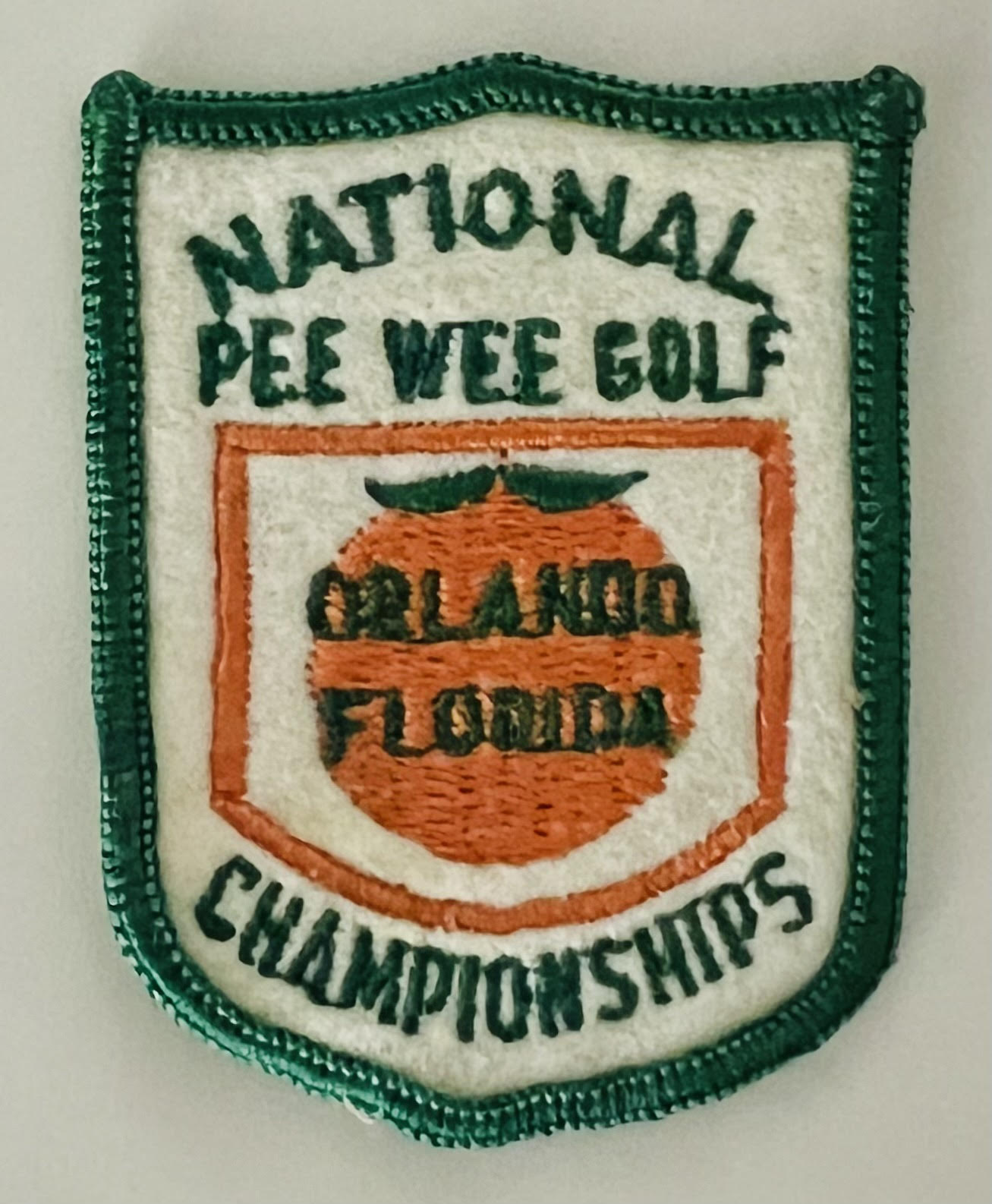
In the summer of 1965, I competed in my first “major” golf tournament. I played in the boys 10-12 division in the National Pee Wee Golf Championships at Orlando’s Rio Pinar Country Club. In those days, it was a top-tier junior event and, I remember having had to go through an 18-hole qualifying round held at Miami-Biltmore golf course in Coral Gables.
When the time came, my mother drove my sister, Debbie and I north to Orlando from our home in Miami Beach. I remember beginning my first round on the dog-leg to the right 10th hole. After hitting two good shots I used my trusty 5-iron to safely reach the green in three strokes. I must have left my 35-foot putt a bit short of the cup. After carefully lining up my putt for a par five, I missed. However, instead of tapping-in for a three-putt bogey, I unwittingly one-handed it and the ball again failed to drop in the cup! At that moment, my young brain went completely numb because I picked-up my ball and headed for my golf bag. Fortunately, the father of one of the young fellows with whom I was paired, called out rather distinctly, “Young fella, just what in the heck are you doing? Do you realize if you don’t putt out and finish the hole you’re OUT of the tournament! Disqualified! Gonzo!” Then, he told me to return to the scene of the crime and to replace my golf ball as close as possible to where it was when I initially lost my mind and picked it up. After doing what he instructed I tapped in the remaining short putt. At that point, the kind man asked me if I knew what score I had on the hole. Um, let’s see; on the green in three, three putts then the ball goes in my pocket – so that’s a one-stroke penalty, then one more putt to complete the hole. Well, that adds up to eight. Nice going buddy, your first big junior tournament had gotten off to a rather inauspicious start. The next day went a lot better though. No major gaffes. I remember shooting 96 – 89 for a 36-hole total score of 185 and a respectable finish.
There was another woeful incident which I remember about that tournament. It happened the very next day during the final round. On the last hole, my second shot finished to the left of the 18th green. I had a short pitch for my third shot. As my mother was sitting in a golf cart a short distance away, I shanked my shot and it hit one of the many pine trees at Rio Pinar. Mom said: “Dickie, I think you hit every tree on the course!” Knowing my dear mother, her comment was made mostly out of shear amazement and not out of meanness. Now, if my father had been standing there and uttered those same words, the old pro would have been ‘sticking it to me’ in hopes of me never doing that sort of thing again!
The game of golf presents many unique challenges for all of us. In the final/last analysis, of the greatest gifts junior golf gives parents isn’t a college scholarship or a tournament trophy, it’s time together.
Fred Scobie Ridley (born August 16, 1952) in Lakeland, Florida is an American amateur golfer and golf administrator who won the U.S.G.A. Amateur Championship in 1975, was elected president of the United States Golf Association (USGA) in 2004, and then became chairman of Augusta National Golf Club in 2017.
Ridley was introduced to golf by his father, Claude, a citrus grower and later assistant superintendent of schools in Polk County. Claude once recalled to a reporter “sawing off some clubs so [Fred] could knock the ball around a little when he was very tiny.” He played in his first junior tournament when he was 14. Ridley spent his early years learning the game from Jamie Jackson, the head pro at Lone Palm in Lakeland, and later he worked with PGA professionals Mike Killian and his mentor, Irv Schloss.
Fred Ridley developed into a talented golfer and played his college golf at University of Florida, where he was an alternate on the 1973 national championship-winning team. He graduated from the University of Florida’s College of Business Administration with a bachelor’s degree in marketing in 1974. He went on to earn a Juris Doctor degree from Stetson University College of Law in 1977.
“Fred was a good player in college, but not a solid player. We used to fight it out for the seventh and eighth spot on the team,” says former Gator teammate Steve Smyers. But it was a nonchalant comment Ridley heard from another of his teammates at Florida his senior year, Brad Baldwin, that would soon turn his golf game around and alter the course of his life. A friend’s simple suggestion led him to Grout.
“He had taken lessons from Jack Grout,” Ridley said. “Brad and I were going to Pinehurst for the North and South Amateur in 1974 and he said, almost flippantly, ‘I’m going to call Jack Grout and see if he’ll give us a lesson and tune us up for the North and South.'”
Ridley was stunned that his teammate could just ring up such a famous teacher, but they headed south to La Gorce Country Club in Miami Beach, Florida.
“I took two days of lessons and thought, ‘Golly, I’ve never hit it this good,'” Ridley said. Lessons from Jack Grout helped Ridley become a better driver. “I had a good short game, and the thing he did was he made me a good driver of the ball,” Ridley said. “That was always my Achilles’ heel.”
“I won two or three matches at the North and South, beat Jay Sigel (who achieved one of the more illustrious careers in the history of U.S. amateur golf), and then that summer (1975) I qualified for the U.S. Amateur.”
Ridley started law school and said his father allowed him to take the following summer off to play golf.
“That was going to be my last fling,” Ridley said. “I spent a lot of time with him (Grout) that summer at Muirfield Village Golf Club. He continued, “To be at one of the world’s great facilities with one of the best golf instructors of all times was like dying and going to golfer’s heaven … and then I won the U.S. Amateur at the end of the summer. Those other gentlemen (teachers) were great, but Jack Grout really took my game to another level.”
At the 1975 U.S. Amateur championship played at the Country Club of Virginia (James River Course) in Richmond, second-year law student Fred Ridley, played the best golf of his life. On his way to the matchplay title, he defeated the far-more heralded players and future PGA Tour winners Curtis Strange, Andy Bean and, in the final, Keith Fergus. The key to his victory was Ridley’s work with Jack Nicklaus’ lifetime teacher, Jack Grout.
Steve Smyers, who later became a member of American Society of Golf Course Architects (ASGA), and roomed with Ridley during the early stage of the amateur championship said, “We played all three practice rounds together. He was following what Jack Grout was telling him, and you could just see him hitting these great golf shots, and his game had improved dramatically. Grout had been training him to hit it hard, telling him to take a bucket of balls on the range and hit driver as hard as he could while still holding his finish position in balance. Everything was sequencing up right, and he was hitting this low draw that went forever, and straight. It was a magical week.”
At the end of 1975, Ridley was ranked the #2 amateur in the country by Golf Digest Magazine. In 1976 he won the Monroe Invitational in Pittsford, New York; one of the oldest amateur events in the country. Later that year, he competed in the British Open Championship at Royal Birkdale Golf Club in Southport, England. In addition, Ridley was selected as a member of the 1976 Eisenhower Trophy team which competed in Algarve, Portugal. In 1977 he played in the British Amateur Championship in Ganton, England. Later that year, he participated in the prestigious Walker Cup Matches held at Shinnecock Hills Golf Club, Southampton, New York, where he won two singles matches (both against Sandy Lyle).
Fred Ridley remains the last U.S. Amateur champion to have never turned professional. After Ridley’s time as a serious competitor came to an end he continued his dedication to the sport in other ways. He served as non-playing captain for the American sides of the 1987 Walker Cup, 1989 Walker Cup, and the 2010 Eisenhower Trophy. In 2004, Ridley was elected president of the United States Golf Association (USGA). He was awarded the PGA of America’s Distinguished Service Award in 2006. Later in his career he was inducted into the University of Florida Athletic Hall of Fame as a “Distinguished LetterWinner.”
Ridley became a member of Augusta National Golf Club in 2000. He served as the tournament’s Competition Committee chairman from 2007-17. On August 23, 2017, Augusta National announced that Ridley would succeed Billy Payne as chairman of the club. He took over that responsibility on October 16, 2017 when the club reopened for its 2017–18 season.
One of the more popular photos when Fred Ridley became the new chairman of Augusta National Golf Club is shown below. It features Ridley and Jack Nicklaus playing together in the 1976 Masters, the traditional pairing of the defending Masters champion and the current U.S. Amateur champion.
Jack Nicklaus and Fred Ridley stride down the No. 14 fairway during the 1976 Masters Tournament
Personal Life Ridley works as a commercial real estate lawyer in Tampa, Florida. He is a partner in the law firm of Foley & Lardner, and practices in the areas of commercial real estate finance and development, planned unit development, resort development, and multifamily and condominium development. He is married to the former Elizabeth (“Betsy”) Herndon, a fellow University of Florida graduate. They have three daughters and two grandchildren.
My thanks to Doug Ferguson – Golf Writer – The Associated Press for portions of this article.
Are athletes of today better than those of the past? Is Wayne Gretzky the greatest hockey player ever? Is Michael Jordan the greatest basketball player ever? Is Barry Bonds the greatest home run hitter ever?
The argument that athletes are bigger, faster, and stronger is heard frequently today and there is little doubt that this is true. It is also heard that because they are bigger, faster, and stronger – they are better – and many of the top performers in today’s sports are rated better than their predecessors. But, are they really?
One must be careful in making a judgment. Various sports require different skills, conform to different rules, and are played in different ways. In some sports, man competes against the environment on a time or distance basis. In other sports, man competes against man on an action/reaction basis and style of play becomes more important than time or distance.
BIGGER, FASTER, AND STRONGER An impressive book, The Super Athletes, written by David Willoughby and published in 1974, analyzes athletic performances in many sports and is referenced in this blog post.
Willoughby writes “… the records of modern athletes, sport, industry, and medical science combine to show that the civilized portion of the human race is bigger, stronger, and healthier in general today than ever before in history.”
All one has to do is check the height and weight statistics to see that the athletes are larger. Perhaps, the strongest argument that modern athletes are better is the continuous setting of new records in track, field, and swimming events where precise measurements of performances can be made.
In “Man Against Environment” events such as track, field, and swimming, the best technique coupled with specific athletic abilities bring about better performance. Judgment is clear on time and distance. A high jump of 8 feet is better than a jump of 7 feet 11 inches. Running one hundred meters in 10 seconds is better than running it in 10.2 seconds.
As time passes and people get bigger, faster, and stronger and utilize better techniques, athletic performances improve. Times get lower and distances farther. So, do the athletes get better over the years in these sports? It certainly appears that they do.
Yet, even in these “Man Against Environment” sports, there are rules changes and innovations which assist the athlete in his battle against the physical world – starting blocks, fiberglass poles, corked tracks and springy boards for launching broad jumps, etc. So, factors other than pure athletic ability creep into the picture and complicate the task of comparing athletes.
GENERALIZATION A potential error in judgment may occur. A generalization might take place – since athletes perform better than they used to in “Man Against Environment” sports (i.e. the 2024 Olympic shot put record of 77 feet is a definite improvement over the 1968 Olympic shot put record of 67 feet), they perform better in all sports.
MAN AGAINST MAN In “Man Against Man” sports or “Team Against Team” sports (which ultimately boil down to “Man Against Man”), performance is based upon a reaction by one competitor to an action by the other competitor (and not simply a case of running fast or throwing an object a great distance). Speed, power, and quickness offer advantages but often are not as important as “savvy”, anticipation, and the correct action/reaction.
STYLE In “Man Against Environment” sports, a change in technique can be an improvement in that it enables an athlete to do better in his quest for a faster time or greater distance. In “Man Against Man” sports, technique also can improve performance and is very closely related to the “style” of play. Depending upon the sport, style can be a dominant factor. It often offsets “bigger, faster, and stronger”.
As difficult as it is to compare athletic performances over the years in “Man Against Man” sports such as baseball, basketball, football, tennis and golf any comparison is confounded further by the styles used by the athlete.
As it relates to professional golfers on the PGA Tour … the matter of differing styles … makes golfers (i.e. swingers vs. hitters, etc.) so difficult to rate. Instead of more or less uniform techniques – such as apply in running, jumping, swimming, and other athletic events – that can be measured, in golf both approaches can be effective depending on the individual golfer and their swing mechanics.
SUMMARY (ATHLETES) Today, athletes are bigger, faster, and stronger but it all depends upon the sport as to whether they are truly better than those of the past. Different sports have different rules and different objectives (jump, run, throw, etc.). One example is Aaron Judge in baseball. He is the league’s heaviest outfielder. Is he better? Another example is Derrick Rose in basketball. He once ran the forty in 4.18 seconds. He is faster. Is he better? What about Bo Jackson in football? He was 6’1″ and weighed 227 pounds. As a running back, he once ran the forty in 4.18 seconds. He is bigger and faster. Is he better?
The skills needed to succeed in a given sport must be such that they enable an athlete to compete successfully against others. A man who has an abundance of a particular skill may be better than others who possess better “all-around” skills. A standout athlete in one sport may be simply average in another. And, as strange as it seems, the daily activities of a particular period in past history may have equipped individuals better for a certain type of competition than today’s activities.
My opinion is that the best athletes of all-time could compete with each other on a “near-equal” basis with slight advantages “here and there” going to certain ones who possessed “this or that” skill or attribute (depending upon the sport and how the various traits matched up). The modern athlete is not necessarily better than his predecessors. Rules of the game, mental discipline, and style affect outcomes of competition as often as size, speed, quickness, agility, strength, and stamina do.
HOW DOES THIS RELATE TO PGA TOUR PLAYERS? Golf on the PGA Tour is essentially a “Man Against Man” sport in which being bigger, faster, and stronger offers an advantage. But, style and manner of play offsets this physical edge. So, in this sport, those who combine physical advantages with good/proper technique have the upper hand.
Are today’s Tour Players the only men to possess these physical advantages or skills? No, of course not. Throughout history, there have been plenty of men with size, speed, and strength. In addition, over the years, various new styles/techniques have been developed and utilized. Without question, many exceptional professional players have appeared over the past 100 years.
Could Arnold Palmer of the 1960s compete against the Tour Players of today? “Yes” – and be better. Go back twenty or thirty years before Palmer. Could Sam Snead of the 1930s or Walter Hagen of the 1920s battle favorably with the men of the 1960s or today? Again, a resounding “yes” – and, maybe be even better!
Several recent examples of “older” Tour Players who continued to prove their merit are Phil Mickelson, Jim Furyk, Tiger Woods and Ernie Els. These players were able to stand firm against “younger” competition with their on-going physical conditioning, resourcefulness, mental discipline, and technique.
TECHNIQUE Technique is the better (or best) way of doing this or that. It came about as a way to use an individual’s particular combination of height, weight, speed, and strength in an effort to beat the physical advantage or skills of an opponent. In golf, a proper grip, good posture, a steady head, ball position, balance, a full swing arc and proper foot action are examples of technique.
Most techniques used by today’s Tour Players were well-known by the 1930s and used regularly by players since then. Little if any advantage is seen here for the modern players over their predecessors.
WEIGHTTRAINING Today, weights are utilized by PGA Tour players much more than ever in comprehensive strength training programs. A strength advantage is seen for the modern player due to more frequent time spent in the gym. But, care must be exercised to prevent the player from becoming too heavily muscled or “stiff” because limber arm and shoulder movement is a valuable asset which a player does not want to lose.
Until the later part of the 20th century, professional golfers primarily stayed in shape by playing a lot of golf itself, relying on the walking aspect of the game for exercise. There were some players who participated in the use of weights, core work and light exercises like stretching but mostly they stayed away from the gym for fear of becoming too “muscle bound.” Once again, this fact seems to indicate the strength and overall fitness advantage of the modern Tour professional.
MENTAL DISCIPLINE The society of earlier years in this nation (and most other nations) insisted upon strict adherence to its rules. This attitude prevailed in athletics as well. An athlete who was taught/coached in a certain manner to play a certain way generally followed the rules while practicing and played his round as planned.
“Absolute” insistence to follow the rules/game plan by those in-charge developed an “absolute” resolution to do so on the part of the player. This, in turn, cultivated an “absolute” will – an indomitable will – in many cases. So, it seems that an earlier time in our history produced men of a greater “will” and thus, has the advantage here.
The rather lax mental attitude of today’s society has affected its teachers/coaches and players. Some players today fail to practice effectively and abandon their game plan in the course of a round. Many times, their poor concentration/focus is apparent. Most teachers/coaches do not insist upon rigid adherence to his rules of player development. They give in to the whims of the lazy or rich or ranked Tour Player. Consequently, many players today are not as disciplined and prepared as they could/should be.
SUMMARY (PGA TOUR PLAYERS) Golf is a sport in which “bigger, faster, and stronger” provides a definite advantage but does not necessarily equate to being better. As useful as height, weight, speed and strength are, they are not as important as the correct swing action/reaction which is generally associated with style and technique.
A player needs savvy, physical conditioning, mental discipline and stamina. Today’s top players seem to have an edge in physical conditioning and a slight edge in technique. The best players of the past seem to have the advantage in mental discipline, stamina, and motivation/strong desire.
PGA Tour players who competed at the elite level 30, 50, or 80 years ago were also very good, more talented than is perceived by those seduced by the sizzle of the moment. In fact, given the equipment, course conditions, travel logistics, and relative lack of golf-specific knowledge in the roughly six-decade window of persimmon heads, steel shafts, wound balls, and other realities from 1940 to 1990, those players were tougher, better.
Finally, this post is not meant to goad the reader into arguing over things that cannot be proven. It is simply my opinion that the twelve (12) best players forty (40) years ago are tougher and thus, better than today’s twelve (12) best players. I believe, in a straight-up 10-Ryder Cup Match Series, the “old-timers” of 1981 would consistently defeat today’s younger, faster and stronger players at least 6 out-of-ten times. Could it be that the nostalgia factor has had an influence on my perception of those players being “The Best?” Believe me, it doesn’t. Well, I am rather sentimental. So, maybe it does a little bit.
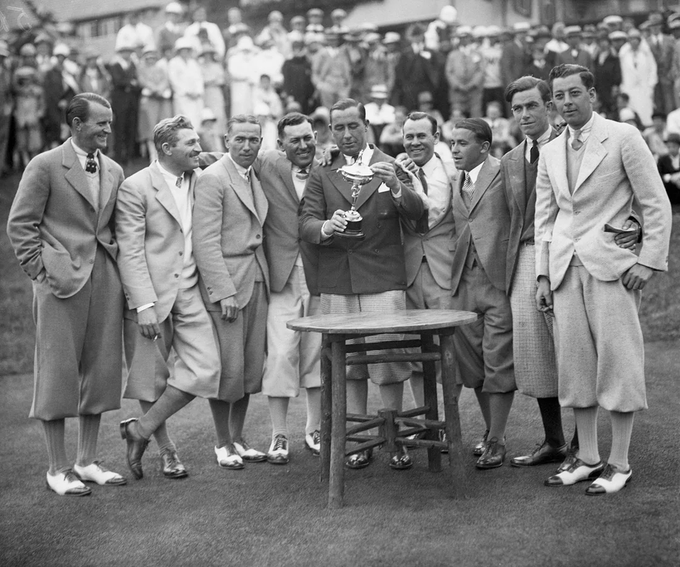
United States Ryder Cup roster1981 – The greatest United States Ryder Cup team ever assembled was in 1981 at Walton Heath Golf Club, England. Members of the team included: Jack Nicklaus, Tom Watson, Lee Trevino, Johnny Miller, Hale Irwin, Raymond Floyd, Tom Kite, Ben Crenshaw, Larry Nelson, Jerry Pate, Bill Rogers and Bruce Lietzke. Dave Marr (Captain) *Total of 49 Major Championship Victories.
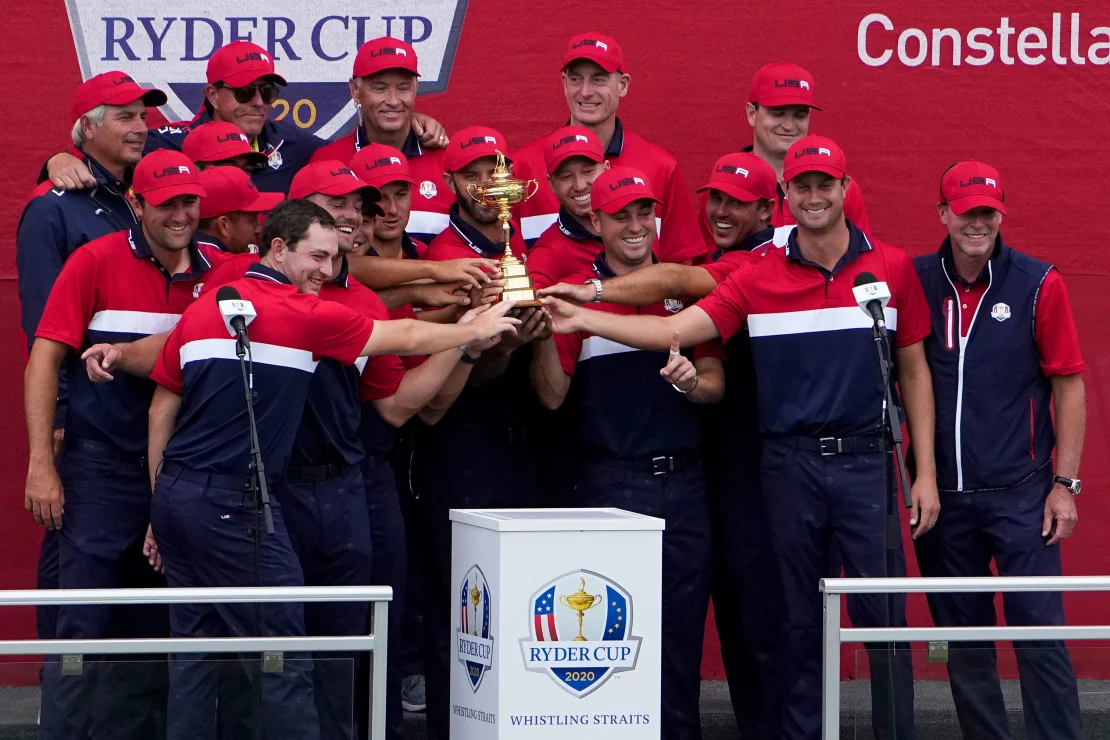
United States Ryder Cup roster 2021 – The youngest Ryder Cup Team ever assembled was in 2021 at Whistling Straits, Haven, Wisconsin. With a record (19-9) victory; this was the largest margin of victory in a Ryder Cup since 1967. Members of the team included Collin Morikawa, Dustin Johnson, Bryson DeChambeau, Brooks Koepka, Justin Thomas, Patrick Cantlay, Tony Finau, Xander Schauffele, Jordan Spieth, Harris English, Daniel Berger and Scottie Scheffler. Steve Stricker (Captain) *Total of 20 Major Championship Victories
A tune, a dialogue, and a painting from the mid-nineteenth century, the Arkansas Traveler became a catch-all phrase for almost anything or anyone from Arkansas. It has been the name of a kind of canoe, various newspapers, a racehorse, a baseball team, and a well-known American professional golfer whose career spanned over four decades – one of the longest in the history of The PGA Tour.
Ernest Joseph (E. J.) “Dutch” Harrison was born in Conway, Arkansas and nicknamed “The Arkansas Traveler.” Harrison turned professional in 1930 at the start of the Great Depression. In short, he took the plunge into the ultimate insecure job, touring professional golfer, at the precise moment when life on tour was at its toughest point. The early years of the Depression left 30 million people with no income at all. They were desperate people whose tolerance of crime was the highest in American history. It was Bonnie and Clyde time.
The tour in the 1930s was little more than an excuse to go gambling, if not on the course then in a hotel room dealing poker and rolling dice. My father, who joined the pro tour in December, 1931, laughed when he recounted a story about a craps game he was in with Dutch Harrison and some other pros. When it was ol’ Dutch’s turn for the “come out roll,” he reckoned that it would be lucky for him to back away from the others so he could heave the dice clear across the hotel room!
“It was all gambling,” said Jack Burke Jr., the 1956 Masters champion. who learned the game during the Depression from his father, a prominent Texas pro. “They had bookmakers at every tournament. They’d make more gambling with each other than there was in the purse.”
“As long as there’s been golf, there’s been gambling.
And where there is gambling, there will be hustling.”
Dutch Harrison believed the modern art of golf hustling was a product of The Great Depression. “After the stock market crash in 1929, half of the country’s 6,000 golf courses went broke,” he said. “Who’d want to become a golf pro? It was the day of the hustlers hustling the hustlers, and anyone else.”
In addition to the usual cons, down-home Harrison was known in the trade as an “oil artist.” He buttered up his opponent as a means of playing with the man’s head. “This course is built for your game, Mr. Henry – fits you perfect,” or “You’re such a great putter, Mr. Henry, I probably should concede that short putt, ’cause it’s a lead-pipe cinch you’ll make it.”
Although he was one of the better players on tour for over two decades, the mainstay of his income was the many exhibition matches and private “money” games in which he played. Adding his gambling income to his “official” prize money vaulted him into being one of the “unofficial” leading money winners in the late 1940s. Undoubtedly, Harrison won so many bets because of his gamesmanship. He would always find a way to beat you. But the stakes did not necessarily have to be high. Sam Snead recalled a day when Dutch Harrison lost a $5 bet to a player he thought was an easy mark.
“Dutch, this is really an honor,” said the man. “I’m going to frame this bill.”
Harrison grabbed it back and said, “In that case, I’ll write you a check.”
My father and Dutch Harrison were pals and occasionally they roomed together while on tour. Dad was an “Okie” from Oklahoma, born on March 24, 1910. Dutch Harrison was an “Arkie” from Arkansas, born on March 29, 1910. In my father’s instruction book, Jack Grout’s Golf Clinic, there is the story about the amateur, who had not been playing well at all in the Bing Crosby Pro-Am at Pebble Beach. Somewhere around the seventeen or maybe even the eighteenth hole he had the chance to make a long putt for the team’s best score on that hole. He nervously asked his professional partner, Dutch Harrison, what his best strategy was. Harrison’s reply was, “Try to keep it low!”
Dutch Harrison had a total of 18 career victories spanning from the 1939 Bing Crosby Pro-Am to the 1958 Tijuana Open Invitational. However, as late as 1969, Harrison had a top-25 finish in the Canadian Open at the age of 59. He played on three Ryder Cup teams: 1947, 1949, and 1951. Harrison finished nine times in the top-10 at major championships, including third place finishes at the PGA Championship in 1939 and the U.S. Open in 1960. He won the Vardon Trophy for lowest scoring average in 1954, and ranks fifth on the list of players with the most PGA Tour victories without a major championship on his resume. In 1954 Harrison became the Old Warson Country Club’s first golf professional. He died of heart failure at age 72 in 1982 in St. Louis, Missouri.
A week before final exams, during my junior year of high school, my father asked me a couple of memorable questions. In his typical nonchalant manner, he said, “Dickie, do you want to be in Golf Digest with me?” My response was a clear and unambiguous “Whaddya’ kiddin’?” Then, he asked, “Can you get out of school?” I gave him an enthusiastic, “Yes, I’m sure I can!”
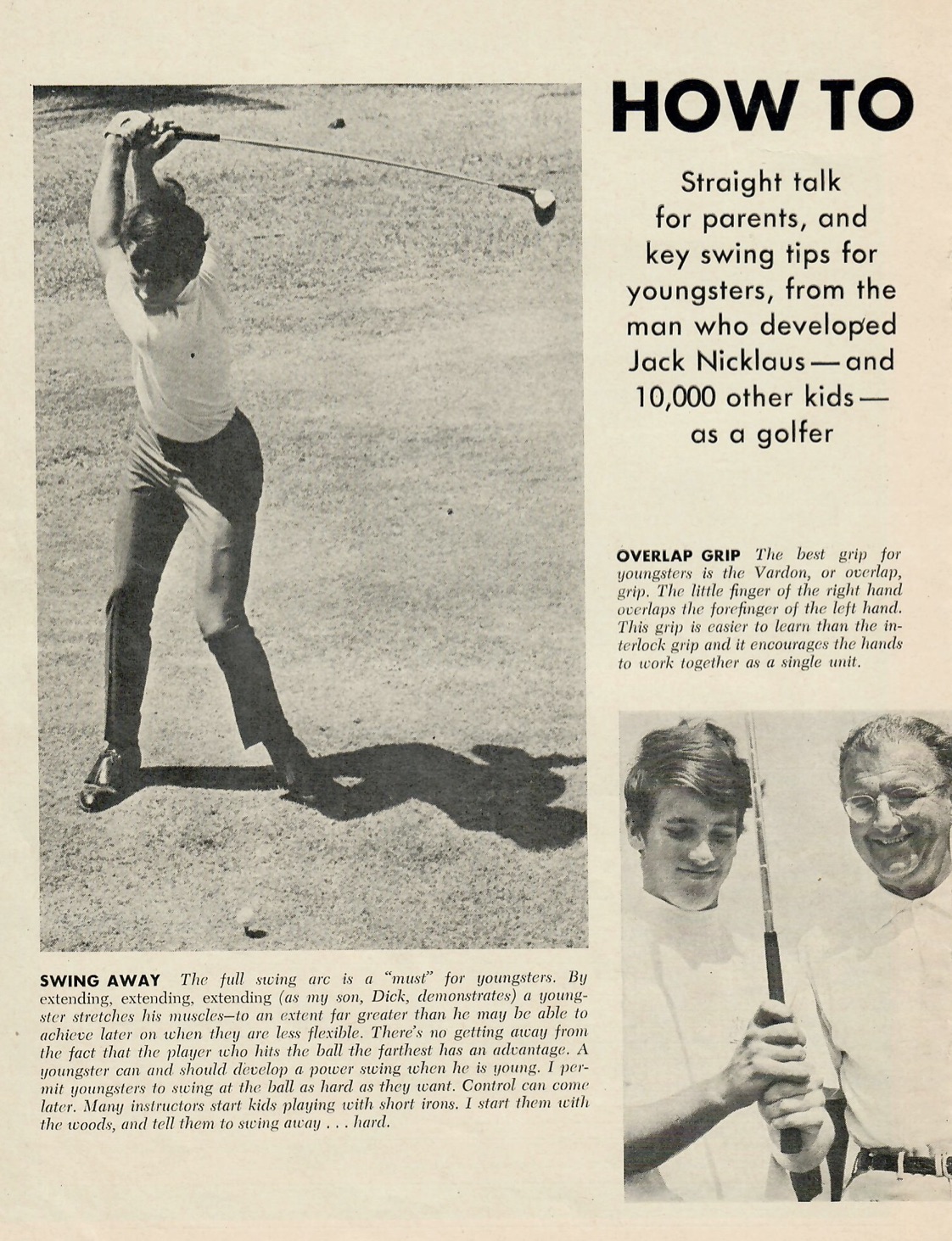
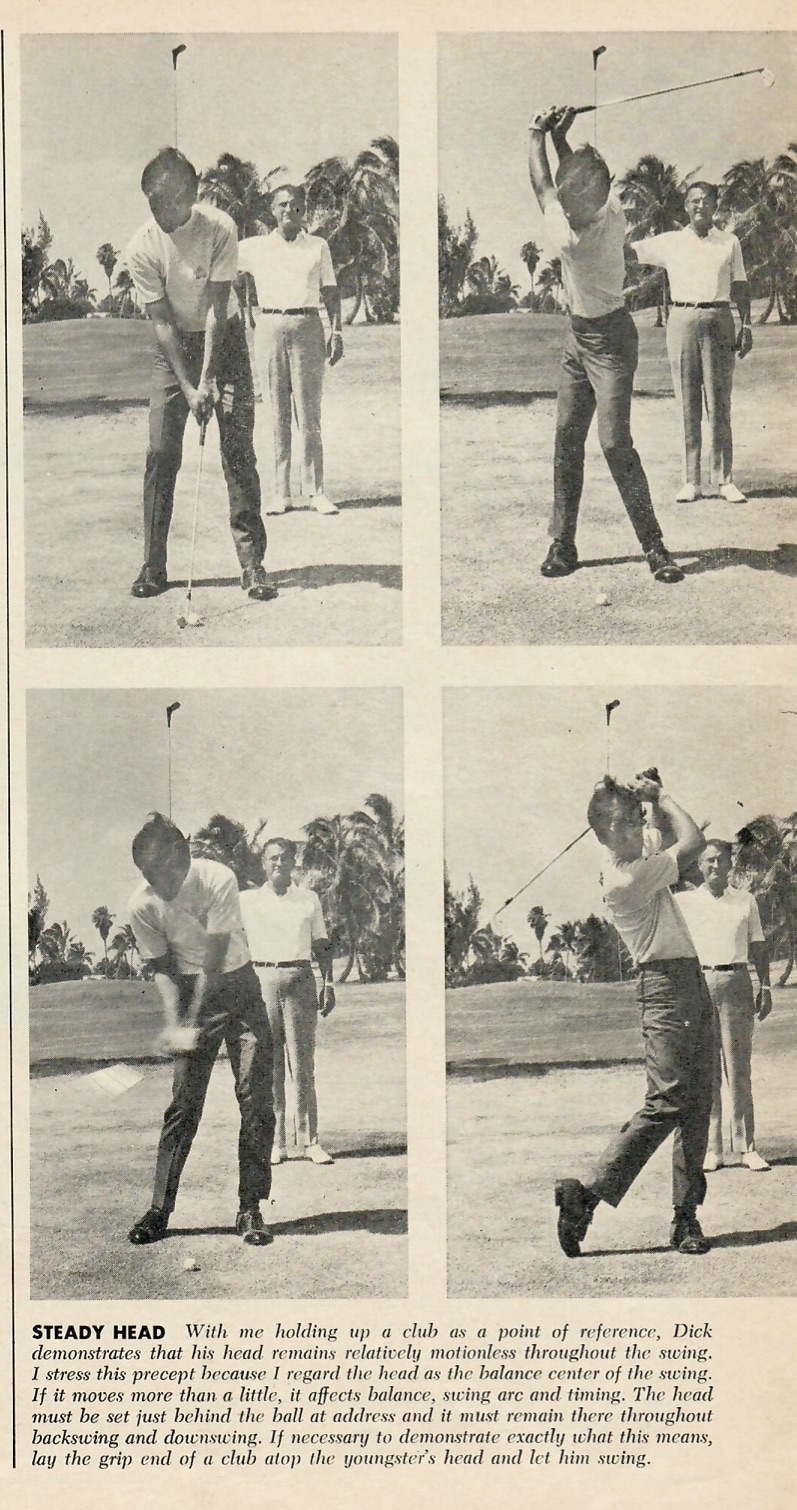
As it was, my father had already written his article on junior golf for the magazine. What he wanted from me was to be his demonstration model. The photo session was scheduled on May 14-15, 1970 at La Gorce Country Club. Dad and photographer Doug Kennedy worked together to capture the various images needed to illustrate and compliment the story. My father’s feature article along with a number of photos appeared in a four-page spread in the August 1970 issue of Golf Digest magazine.
HOW TO RAISE ANOTHER NICKLAUS
By Jack Grout
Professional, La Gorce Country Club, Miami Beach, Florida
In my 44 years as a golf professional I probably have taught more than 10,000 youngsters to play the game. Many of them have gone on to considerable success as amateur and professional golfers.
But whenever my name is mentioned in a group of golfers, someone invariably refers to me as “Jack Grout, the man who taught Jack Nicklaus.”
I appreciate the many nice things Jack Nicklaus has said about me. He still comes to me when he wants to work out a problem in his swing. Jack calls me “my only golf pro.” We had a close rapport when he was a youngster of 10 taking up golf. But his great ability was developed more through his own determination than my teaching.
For instance, I first taught Jack in the summer of 1950. He worked harder than any of the 50 or so youngsters I had in my class at Scioto Country Club in Columbus, Ohio. He was always the first there and the last to leave. One of the points I made then, and still do, was that, to be a really fine player, a golfer must be willing to practice. Significantly, when it rained at Scioto, Jack was usually the only one of my juniors who’d come out to the course.
During the past two decades I’ve also had a chance to teach golf to my own sons, so many remarks are made as much from the viewpoint of a parent as from that of a golf professional. My son, Dick, reminds me a great deal of Jack – he even started at the same age. Dick is 16 now, and he has the same attitude toward practice. He hits bucket and bucket of practice balls every day. He appears to have the desire and the determination to become a fine golfer.
Dick’s older brother, John, had a fine golf swing when he was 13 or so, but later lost interest in the game and decided not to play. I didn’t try to argue him out of that decision, and I don’t think that any parent should, in similar circumstances. But now, as an adult, John has started playing again – in fact, he’s worked down to a two handicap. This is tremendously satisfying to me as a father because, in effect, it justifies my action in exposing him as a boy to a thorough grounding in the fundamentals of golf. Once a child learns the basics of the swing (or any skill, for that matter), he’ll never forget them; he can pick up his game again and play at least decently after any period of golfing inactivity or disinterest.
The best incentive to play golf that a child can initially receive is the example of one or both of his parents actively and happily (by which I particularly mean in good temper) playing the game. Unless you spend a lot of time on a golf course, as I do, your children won’t be as naturally exposed to the golfing environment as mine were. But, with very little fuss, it’s possible to involve a child in some of your practice sessions in the backyard or at the driving range. You may even be able to have the youngster trail you for a few holes during an actual round at your course, but only let him tag along while his interest lasts – don’t try to force him into your kind of commitment to the game if his interest wanders.
Golf, to appeal to very young children, has to be fun, a game – not a “must” subject like school or homework. One excellent way of increasing a child’s interest in the sport is to take him to one of the pro tournaments. Most youngsters are thrilled to watch famous sportsmen perform, and if you are able to manage an introduction and chat with one of the players, the youngster will always remember the day. Children are great imitators, too, and will often benefit from watching the actions and absorbing the rhythm and swing tempo of the top players.
Most boys and girls are mature enough physically to start learning golf – at least in a clinic – at age 10. A child will normally take well to group instruction at this time, particularly if he already has been given a taste of the game by his parents. Individual lessons generally should wait until the child is around 14. In my experience, that’s when a youngster generally begins to have the interest and intelligence to properly assimilate detailed instruction, and also to accept the idea of meaningful practice.
Unfortunately, girls tend to give up golf at about age 14 in favor of other pursuits. It’s too bad, for girls have natural rhythm, good touch around the green and the ability to learn quickly. But even the girl who “drops out” of golf will usually have absorbed enough of the fundamentals to make it worthwhile. And very often she will decide to start playing again after she’s married or is well into a career. So don’t automatically count out your daughter as a golfer if she quits as a teenager. She’ll probably thank you for getting her started when she’s a wife and mother herself.
Ideally a child should play with equipment fully-suited to his size and swing. Adult-size clubs, whether “cut down” or not, can produce bad swing habits if youngsters find them too heavy to control and tiring to go on swinging. My son, Dick, started with regular junior clubs, then shifted to using his mother’s (ladies’) clubs when he grew a little older and stronger. Finally, he started using men’s clubs. This is a natural progression for any boy who plays the game regularly.
A sound group-instruction program will, in the course of a summer, firmly implant the fundamentals of golf in a child. It also should be so structured as to give the youngster his first taste of golf competition – showing him the point and purpose of what he’s learning. Thereafter, he’ll probably prefer playing with golfers in his own age group, rather than with his parents, and that’s fine. It’s in actual competition that the junior golfer will quickly learn to play all the shots he didn’t learn on the practice tee.
Parents still have a role to play, though. They must constantly help and encourage the child by setting realistic scoring goals, and in developing a healthy attitude to competition. For instance, as a parent I am always watching for suitable junior competitions in our area in which to enter my son. Young golfers today are lucky in that there are numerous opportunities to compete in club programs, municipal tournaments and the like.
Attempting to do well in a tournament can be a realistic goal, but I believe that it is more important for the parent to help the child set goals that are not directly related to competition. Rather than having a child aim towards winning a certain event, for instance, it is better to encourage him to keep track of his scores. A realistic goal would be for him to make his scores for every two-week period, taken as a total, better than for the same number of rounds in the previous period.
In practice, too, the child should be urged to set goals. For example, he could work with his driver until he is able to put the ball within a designated area half of the time, or chip until half of his shots end up within three feet of the pin.
The photos accompanying this article show my son Dick illustrating the swing fundamentals I would stress in teaching all junior golfers. These are basically the key points I have concentrated on ever since starting to teach golf. The only change I’ve made in my teaching program over the years has been the emphasis I now place on the short game. I believe strongly in the value of practicing all possible shots required from 50 yards and on in – pitches over bunkers, chips from rough, lag putts, and all the rest. Even today I see pros on tour with beautiful swings who, after getting close to the green, can’t get the ball “up and down.” I’d recommend intense short-game practice to any youngster who wants not only to swing well, but also to score low.
May 15, 1970, Father & Son alongside the putting green at La Gorce Country Club
The 68th Amateur Championship of the United States Golf Association was held at Scioto Country Club in Columbus, Ohio. The tournament was won by Bruce Fleischer with an even-par total of 284 on the famous Donald Ross design. There was only one sub-par round that week and it came on the final day when then University of Virginia law student Marvin “Vinnie” Giles III shot an incredible closing 65 and set a course record but came up a shot short of Fleisher.
One of the most memorable aspects of that championship was the unusual number of young golfers – virtually all collegians – in the field who went on to become well-known regulars on the PGA Tour. Besides Fleisher, there was Tom Watson, Hubert Green, Lanny Wadkins, Andy North, Doug Tewell, Leonard Thompson, Rod Curl, Barry Jaeckel and Jim Simon.
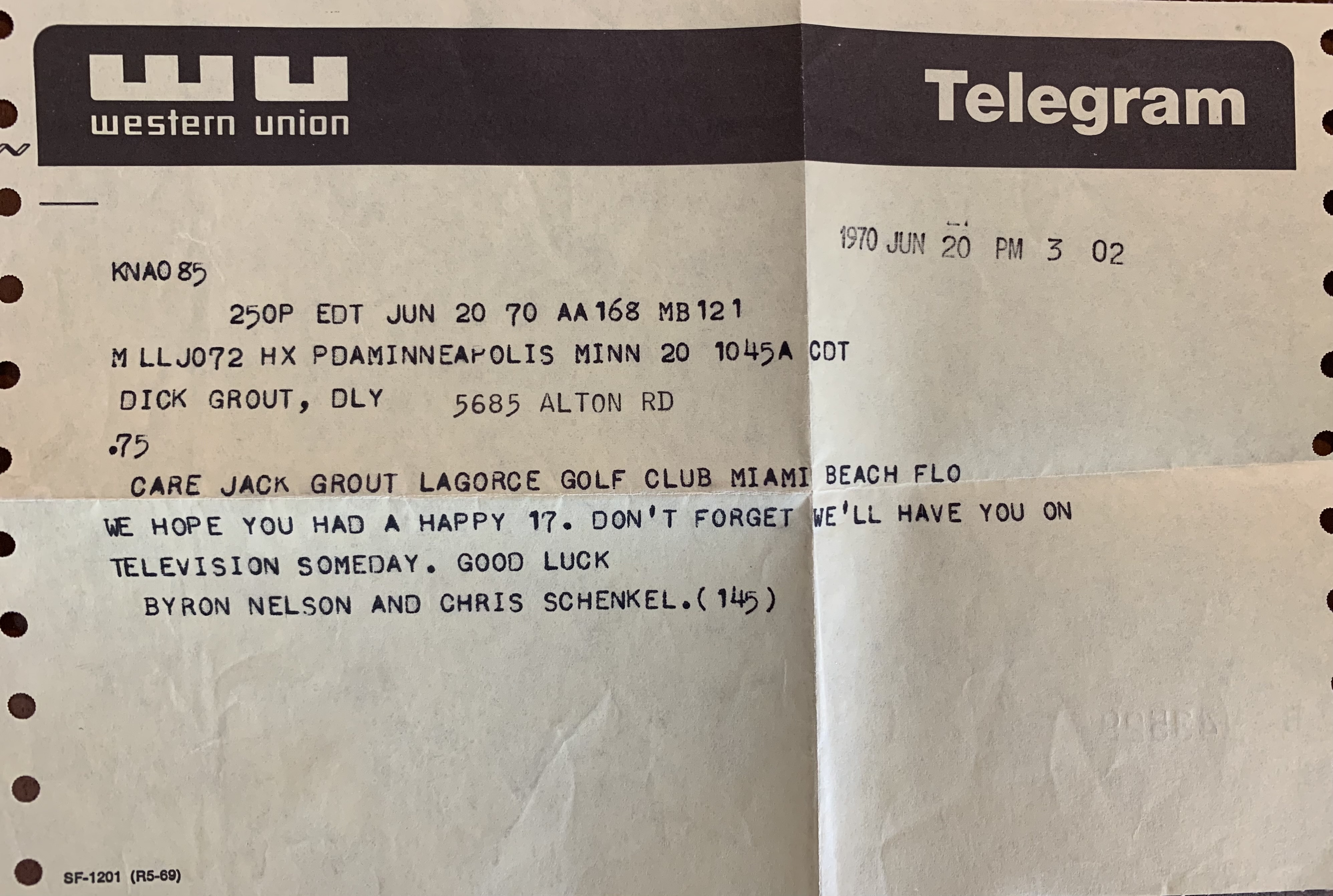
My father and I were at Scioto for the 1968 U.S. Amateur. One morning after arriving at the club and before we went our separate way, Dad told me to meet him at the practice area at 4:00 p.m. He said, “we’ll hit some balls.” Later that afternoon, while I was in the midst of hitting a few warm up shots, he approached the tee. But, Dad was not alone. Walking alongside him was his longtime companion Byron Nelson and legendary sportscaster Chris Schenkel.
My father introduced me to his famous friends and then mentioned that they had come to watch me swing a bit. As I remember it, Chris Schenkel appeared as the consummate gentleman; very pleasant but he did not say much. By contrast, Byron Nelson was in his element and ready and willing to give counsel. First, he told me to relax and just swing the club like I always did. Then, as I was about to hit another shot, he moved in close enough to actually step-on the head of my club. At that point, Mr. Nelson’s instruction was pretty simple. He said, “Even though my foot is on the club, I want you to go ahead and make a swing.” With obvious restrictions, I moved as far as I could into my limited backswing. Then, he lifted his foot off the club head and, in an instant, the club rebounded its way to the top of my backswing.
Byron Nelson’s lesson that day dealt with the importance of everything moving together during the takeaway. Evidently, by using primarily my hands and arms to move the club away from the ball, I had gotten too far or too deep into my backswing without shifting my weight and turning my hips and shoulders. For future practice sessions, Mr. Nelson advised me to purposely keep the club head on the ground a little longer as I hit balls. Though still in my mid-teens, I knew what he meant because that was how my father taught. Both of them favored a teaching technique that involved getting people to do something by prompting them to do the opposite.
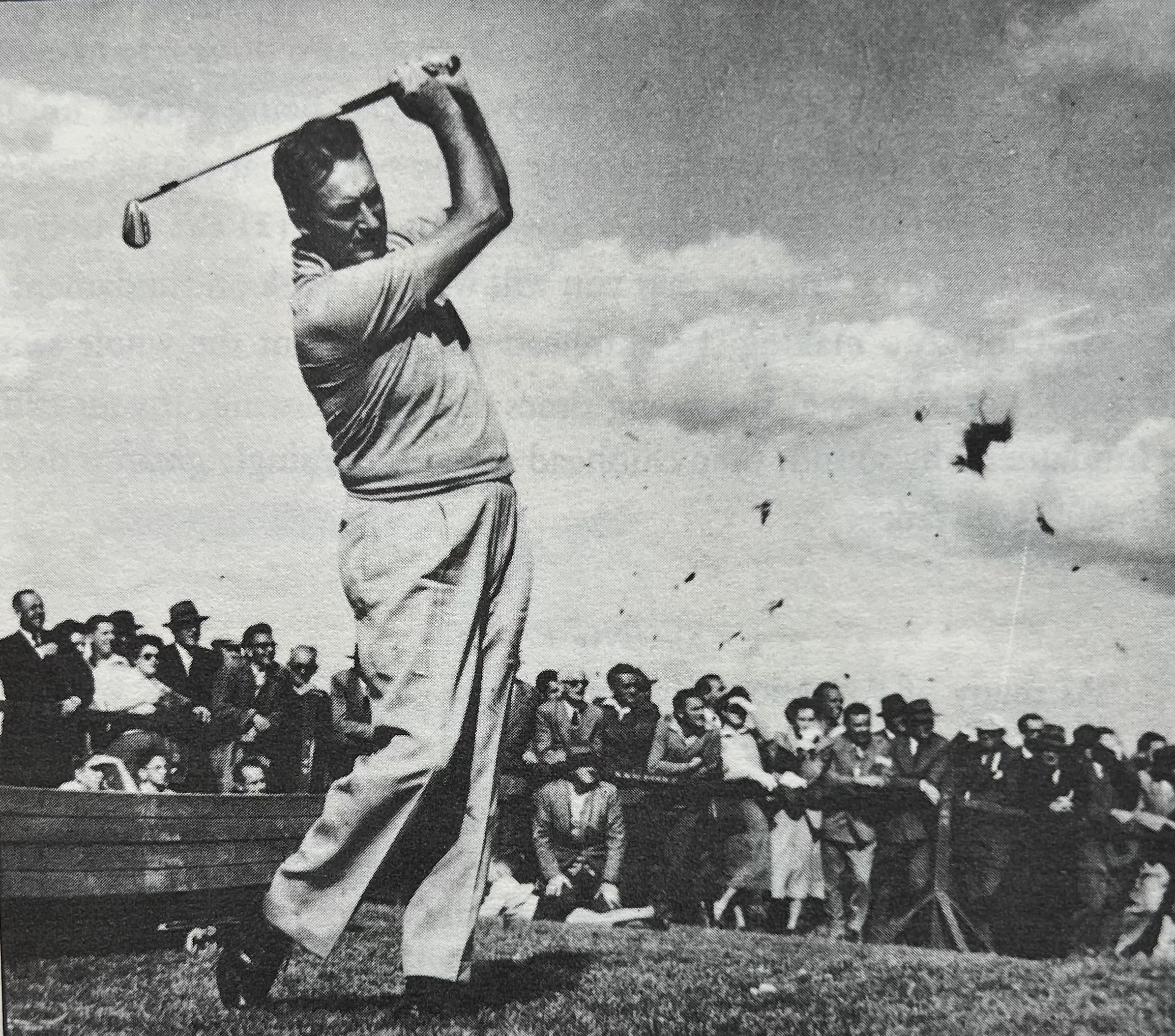
During those halcyon days in 1940s, when Nelson was winning a record number of tournaments on the early PGA Tour, his backswing started off with a choreographed movement of his right foot. His right knee moved slightly forward which would roll his right ankle inward and imperceptibly pull his right heel off the ground. From there he would plant his right heel down as his club, arms and body moved together away from the ball. For Nelson, these initial swing movements acted as a trigger to relax his muscles which gave him the great rhythm, tempo and timing that he always seemed to have.
Through the years my dear father was responsible for introducing me to a great many wonderful people. Which I am most grateful. Both Byron Nelson and Chris Schenkel were indeed world-class gentlemen. I know that the instruction given to me that day by Byron Nelson helped my golf game. His interest in me added to my love and respect for the game. Mr. Nelson made himself available on a number of occasions and he offered valuable information to my book Jack Grout, A Legacy In Golf. I am happy to say that I was fortunate to remain in contact with him until the time of his death on September 26, 2006.
Byron Nelson and his ABC broadcast partner Chris Schenkel at the British Open Golf Championship, Carnoustie Golf Links in Angus, Scotland (Photo is dated 06-18-1968)
Chris Schenkel was a television stalwart. His versatility and easygoing baritone won over fans during a more than six-decade broadcasting career in which he covered all major sporting events. He was the first to cover The Masters on television, in 1956; the first to call a college football game coast to coast on ABC; and the first to serve as live sports anchor from the Olympics, in Mexico City in 1968. And he did it while earning a reputation as one of the nicest guys in the business.
Mr. Schenkel was named sportscaster of the year in 1963, 1964, 1967 and 1970 by the National Sportscasters and Sportswriters Association, which inducted him into its hall of fame in 1981. He died September 11, 2004, following a long battle with emphysema. He was 82.
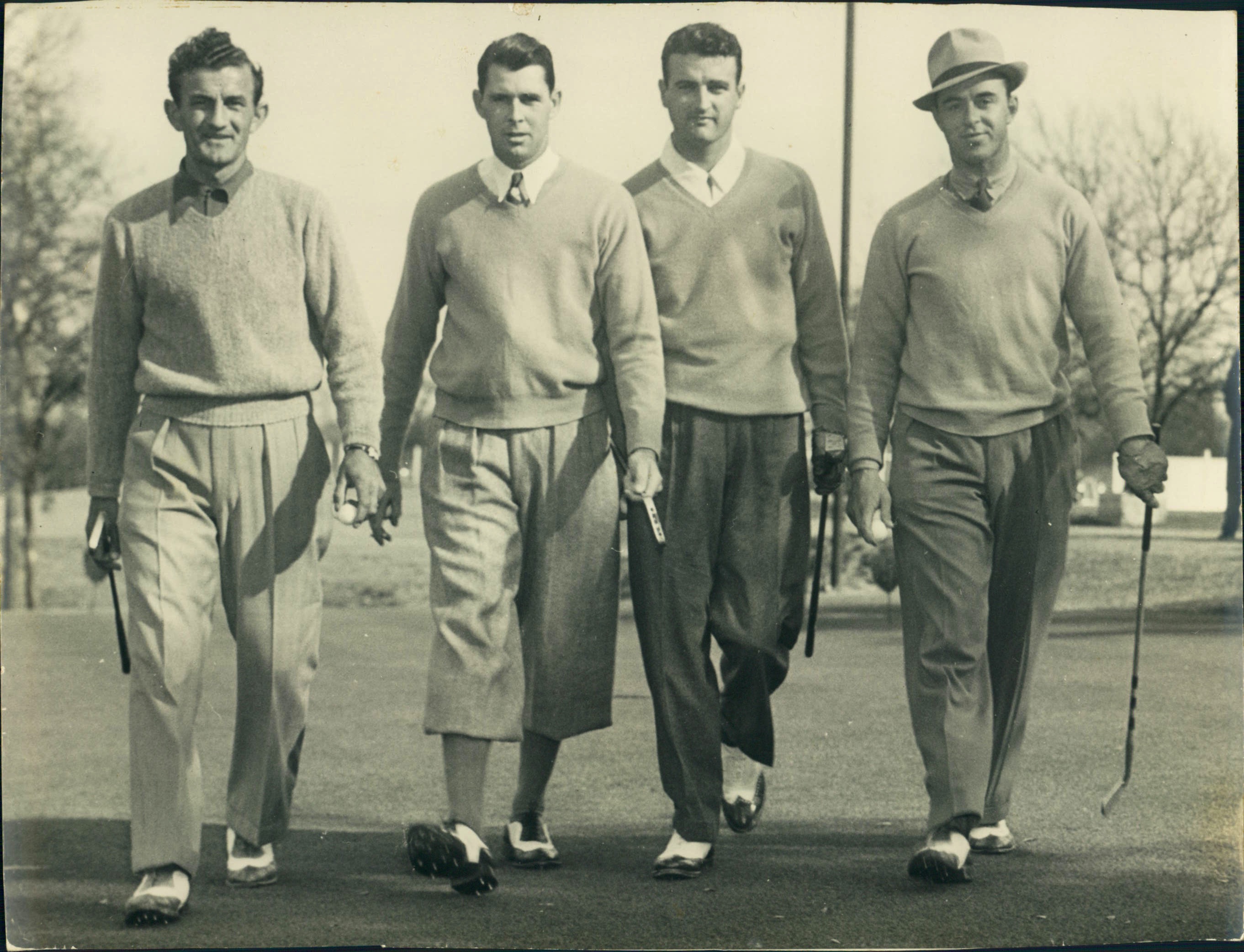
Jack Grout probably didn’t realize it as he was driving across the desert in early 1936, heading back to Texas, but a key factor in creating a higher comfort level for himself as a touring pro was finding the ideal traveling companion. Having a pal alongside to help ease him through the rough patches, a chum right there to share the good times, was what he lacked. In each of Dad’s previous winter excursions he paired himself with friends who would become exceptional players. As great as Ben Hogan, Byron Nelson and Jimmy Demaret were on the golf course, though, all three were emotionally tough guys to be around on a daily basis, at least for my father. All three were, in a sense, lone wolves.
My father’s search for a supportive tour traveling partner came to a happy conclusion later in 1936 in the person of one of the game’s most accomplished players, Massachusetts’ own Henry Picard. Picard liked Dad’s strong character and businesslike approach to the game, and a close and lasting friendship developed. As they traveled the circuit together and eventually worked side by side as club professionals, Picard became one of my father’s key mentors, teachers and colleagues.
Henry Gilford Picard was born in Plymouth, Massachusetts on November 28, 1906. He began his lifelong career in golf as a caddie at the Plymouth Country Club. While in high school, Picard advanced to the position of clubhouse steward with the help of Donald Vinton, the club’s golf professional. The pro knew that this promotion would give the young fellow playing privileges at the club. Vinton recognized Henry’s love for golf and wanted him to have an opportunity to develop his burgeoning natural talent.
In the fall of 1925, after Picard had graduated from high school, Vinton petitioned William Picard for his 17-year old son’s services, as his assistant, at the Charleston Country Club. Vinton had the pro position at the South Carolina club in the wintertime. When Henry told his father how badly he wanted to go, Mr. Picard reluctantly gave his approval. Before Henry left home, however, his father gave him a little piece of advice to take along with him. He said, “You’ll always be rated by the people you choose as friends.”
1937, Jack Grout and Henry Picard at Hershey Country Club in Hershey, Pennsylvania
In 1925, the Carolina’s Open was held at the Charleston Country Club. To everyone’s surprise, it was won by young Henry Picard. However, to show that it wasn’t a fluke, he won the tournament again the following year. In January 1935, Picard journeyed to the West Coast to put his flourishing game to the test against much tougher competition. During that winter campaign, Picard was traveling and rooming with his pal Johnny Revolta, an excellent player who would win nineteen pro tournaments, including the 1935 PGA Championship. When my sister Ronnie and her husband Tom visited Mr. Picard at his Charleston, South Carolina home in December, 1995, the aging pro reminisced how Revolta was “out on the town every night.” While Picard enjoyed Revolta’s company, rooming with him was difficult because Picard was a staunch family man. He didn’t begrudge Revolta and the other pros their nighttime fun; he just preferred to have calm and restful evenings, better to prepare himself for the next day’s golf.
December 1995, Ronnie (Grout) Christman and Henry G. Picard at his residence in Charleston, SC
Picard and his wife, Sunny (Annie Addison), had married in December, 1930 and by 1936 were parents of a pair of young sons, Bill and Larry, my dad being the latter’s godfather. It was disquieting to family-man Picard during his first foray in 1935-36 that Revolta sometimes was returning to their shared hotel room just as Picard was leaving for his morning round. It was a piece of good fortune that Picard began to notice my father’s purposeful ways and quiet work ethic at about the same time. Soon the two men began palling around away from the golf course, and later in 1936 they began traveling together.
Jack Grout would find no greater ally, confidante and traveling companion in all of golf than Henry Picard. In retrospect, the Picard-Grout pairing seems such a natural. Their playing styles were comparable; each had a long, rhythmic swing and could hit the ball a great distance. More importantly, the two also were like-minded, with many similarities in the way they approached life. Honesty, hard work and modesty were attributes they shared. Picard was more serious-natured than my father and a tougher individual both physically and competitively. With his lighter personality, Dad generally was more fun to be around. In many ways these contrasting traits tended to attract one to the other.
When the tour reached San Francisco in January 1937, Picard had a candid discussion with my dad about his own increasingly busy work schedule and how my father could help him deal with his obligations as head pro at Hershey Country Club. Then and there the job offer was made and accepted. My father experienced three solid years of growth as a player and a teacher at Hershey. His day-to-day association with Henry Picard had a lot to do with that. That is, Picard and Dad worked together on the golf swing for countless hours.
Over the succeeding decades the personal lives and golf careers of Henry Picard and Jack Grout would crisscross many times. In the fall of 1943 when Picard was in his second year as Twin Hills’ head pro in Oklahoma City while also employed during the week in a war-plant job at Douglas Aircraft Company, his trusted friend Jack Grout was there to run the golf operation in his weekday absence. In the fall of 1945 this golf version of musical chairs continued to unfold after the prestigious Canterbury Country Club reached out to Picard offering him its head professional position. When Picard told his employers at the Harrisburg (PA) Country Club that he was headed for Cleveland, Ohio, the club quickly set its sights on my father and in 1946 made him their new golf professional.
Dad wasn’t looking to begin the 1950s in a new job or in a new city. The four years in Harrisburg had been good for him and his family. But in the fall of 1949, a head professional position opened in a city that my father had driven through a number of times during his various travels and he had liked a lot. Things happened pretty fast after that. Henry Picard, still the head pro at Canterbury, teamed with Ohio businessman John W. Roberts in contacting my father about the position. Then the two men backed Dad’s eventual efforts to secure the new job.
The Associated Press reported the news on December 9, 1949: Thirty-nine-year-old Jack Grout, head professional at Harrisburg Country Club in Pennsylvania for the past four years, had been named head professional of Scioto Country Club in Columbus, Ohio. The story noted that, as the new head pro, Grout would be the host for the 1950 PGA Championship, scheduled at Scioto on June 21-29, 1950.
The prospect of hosting one of golf’s major championships excited my dad. But I know he would have been infinitely more excited had he been able to look into the future and see that within a few months, his orbit would collide with that of a husky Columbus ten-year-old redhead named Jackie Nicklaus, who would become under Jack Grout’s tutelage, the most successful golfer the world had ever seen.
My father and Henry Picard were shy and humble men. They were gentlemen and “first-class guys” who had great respect for one another. Throughout their long and successful careers they provided each other with assistance and support whenever and wherever it was needed. Both men had much to be proud of, including their ability to inspire in their respective families great loyalty and devotion for their father.
December 1995, Henry Picard said the 3 keys to great golf are: Posture, Balance and Grip. He added that having a “strong left is the key.” Also, “honesty” is what makes for a fine golf professional.
Note: Henry Picard had 26 wins on the PGA Tour and won the 1938 Masters Tournament and the 1939 PGA Championship. He retired in 1973 and returned to Charleston where he was a fixture in the local golf community. Picard played golf regularly into his 80s and died at age 90 on April 30, 1997. He was elected to the World Golf Hall of Fame in April 2006.
By TOM HANSON Naples Daily News Posted June 15, 2013 at 5:41 p.m.
Ceremony in downtown Columbus, Ohio following the ticker-tape parade given to Jack Nicklaus for his victory in the 1962 United States Open Championship
Father and son at La Gorce Country Club in 1970 during a Golf Digest Magazine photoshoot (Doug Kennedy photo, used with permission)
Jack Grout and Jack Nicklaus at La Gorce Country Club’s practice tee just prior to Nicklaus’ victory in the 1962 U.S. Open at Oakmont Country Club. (From the Nicklaus family collection.)
Dick Grout remembers his dad turning work into family vacations. He remembers traveling the country, going to U.S. Opens and PGA Championships.
Grout remembers watching his dad’s protégé’s — Jack Nicklaus, Ray Floyd and David Graham — capturing those major championships.
Now, he’d like the golf community to do more than remember his dad, one of the game’s most prolific instructors.
Dick Grout is pushing for his father, Jack Grout, whose pupils have won 24 major titles, to be inducted into the PGA of America Hall of Fame.
Dick Grout calls it a travesty that he’s not already there.
“It’s absurd,” Dick Grout said. “I know I am tremendously partial but how can there be a PGA Hall of Fame without my father in it? The Hall should be honored to have him as a part of it.”
To spread his message, Dick Grout wrote a book — with the help of part-time Collier resident Bill Winter — about his dad. The book: “Jack Grout: A Legacy in Golf” isn’t a traditional golf tale about swings and score cards. This is a story told through the eyes of a son, about a quiet and humble family man who had a solid career as a touring professional, then a truly brilliant one as a teacher to the pros and the stars. This is a love story about Jack Grout’s passion for his wife, their four children and for the game of golf. This is a golf history book and the considerable impact one man made on the game.
“We tried to make it a human interest story,” Dick Grout said, “not just a sports book and not solely about golf, but about someone’s life.”
■■■
Jack Grout’s life changed back in 1950 when a husky 10-year-old redhead named Jackie Nicklaus attended his junior clinic at Scioto Country Club in Columbus, Ohio.
But some may say Nicklaus and golf had the good fortune that Jack Grout landed the head teaching job at Scioto. There had never been a junior clinic held in Columbus before, and who knows, a superb athlete like Jack Nicklaus may have become a football player.
Unlike today’s golf world, where players have strength coaches, swing coaches and sports psychologists, Nicklaus had only one coach for nearly 40 years.
With his 73 PGA Tour victories and 18 major titles, Nicklaus said: “If Jack Grout had not arrived as the new pro at Scioto concurrent with my father’s convalescence, right now I would probably be selling insurance Monday through Friday and flipping a fishing rod for my weekend fun. Conceivably, I would have continued to play golf, or come back to it in later years. But I am certain that my life overall would have been very different from what it became.” He added, “Without (Jack Grout), I’m certain I would never have achieved the professional success I have enjoyed.”
Nicklaus said Jack Grout’s omission from the PGA Hall of Fame mystifies him, but his coach wouldn’t be bothered by it.
“J. Grout, as I called him, was just too humble and too comfortable in his own skin — and with what he accomplished in life — to spend even one minute worrying about such things,” Nicklaus said in the foreword of the book.
Jack Grout was as simple as his golf theories: head still, good footwork, balance and a wide arc.
“He knew the golf swing probably as well as any instructor ever has,” Nicklaus said. “But I think his greatest gift to his students was his belief in them and his ability to get them to believe in themselves.”
■■■
Ray Floyd described Jack Grout as low-key and always positive.
Raymond Floyd and Jack Grout at Frenchman’s Creek Country Club’s practice tee in 1978
Floyd said Grout always focused on “telling you what you were doing right. If I went to him when I was playing well, I came away from a session, man, I couldn’t wait to get to the tee. I knew I was going to beat everybody.”
In a letter to Jack Grout after winning the 1986 U.S. Open, Raymond Floyd wrote, “I want you to know that I could not have accomplished all that I have done without you. Your patience, your tutelage and your inspiration has been the formula of my success. I sincerely thank you.”
Nicklaus’ and other players’ tremendous success didn’t change Jack Grout.
Dick Grout said his dad may have never fit into today’s instant golf lesson landscape. Jack Grout would have been the polar opposite of Hank Haney. My father would have never participated in reality- celebrity TV, despite giving lessons to the likes of Joe DiMaggio, Andy Williams and Sean Connery.
“That would have gone against the grain of his shy nature,” Dick Grout said. “Dad would sooner put on a disguise and change his name before going on any reality TV show.”
Instead, Jack Grout quietly grinded out a career as a highly sought-out teaching professional. Besides Nicklaus, Floyd and Graham, Jack Grout worked with a stable of touring pros such as Jim Colbert, J.C. Snead, Gibby Gilbert, Roger Maltbie, Tom Purtzer, Olin Browne and Lanny Wadkins.
“Dad was a lunch pail guy. He was quiet, uncomplicated and did the job at hand,” Dick Grout said. “His desire to remain in the background and not promote himself in the public eye seems a key reason why
he hasn’t yet taken his rightful place in the Hall of Fame. But, he enjoyed his life; he lived his life the way he wanted to live it and on his terms.”
■■■
Lost in the lessons and his players’ accolades is the fact that Jack Grout was a respectable player in his early days. According to PGA Tour Selected All-Time Rankings and Statistical Highlights:
ERA Rankings (1930 – 1945)
#79 Jack Grout – Officially credited with 18 Top Ten and 35 Top Twenty-five finishes
Top 500 Players (1916 – 1988)
#425 Jack Grout – Officially credited with 20 Top Ten and 40 Top Twenty-five finishes
Grout learned the game working as a caddie at Oklahoma City Golf and Country Club. He earned 35 cents shagging balls and eventually won the caddie championship.
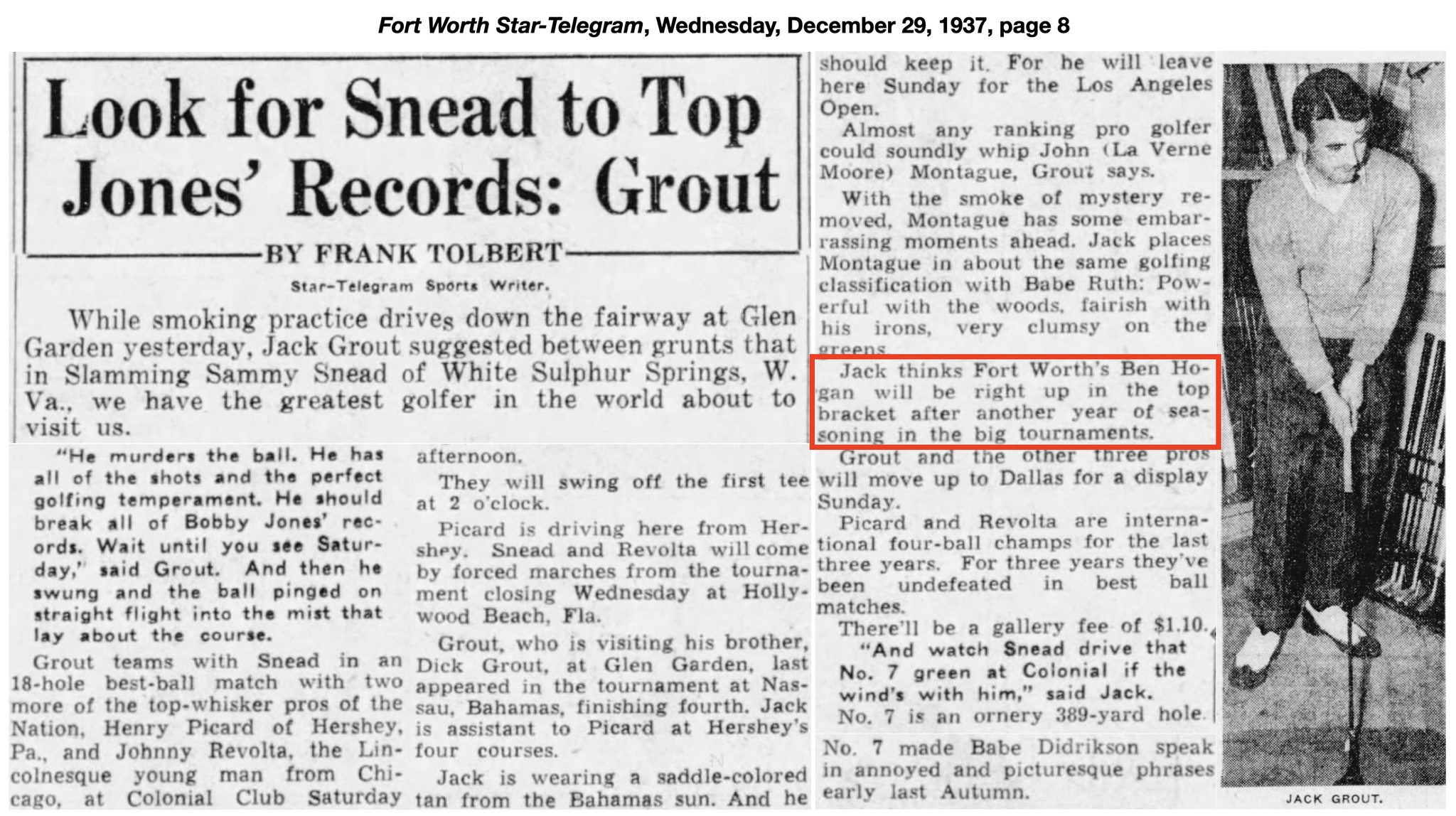
He turned pro in the early 1930s and traveled the PGA Tour with the likes of Ben Hogan, Byron Nelson, Jimmy Demaret, and Henry Picard. He was a pioneer of the Tour and finished in the top 25 on the money list in 1941, 1942 and 1943.
Jack Grout gave up tour life in 1945 after marrying and starting a family.
“What surprised me the most was that on top of being a great teacher, he had a pretty solid playing career,” said Bill Winter, the book co-author who is a member at Hammock Bay in East Naples.
Winter met Dick Grout by chance at The Cliffs at Keowee Vineyards in South Carolina. Winter’s wife, Rosanne, had heard the teaching pro at the course, Dick Grout, talking of a book about his father and looking for a journalist to help write it. After hearing the book was about Jack Grout, Winter, an Ohio native, walked over to Dick Grout and said don’t look any further, I’m your man.
“I wanted to do something that was worthwhile and a good story,” Winter said of his interest in writing the Jack Grout story, “and something someone may care about.”
Dick Grout had followed in his dad’s footsteps, becoming a good player and a teaching professional, too. The 59-year-old spent four years compiling notes and stories about his father. Winter and Grout spent another four years retooling the book.
“I quickly came to realize that his father is my father,” Winter said about the correlation between Jack Grout and Winter’s father who quit college to support the family and still became a successful accountant. “I realized that Jack Grout was every father who wanted what was best for his family and didn’t seek any acknowledgment or accolades for the hard work.”
Jack Nicklaus also looked up to Jack Grout as a father figure.
“The truth is that we developed a friendship as close and warm and comfortable as two men can, and particularly after my dad’s death in 1970, when Jack Grout became a second father to me,” Nicklaus said.
■■■
Dick Grout said growing up he didn’t even understand his father’s prominence in the game. He said when one of his father’s students won a Tour event, Jack Grout didn’t make a big deal about it. Grout said looking back the family should have celebrated his dad’s success.
“We all took our lead from our dad and we kept these things in perspective,” Grout said. “He didn’t come home and go crazy about it during tournaments or when Jack was in the lead.
“We took all of that in stride. I look back now and say this was really something else, history being made and made over and over again, and maybe should have made a bigger deal about it and it was almost crazy that we didn’t.”
Jack Grout was humble. He was quiet and reserved. He was loyal till the day he died. On his deathbed, days after the 1989 Masters, Nicklaus and his wife Barbara came to the family home. Jack Grout asked Nicklaus why he pushed his second shot on 18. Jack Grout asked Nicklaus to stand up and take his stance. Then Jack Grout proceeded to give Jack Nicklaus one last lesson even though he could barely lift his head off the pillow.
Dick Grout said his father had a saying: “If you know what is right, do what is right.”
Dick Grout said golf knows what’s right: His father, the second father to Jack Nicklaus and many other successful pros, should occupy a place of honor in his sports Hall of Fame.
Note: For the purposes of this story more information was added to the original article.
I first met Doug Sanders as a seventeen-year-old on September 1, 1970 when forecaddying for his foursome (which included the legendary jockey Eddie Arcaro) during a Pro/Celebrity event to reopen the newly renovated Bayshore Golf Course on Miami Beach. As the group’s forecaddie, my main duties included watching where the player’s golf balls went, raking bunkers, helping to tend the flagstick and bringing putters to the green for the players to use. Apart from spending an enjoyable time in the company of a pair of famous athletes, I really only recall two episodes from that day. Both of which involve the flamboyant Doug Sanders: Firstly, while playing a par #4 on the back-nine, Sanders’ approach shot finished on the front section of the green. With the edge of a bunker and fringe in his direct line to the hole, he cleanly pitched his ball from off the pristine surface of the green to within a few inches of the hole to save par. The deft touch he demonstrated on that delicate shot was downright remarkable! Secondly, upon completion of his round, the two of us walked to where his car was parked. At that point, I placed his golf bag in the trunk and Doug Sanders handed me some money and his business card. Then, in the most sincere and convincing manner, he said for me to call him if I should ever need his help. I can tell you, I came away from that day with a very favorable impression of Mr. Doug Sanders.
Whenever the name Doug Sanders arises in conversation the majority of golfers immediately tend to think about just one detail in the American’s career…..that infamous short putt on the wickedly contoured final green at St. Andrews which denied him the British Open Championship in 1970. It remains one of the most unfortunate images in the history of the event and, though it was a cruel blow to a great champion in an otherwise illustrious career, it cannot take away from his many achievements.
Indeed, the record books show that Doug Sanders was one of the game’s outstanding players during the late 1950’s and 1960’s when his contemporaries included such greats as Ben Hogan, Sam Snead, Arnold Palmer, Gary Player, Jack Nicklaus, Lee Trevino and Billy Casper.
When looking back on the career of Doug Sanders, one must wonder at what might have been if he had enjoyed a slice of luck at crucial moments in all four Major Championships. The fact is that he came agonizingly close to winning the entire set, a feat accomplished by only a handful golfers in the history of the game.
Doug’s Near Misses In The Majors
1959 PGA Championship – tied second behind Bob Rosburg at Minneapolis Golf Club
1961 United States Open Championship – second to Gene Littler at Oakland Hills
1966 Masters Tournament – tied fourth, only two strokes behind Jack Nicklaus
1966 British Open – runner-up to Jack Nicklaus at Muirfield, and defeated by Nicklaus in playoff at St. Andrews in 1970
He might have missed out on glory in the Majors, but he scored twenty (20) victories on the PGA Tour in a richly rewarding fifteen-year spell, including five big wins in 1961 when he climbed to a career high 3rd place in the money rankings.
His career statistics for the period between 1955 and 1975 show that he was a fearless and consistent competitor at the highest level. Apart from his twenty tour victories, he was placed second on 21 occasions, third on 13 occasions, he had 154 top-10 finishes and he featured amongst the top-25 in no fewer than 286 tournaments! He also enjoyed the special feeling of being a member of the 1967 United States Ryder Cup Team – “the finest golfers in the world” captained by Ben Hogan which demolished Britain & Ireland (23.5 – 8.5) in the match held at Champions Golf Club in Houston, Texas.
Despite the great success he achieved many golfers will tend to remember Doug Sanders for his eye-catching wardrobe and swashbuckling characteristics, his compact golf swing, and, of course, that putt for the British Open title at St. Andrews over a half-century ago. However, I will remember Doug as a truly kind man and the genuine article. He was a credit to the game and the most “colorful” golfer who has ever lived.
As luck would have it, our paths crossed several more times through the years. In 1997, I was the golf professional at a country club just outside of Boise, Idaho. During the fall, Doug Sanders paid us a visit and orchestrated one of his Sanders Style corporate outings which included a group clinic, a round of golf and an after-dinner speech. Needless to say, the show he put together for our members and guests was quite a success. Then, the last time I saw Doug was in 2016 at Augusta National Golf Club where we had lunch together during the Masters Tournament. As usual, his big heart and winning personality were apparent.
At some point early in the ’70s, Jack Nicklaus talked with my father about the new course he was building in the Columbus suburb of Dublin (that later became known as Muirfield Village Golf Club), about his plan to launch The Memorial Tournament, and about his personal gratitude for the good work Dad had done with him. Then, Nicklaus asked my father a question that was both generous and very smart: Would Dad consider coming to Muirfield Village in the summers as the club’s Golf Professional-Emeritus and teacher-in-chief? Dad would set his own hours, teaching as much as he wanted, and he never would have to stick around for the cold and damp Ohio winters.
The Muirfield offer had no downside for my father. He was nearing retirement age, and this would be a wonderful opportunity for him to remain active without working full-time. Plus, he would get to return during the beautiful summer season to an Ohio city he had enjoyed a great deal. With the rest of the year free, he would be able to steal away to the milder climate of Florida. Jack Nicklaus had made an offer that could not be refused, so when the time was right Dad informed his colleagues at La Gorce Country Club that he was going to retire.
While never one to want a fuss made over him, my father was pleased to find that his friends and admirers at La Gorce weren’t about to let him just walk quietly into the night. In late spring of 1974, Jack and Barbara Nicklaus, the noted golf instructor Bob Toski, 1941 PGA Championship winner Vic Ghezzi, New York Yankees owner Dan Topping and scores of other La Gorce members and guests – including the reigning world champion backgammon player, Tim Holland – gathered for a send-off dinner for Dad and Mom in the main dining room of the La Gorce clubhouse, up the beautiful, broad staircase from the large sitting area on the club’s main level. Guests could hear live music as they entered the front door and were greeted by a display of photos of my dad, including some from his childhood in Oklahoma City and others from his days on the early pro-golf circuit with Ben Hogan, Byron Nelson and other all-time greats. And there were, of course, photos of Dad with Jack Nicklaus.
With club president Harry Daumit as emcee, the evening was full of fun stories and tributes to my father, including warm statements by Nicklaus and Toski and some parting remarks by the guest of honor. There was dancing after dinner, and Dad was in high spirits, with my mother vibrant and beautiful in a lovely outfit with her hair pulled up in her signature style. At evening’s end, honorees Jack and Bonnie Grout, basking in the afterglow of the loving and appreciative sendoff by their many friends at La Gorce, went home to prepare for their next adventure, one that would last for the final fifteen years of my father’s life.