Are athletes of today better than those of the past? Is Wayne Gretzky the greatest hockey player ever? Is Michael Jordan the greatest basketball player ever? Is Barry Bonds the greatest home run hitter ever?
The argument that athletes are bigger, faster, and stronger is heard frequently today and there is little doubt that this is true. It is also heard that because they are bigger, faster, and stronger – they are better – and many of the top performers in today’s sports are rated better than their predecessors. But, are they really?
One must be careful in making a judgment. Various sports require different skills, conform to different rules, and are played in different ways. In some sports, man competes against the environment on a time or distance basis. In other sports, man competes against man on an action/reaction basis and style of play becomes more important than time or distance.
BIGGER, FASTER, AND STRONGER
An impressive book, The Super Athletes, written by David Willoughby and published in 1974, analyzes athletic performances in many sports and is referenced in this blog post.
Willoughby writes “… the records of modern athletes, sport, industry, and medical science combine to show that the civilized portion of the human race is bigger, stronger, and healthier in general today than ever before in history.”
All one has to do is check the height and weight statistics to see that the athletes are larger. Perhaps, the strongest argument that modern athletes are better is the continuous setting of new records in track, field, and swimming events where precise measurements of performances can be made.
In “Man Against Environment” events such as track, field, and swimming, the best technique coupled with specific athletic abilities bring about better performance. Judgment is clear on time and distance. A high jump of 8 feet is better than a jump of 7 feet 11 inches. Running one hundred meters in 10 seconds is better than running it in 10.2 seconds.
As time passes and people get bigger, faster, and stronger and utilize better techniques, athletic performances improve. Times get lower and distances farther. So, do the athletes get better over the years in these sports? It certainly appears that they do.
Yet, even in these “Man Against Environment” sports, there are rules changes and innovations which assist the athlete in his battle against the physical world – starting blocks, fiberglass poles, corked tracks and springy boards for launching broad jumps, etc. So, factors other than pure athletic ability creep into the picture and complicate the task of comparing athletes.
GENERALIZATION
A potential error in judgment may occur. A generalization might take place – since athletes perform better than they used to in “Man Against Environment” sports (i.e. the 2024 Olympic shot put record of 77 feet is a definite improvement over the 1968 Olympic shot put record of 67 feet), they perform better in all sports.
MAN AGAINST MAN
In “Man Against Man” sports or “Team Against Team” sports (which ultimately boil down to “Man Against Man”), performance is based upon a reaction by one competitor to an action by the other competitor (and not simply a case of running fast or throwing an object a great distance). Speed, power, and quickness offer advantages but often are not as important as “savvy”, anticipation, and the correct action/reaction.
STYLE
In “Man Against Environment” sports, a change in technique can be an improvement in that it enables an athlete to do better in his quest for a faster time or greater distance. In “Man Against Man” sports, technique also can improve performance and is very closely related to the “style” of play. Depending upon the sport, style can be a dominant factor. It often offsets “bigger, faster, and stronger”.
As difficult as it is to compare athletic performances over the years in “Man Against Man” sports such as baseball, basketball, football, tennis and golf any comparison is confounded further by the styles used by the athlete.
As it relates to professional golfers on the PGA Tour … the matter of differing styles … makes golfers (i.e. swingers vs. hitters, etc.) so difficult to rate. Instead of more or less uniform techniques – such as apply in running, jumping, swimming, and other athletic events – that can be measured, in golf both approaches can be effective depending on the individual golfer and their swing mechanics.
SUMMARY (ATHLETES)
Today, athletes are bigger, faster, and stronger but it all depends upon the sport as to whether they are truly better than those of the past. Different sports have different rules and different objectives (jump, run, throw, etc.). One example is Aaron Judge in baseball. He is the league’s heaviest outfielder. Is he better? Another example is Derrick Rose in basketball. He once ran the forty in 4.18 seconds. He is faster. Is he better? What about Bo Jackson in football? He was 6’1″ and weighed 227 pounds. As a running back, he once ran the forty in 4.18 seconds. He is bigger and faster. Is he better?
The skills needed to succeed in a given sport must be such that they enable an athlete to compete successfully against others. A man who has an abundance of a particular skill may be better than others who possess better “all-around” skills. A standout athlete in one sport may be simply average in another. And, as strange as it seems, the daily activities of a particular period in past history may have equipped individuals better for a certain type of competition than today’s activities.
My opinion is that the best athletes of all-time could compete with each other on a “near-equal” basis with slight advantages “here and there” going to certain ones who possessed “this or that” skill or attribute (depending upon the sport and how the various traits matched up). The modern athlete is not necessarily better than his predecessors. Rules of the game, mental discipline, and style affect outcomes of competition as often as size, speed, quickness, agility, strength, and stamina do.
HOW DOES THIS RELATE TO PGA TOUR PLAYERS?
Golf on the PGA Tour is essentially a “Man Against Man” sport in which being bigger, faster, and stronger offers an advantage. But, style and manner of play offsets this physical edge. So, in this sport, those who combine physical advantages with good/proper technique have the upper hand.
Are today’s Tour Players the only men to possess these physical advantages or skills? No, of course not. Throughout history, there have been plenty of men with size, speed, and strength. In addition, over the years, various new styles/techniques have been developed and utilized. Without question, many exceptional professional players have appeared over the past 100 years.
Could Arnold Palmer of the 1960s compete against the Tour Players of today? “Yes” – and be better. Go back twenty or thirty years before Palmer. Could Sam Snead of the 1930s or Walter Hagen of the 1920s battle favorably with the men of the 1960s or today? Again, a resounding “yes” – and, maybe be even better!
Several recent examples of “older” Tour Players who continued to prove their merit are Phil Mickelson, Jim Furyk, Tiger Woods and Ernie Els. These players were able to stand firm against “younger” competition with their on-going physical conditioning, resourcefulness, mental discipline, and technique.
TECHNIQUE
Technique is the better (or best) way of doing this or that. It came about as a way to use an individual’s particular combination of height, weight, speed, and strength in an effort to beat the physical advantage or skills of an opponent. In golf, a proper grip, good posture, a steady head, ball position, balance, a full swing arc and proper foot action are examples of technique.
Most techniques used by today’s Tour Players were well-known by the 1930s and used regularly by players since then. Little if any advantage is seen here for the modern players over their predecessors.
WEIGHT TRAINING
Today, weights are utilized by PGA Tour players much more than ever in comprehensive strength training programs. A strength advantage is seen for the modern player due to more frequent time spent in the gym. But, care must be exercised to prevent the player from becoming too heavily muscled or “stiff” because limber arm and shoulder movement is a valuable asset which a player does not want to lose.
Until the later part of the 20th century, professional golfers primarily stayed in shape by playing a lot of golf itself, relying on the walking aspect of the game for exercise. There were some players who participated in the use of weights, core work and light exercises like stretching but mostly they stayed away from the gym for fear of becoming too “muscle bound.” Once again, this fact seems to indicate the strength and overall fitness advantage of the modern Tour professional.
MENTAL DISCIPLINE
The society of earlier years in this nation (and most other nations) insisted upon strict adherence to its rules. This attitude prevailed in athletics as well. An athlete who was taught/coached in a certain manner to play a certain way generally followed the rules while practicing and played his round as planned.
“Absolute” insistence to follow the rules/game plan by those in-charge developed an “absolute” resolution to do so on the part of the player. This, in turn, cultivated an “absolute” will – an indomitable will – in many cases. So, it seems that an earlier time in our history produced men of a greater “will” and thus, has the advantage here.
The rather lax mental attitude of today’s society has affected its teachers/coaches and players. Some players today fail to practice effectively and abandon their game plan in the course of a round. Many times, their poor concentration/focus is apparent. Most teachers/coaches do not insist upon rigid adherence to his rules of player development. They give in to the whims of the lazy or rich or ranked Tour Player. Consequently, many players today are not as disciplined and prepared as they could/should be.
SUMMARY (PGA TOUR PLAYERS)
Golf is a sport in which “bigger, faster, and stronger” provides a definite advantage but does not necessarily equate to being better. As useful as height, weight, speed and strength are, they are not as important as the correct swing action/reaction which is generally associated with style and technique.
A player needs savvy, physical conditioning, mental discipline and stamina. Today’s top players seem to have an edge in physical conditioning and a slight edge in technique. The best players of the past seem to have the advantage in mental discipline, stamina, and motivation/strong desire.
PGA Tour players who competed at the elite level 30, 50, or 80 years ago were also very good, more talented than is perceived by those seduced by the sizzle of the moment. In fact, given the equipment, course conditions, travel logistics, and relative lack of golf-specific knowledge in the roughly six-decade window of persimmon heads, steel shafts, wound balls, and other realities from 1940 to 1990, those players were tougher, better.
Finally, this post is not meant to goad the reader into arguing over things that cannot be proven. It is simply my opinion that the twelve (12) best players forty (40) years ago are tougher and thus, better than today’s twelve (12) best players. I believe, in a straight-up 10-Ryder Cup Match Series, the “old-timers” of 1981 would consistently defeat today’s younger, faster and stronger players at least 6 out-of-ten times. Could it be that the nostalgia factor has had an influence on my perception of those players being “The Best?” Believe me, it doesn’t. Well, I am rather sentimental. So, maybe it does a little bit.
United States Ryder Cup roster 1981 – The greatest United States Ryder Cup team ever assembled was in 1981 at Walton Heath Golf Club, England. Members of the team included: Jack Nicklaus, Tom Watson, Lee Trevino, Johnny Miller, Hale Irwin, Raymond Floyd, Tom Kite, Ben Crenshaw, Larry Nelson, Jerry Pate, Bill Rogers and Bruce Lietzke. Dave Marr (Captain) *Total of 49 Major Championship Victories.

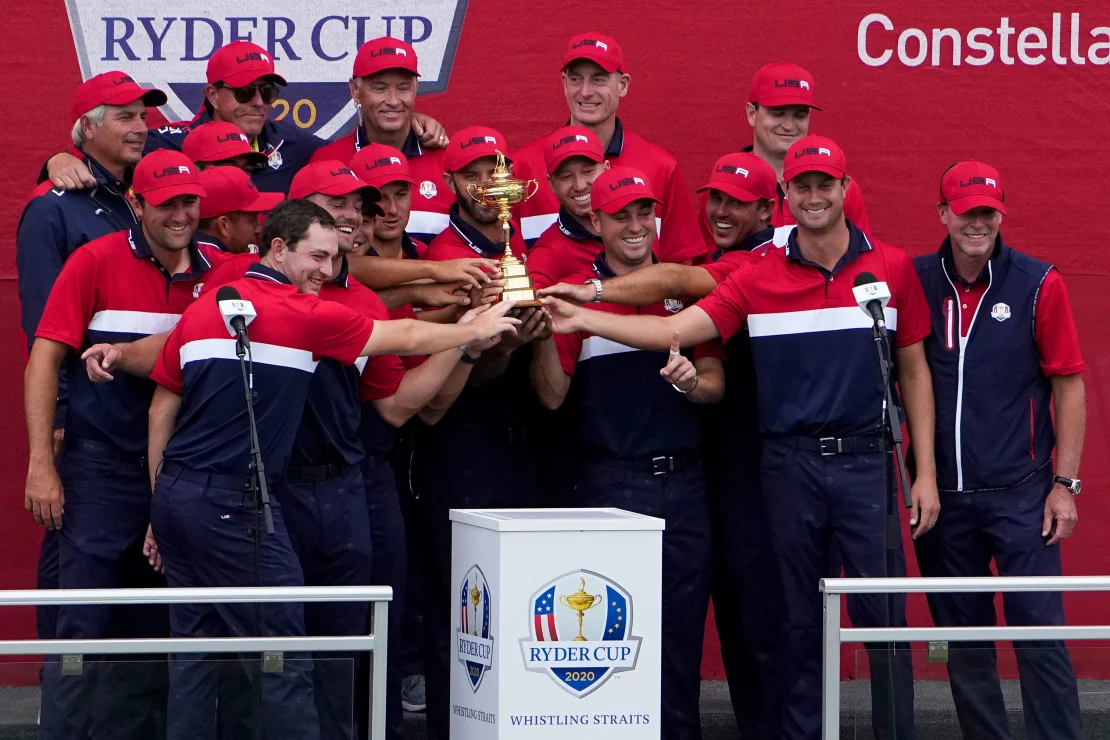
United States Ryder Cup roster 2021 – The youngest Ryder Cup Team ever assembled was in 2021 at Whistling Straits, Haven, Wisconsin. With a record (19-9) victory; this was the largest margin of victory in a Ryder Cup since 1967. Members of the team included Collin Morikawa, Dustin Johnson, Bryson DeChambeau, Brooks Koepka, Justin Thomas, Patrick Cantlay, Tony Finau, Xander Schauffele, Jordan Spieth, Harris English, Daniel Berger and Scottie Scheffler. Steve Stricker (Captain) *Total of 20 Major Championship Victories
 Grout Golf