A tune, a dialogue, and a painting from the mid-nineteenth century, the Arkansas Traveler became a catch-all phrase for almost anything or anyone from Arkansas. It has been the name of a kind of canoe, various newspapers, a racehorse, a baseball team, and a well-known American professional golfer whose career spanned over four decades – one of the longest in the history of The PGA Tour.
Ernest Joseph (E. J.) “Dutch” Harrison was born in Conway, Arkansas and nicknamed “The Arkansas Traveler.” Harrison turned professional in 1930 at the start of the Great Depression. In short, he took the plunge into the ultimate insecure job, touring professional golfer, at the precise moment when life on tour was at its toughest point. The early years of the Depression left 30 million people with no income at all. They were desperate people whose tolerance of crime was the highest in American history. It was Bonnie and Clyde time.
The tour in the 1930s was little more than an excuse to go gambling, if not on the course then in a hotel room dealing poker and rolling dice. My father, who joined the pro tour in December, 1931, laughed when he recounted a story about a craps game he was in with Dutch Harrison and some other pros. When it was ol’ Dutch’s turn for the “come out roll,” he reckoned that it would be lucky for him to back away from the others so he could heave the dice clear across the hotel room!
“It was all gambling,” said Jack Burke Jr., the 1956 Masters champion. who learned the game during the Depression from his father, a prominent Texas pro. “They had bookmakers at every tournament. They’d make more gambling with each other than there was in the purse.”
“As long as there’s been golf, there’s been gambling.
And where there is gambling, there will be hustling.”
Dutch Harrison believed the modern art of golf hustling was a product of The Great Depression. “After the stock market crash in 1929, half of the country’s 6,000 golf courses went broke,” he said. “Who’d want to become a golf pro? It was the day of the hustlers hustling the hustlers, and anyone else.”
In addition to the usual cons, down-home Harrison was known in the trade as an “oil artist.” He buttered up his opponent as a means of playing with the man’s head. “This course is built for your game, Mr. Henry – fits you perfect,” or “You’re such a great putter, Mr. Henry, I probably should concede that short putt, ’cause it’s a lead-pipe cinch you’ll make it.”
Although he was one of the better players on tour for over two decades, the mainstay of his income was the many exhibition matches and private “money” games in which he played. Adding his gambling income to his “official” prize money vaulted him into being one of the “unofficial” leading money winners in the late 1940s. Undoubtedly, Harrison won so many bets because of his gamesmanship. He would always find a way to beat you. But the stakes did not necessarily have to be high. Sam Snead recalled a day when Dutch Harrison lost a $5 bet to a player he thought was an easy mark.
“Dutch, this is really an honor,” said the man. “I’m going to frame this bill.”
Harrison grabbed it back and said, “In that case, I’ll write you a check.”
My father and Dutch Harrison were pals and occasionally they roomed together while on tour. Dad was an “Okie” from Oklahoma, born on March 24, 1910. Dutch Harrison was an “Arkie” from Arkansas, born on March 29, 1910. In my father’s instruction book, Jack Grout’s Golf Clinic, there is the story about the amateur, who had not been playing well at all in the Bing Crosby Pro-Am at Pebble Beach. Somewhere around the seventeen or maybe even the eighteenth hole he had the chance to make a long putt for the team’s best score on that hole. He nervously asked his professional partner, Dutch Harrison, what his best strategy was. Harrison’s reply was, “Try to keep it low!”
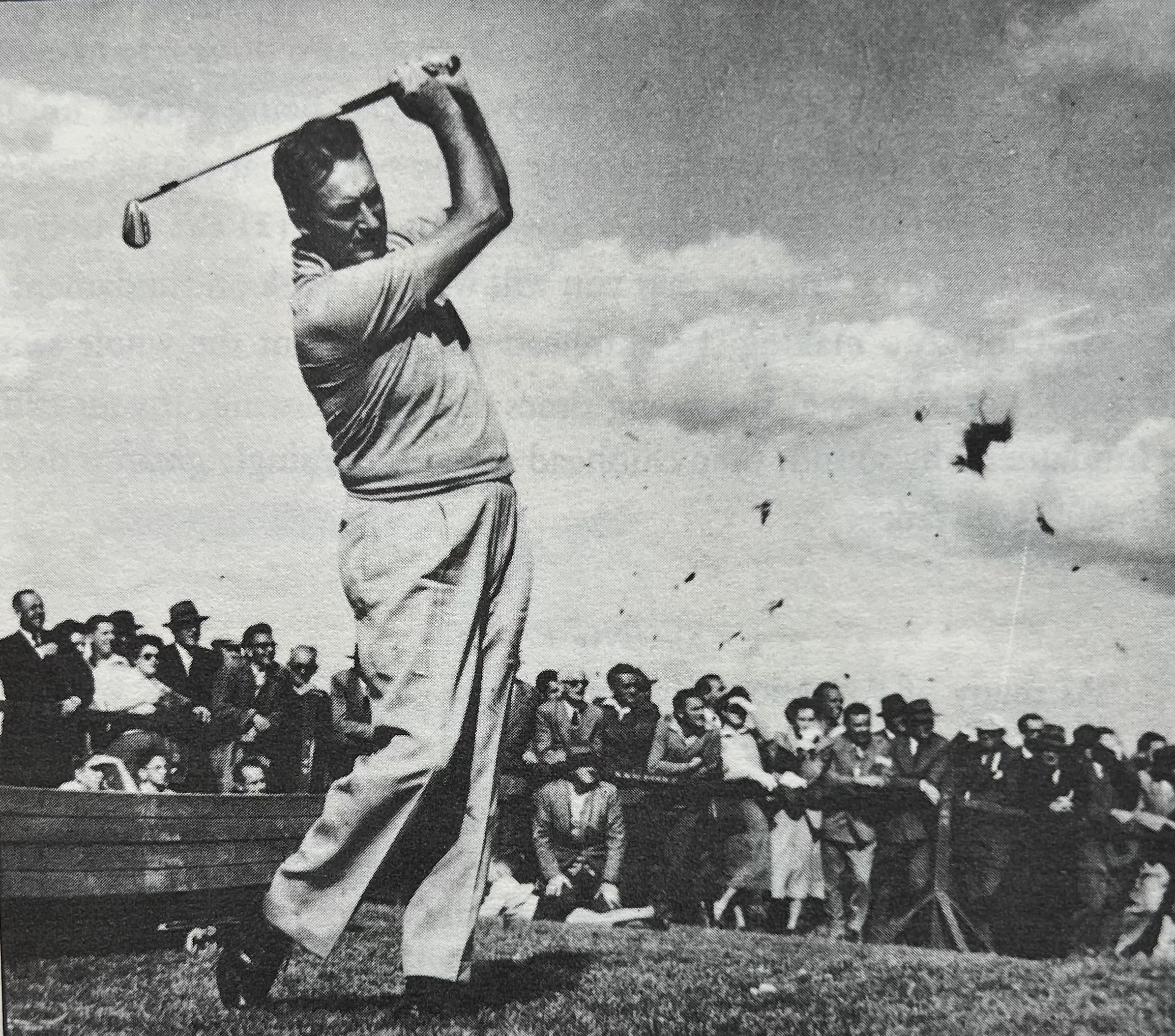
Dutch Harrison had a total of 18 career victories spanning from the 1939 Bing Crosby Pro-Am to the 1958 Tijuana Open Invitational. However, as late as 1969, Harrison had a top-25 finish in the Canadian Open at the age of 59. He played on three Ryder Cup teams: 1947, 1949, and 1951. Harrison finished nine times in the top-10 at major championships, including third place finishes at the PGA Championship in 1939 and the U.S. Open in 1960. He won the Vardon Trophy for lowest scoring average in 1954, and ranks fifth on the list of players with the most PGA Tour victories without a major championship on his resume. In 1954 Harrison became the Old Warson Country Club’s first golf professional. He died of heart failure at age 72 in 1982 in St. Louis, Missouri.
 Grout Golf